 Inglés
 Español
Ultrasonic Level Sensor: Working Principle, Applications & Buying Guide
In modern industries such as manufacturing, water treatment, agriculture, and energy, accurate liquid level monitoring is essential for efficiency and safety.
Pokcenser ultrasonic level sensors are designed to deliver high-precision, non-contact, and maintenance-friendly solutions, making them an ideal choice for global industrial applications.
How Does an Ultrasonic Level Sensor Work?
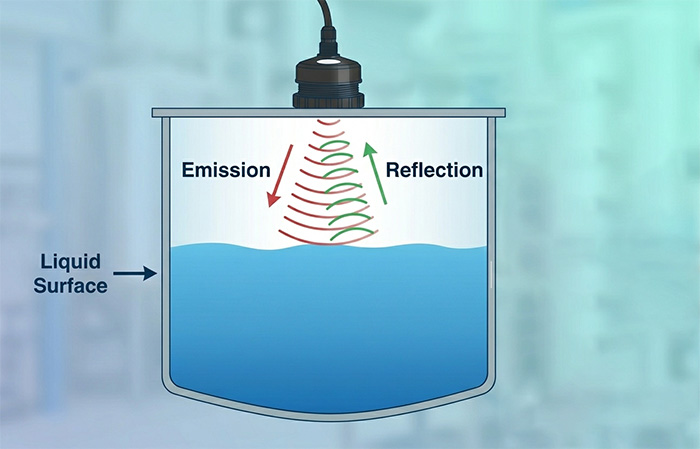
Ultrasonic level sensors operate based on the echo reflection principle of ultrasonic waves.
- The sensor emits ultrasonic pulses
- Waves travel through air (or medium) to the liquid surface
- The signal reflects back to the sensor
- Distance is calculated using time-of-flight and speed of sound
👉 This allows accurate, non-contact measurement of liquid levels.
Common Measurement Methods:
- Time-of-flight method
- Frequency modulation method
- Phase detection method
Regardless of the method, the core principle remains:
precise distance calculation using ultrasonic propagation.
Why Choose Pokcenser Ultrasonic Level Sensors?
✅ High Accuracy
Detect even small liquid level changes with precision up to ±0.25%.
✅ Non-Contact Measurement
Perfect for:
- Corrosive liquids
- High-temperature environments
- Viscous or hazardous fluids
✅ High Reliability
Stable performance even in environments with bubbles, vapor, or impurities.
✅ High Sensitivity
Real-time response to even minor fluctuations.
✅ Easy Installation & Maintenance
- Sin partes móviles
- Minimal calibration required
- Larga vida útil
Applications of Ultrasonic Level Sensors
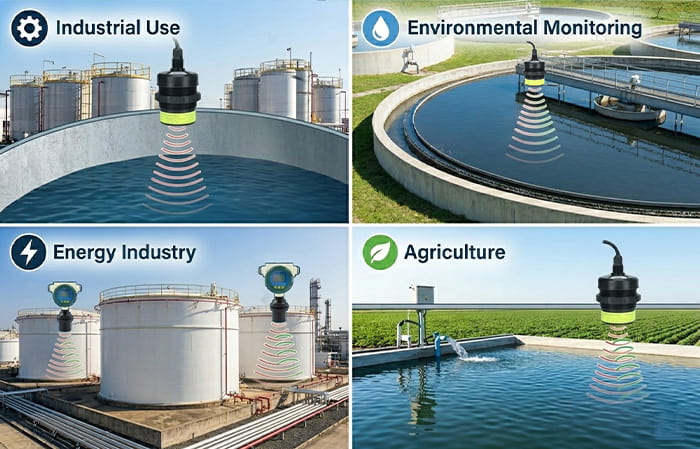
Industrial Use
- Depósitos químicos
- Oil & gas storage
- Pharmaceutical reactors
Vigilancia medioambiental
- Wastewater treatment plants
- Water reservoirs
- River level monitoring
Energy Industry
- Depósitos de aceite
- Fuel storage systems
- Inventory management
Agriculture
- Irrigation systems
- Water-saving automation
Installation Guidelines (Important for Accuracy)
To ensure optimal performance:
- Install vertically to liquid surface
- Avoid obstacles (pipes, agitators, inlets/outlets)
- Maintain proper distance from liquid
- Consider environmental factors (temperature, humidity, gas)
- Use explosion-proof models in hazardous areas
- Perform regular calibration and maintenance
Recommended Pokcenser Ultrasonic Level Sensors
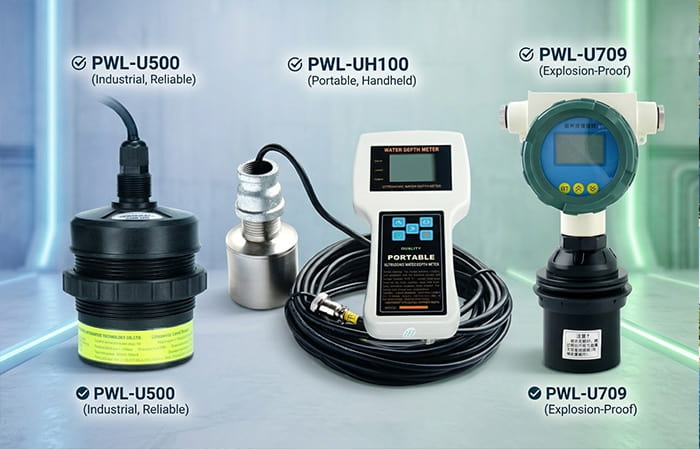
PWL-U500 Sensor de nivel ultrasónico
- Range: 0–5m / 7m / 10m / 15m
- Accuracy: ±0.25% / 0.5%
- Output: 4-20mA / RS485 / Voltage
- Protection: IP66/IP68
Ideal for industrial liquid level monitoring
PWL-UH100 Portable Ultrasonic Depth Meter
- Range: up to 300m
- Accuracy: ±0.5%
- Portable handheld design
- Built-in rechargeable battery
Perfect for field measurement (rivers, lakes, seawater)
PWL-U709 Explosion-Proof Ultrasonic Sensor
- Range: up to 60m
- Output: HART / RS485 / Analog
- Explosion-proof: Exia / Exd
Best for hazardous environments (oil & gas, chemical plants)
¿Por qué elegir Pokcenser?
- OEM & ODM support
- Competitive factory pricing
- Fast global delivery
- Technical support for integration
Contact Pokcenser today for a custom solution and quotation.
PREGUNTAS FRECUENTES
What is the advantage of ultrasonic level sensors over radar?
Ultrasonic sensors are more cost-effective and ideal for standard environments, while radar is better for extreme conditions.
Can ultrasonic sensors measure corrosive liquids?
Yes. Since they are non-contact, they are perfect for corrosive or hazardous liquids.
What affects measurement accuracy?
- Temperature changes
- Foam or vapor
- Improper installation
How do I choose the right model?
Consider:
- Rango de medición
- Environment (explosive, outdoor, etc.)
- Output signal requirements

