 Inglés
 Español
Understanding the Blind Zone of Ultrasonic Level sensors: Key Influencing Factors and Solutions
Industrial grade ultrasonic level sensor has become essential tool for industrial level monitoring due to their non-contact measurement, high accuracy, and broad applicability. However, their performance is limited by the “blind zone”—an area near the probe where accurate level detection is impossible. This article explores the causes, influencing factors, and solutions for blind zones, while introducing the PWL-U201 Ultrasonic Level Sensor, an advanced solution for complex industrial environments.
Definition and Principles of the Blind Zone
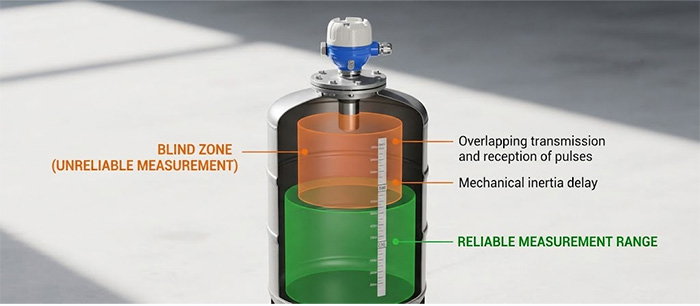
The blind zone refers to the area near the probe where measurements are unreliable due to overlapping transmission and reception of ultrasonic pulses, akin to a visual blind spot. Key principles include:
- Mechanical Inertia Delay:After emitting a pulse, the transducer requires time to switch to receive mode, causing missed near-field signals.
- Multiple Echo Interference: Close proximity to the liquid surface may trigger repeated reflections, generating false signals.
- Range Dependency:Blind zone size correlates with measurement range. For example, a 10m-range device typically has a 0.3–0.5m blind zone, while compact models (e.g., 4–6cm blind zone) suit short-range scenarios (≤0.6m).
Key Factors Influencing the Blind Zone
Environmental Interference
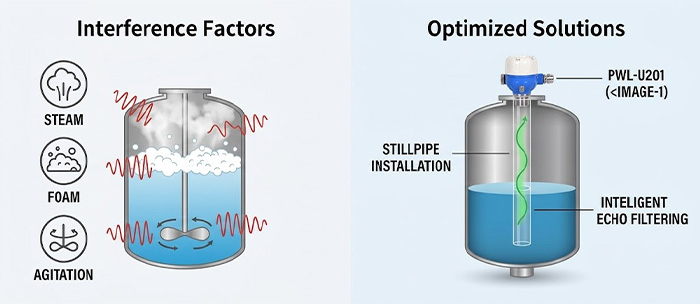
- Steam & Mist: High-temperature vapor absorbs/scatters sound waves, expanding the effective blind zone.
- Foam & Agitation:Thick foam layers attenuate signals, while agitated surfaces distort echo paths.
- Dust & EMI:Particulates weaken signal strength; electromagnetic interference (e.g., from VFDs) disrupts circuitry.
Device Limitations
- Frequency & Beam Angle: High-frequency waves offer precision but poor penetration; narrow beam angles reduce interference but risk obstacle reflections.
- Temperature & Pressure:Thermal shifts alter sound velocity; pressure fluctuations indirectly affect measurements via temperature.
Installation Flaws
- Probe Misplacement:Insufficient blind zone clearance or proximity to agitation sources.
- Missing Stillpipes/Guides:Unstable surfaces (foam, steam, turbulence) amplify blind zone errors without waveguide tubes.
Solutions to Minimize Blind Zone Impact
Optimal Device Selection
- Compact Blind Zone Models:Choose 3cm blind zone devices for confined spaces (e.g., ≤0.6m range).
- Anti-Interference Technology:Advanced echo filtering, such as the PWL-U201’s anti-interference intelligent identification and error correction, reduces false signals.
Environmental Adaptation
- Waveguide Tubes/Stillpipes:Isolate steam, foam, and surface turbulence.
- Probe Protection:PVDF or PTFE-coated probes resist condensation and corrosion.
Installation Best Practices
- Blind Zone Buffer:Ensure maximum liquid level stays below the blind zone (e.g., reserve ≥0.5m for 10m-range devices).
- Angled Mounting & Shading:Minimize condensation and thermal gradients.
Recommended Product: PWL-U201Ultrasonic Level Sensor
Engineered to overcome blind zone challenges, the PWL-U201 integrates cutting-edge features for demanding applications, is ideal as compact liquid level sensor for small tanks:
Core Advantages:
- Precision:±1mm and ±1.5mm, supporting liquid level and distance modes.
- Robust Design:0–50℃ temperature compensation, IP65 protection, optional intrinsic safety (Ex ia) certification.
- Resistencia a las interferencias:Intelligent false echo filtering and auto-correction minimize blind zone errors.
- Flexible Ranges:1m/2m/3m options for diverse scenarios.
Aplicaciones:
- Small water tanks
- Small diesel tanks
- Corrosive liquidtanks
The blind zone is a critical parameter in ultrasonic level transmitter selection and installation. By combining proper device choice (e.g., PWL-U201 fuel level sensor with explosion-proof housing), environmental adaptation, and installation optimization, measurement reliability can be significantly enhanced. For technical support or customized solutions, contact our engineering team today!

