 Inglés
 Español
Capacitance Level Sensor for Autoclave Deionized Water: A High-Temperature Point Detection Solution
Project Background: Autoclave Level Detection for Deionized Water
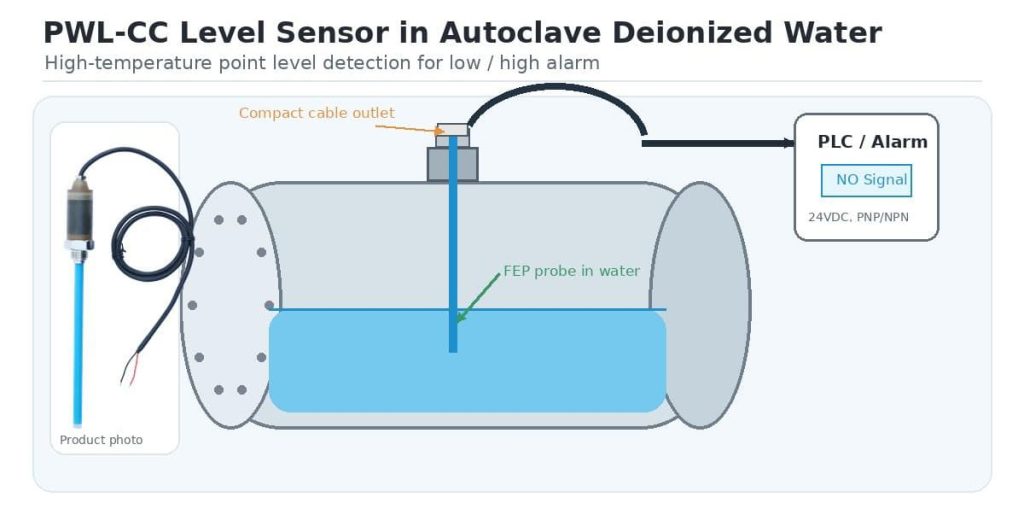
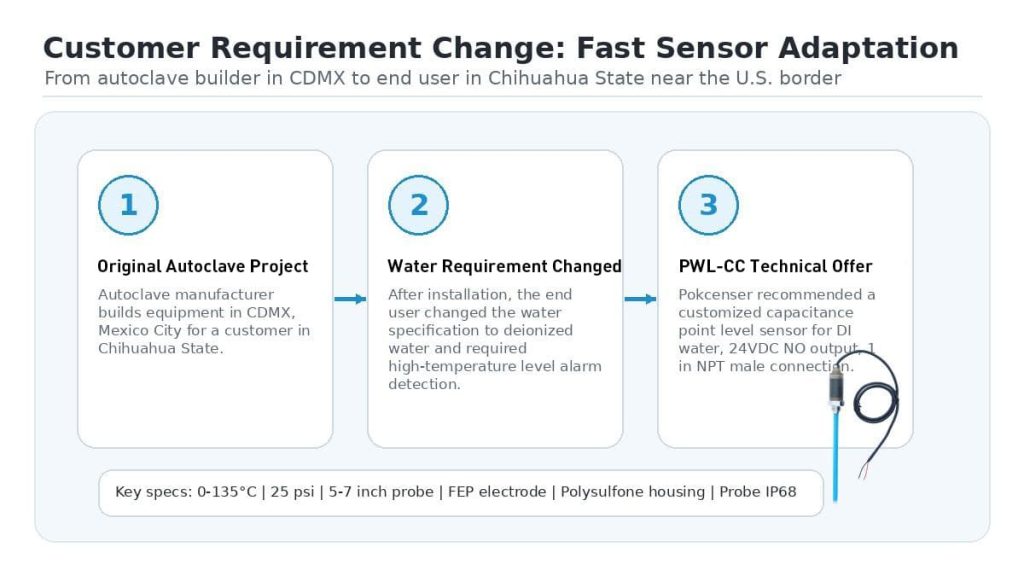
A customer building autoclaves in CDMX, Mexico City, needed a reliable level sensor solution after the end user in Chihuahua State, near the U.S. border, changed the water requirement during the project. The new working condition involved deionized water inside an autoclave, with a regular temperature around 125°C and a maximum temperature up to 135°C. For this type of sealed, high-temperature vessel, stable point level detection is important for low or high alarm control, equipment protection and safe process operation.
Why Deionized Water in an Autoclave Is a Challenging Application
Deionized water has very low conductivity compared with normal tap water or process water. In high-temperature sterilization equipment, the sensor must also handle thermal stress, pressure, sealing requirements and a compact mechanical installation. If the level signal is unstable, the control system may fail to detect low water level or high water level at the right time. In addition, moving parts can be affected by scaling, steam, vibration or long-term mechanical wear.
Pokcenser Solution: PWL-CC Capacitance Level Sensor
Pokcenser recommended the PWL-CC capacitance level sensor for this autoclave application. The sensor uses a compact design and can be configured for normally open point detection with PNP or NPN output, allowing easy connection to an autoclave control panel or PLC. For this project, the recommended configuration includes 24VDC power supply, 1 in NPT male process connection, 5-7 inch probe length, polysulfone housing and FEP probe material.
How the Sensor Helps Solve the Customer’s Problem
The key value of the PWL-CC sensor is that it provides a practical upgrade path when the end user changes the water specification after installation. Instead of redesigning the entire autoclave control system, the customer can use a customized capacitance point level sensor to fit the new deionized water requirement. The IP68 probe protection, corrosion-resistant FEP electrode and compact 1 in NPT installation help make the sensor suitable for sealed vessel applications where reliability and installation flexibility are both important.
Advantages for Autoclave and Bioreactor Manufacturers
For manufacturers of autoclaves, bioreactors and other pressure vessels, the PWL-CC sensor can support different project requirements such as deionized water, high-temperature liquid, corrosive liquid, acid or alkaline liquid, sealed pressure tanks and compact equipment layouts. The sensor has no elastic or movable parts, which helps reduce mechanical failure risks. It can also be customized according to the output signal, process connection, probe length and cable length required by each project.
Aplicaciones típicas
The PWL-CC capacitance level sensor can be used for autoclave deionized water level alarm, bioreactor liquid detection, chemical tank level measurement, agricultural mixing tanks, acid and alkaline liquid tanks, high-temperature liquid tanks and sealed pressure vessels. For OEM equipment manufacturers, Pokcenser can help select the right probe length, process connection and output type according to the vessel structure and control logic.
Conclusión
When the application involves high temperature, deionized water and a sealed vessel, selecting the right point level sensor is essential. Pokcenser PWL-CC capacitance level sensor provides a compact, customizable and reliable option for autoclave and bioreactor manufacturers who need stable low or high level detection under demanding working conditions. Share your medium, temperature, pressure, process connection and output requirement, and Pokcenser engineers can recommend a suitable configuration for your project.
