 Inglés
 Español
How to Improve River Level Monitoring with Pokcenser PWL-R807 Radar Water Level Meter
Across South America, governments and environmental agencies are investing heavily in flood prevention, river monitoring, and hydrological automation systems. Many regions face seasonal flooding, heavy rainfall, and unstable river conditions that create strong demand for reliable outdoor water level monitoring equipment. For water monitoring system integrators, selecting a stable and low-maintenance sensor is extremely important because inaccurate measurement data can affect flood warning systems, water resource management, and environmental monitoring projects.
A South American water monitoring integrator contacted Pokcenser Automation while searching for a radar-based water level monitoring solution for several river monitoring stations and flood warning applications. The customer specialized in hydrological automation projects involving rivers, open channels, drainage systems, and remote monitoring stations. Their previous projects used traditional contact-type measurement technologies, but the customer experienced recurring maintenance problems caused by muddy water, floating debris, algae, and changing environmental conditions.
In many monitoring stations, sensors were installed outdoors under bridges or beside narrow river channels. These locations created additional installation challenges because surrounding structures could interfere with sensor measurement. During heavy rainfall and flooding seasons, water turbulence and unstable river surfaces also affected the performance of some conventional measurement technologies.
The customer therefore wanted a more advanced solution with several key requirements. First, the sensor needed to provide non-contact measurement to reduce maintenance and avoid direct exposure to dirty or fast-moving water. Second, the sensor had to operate reliably in harsh outdoor environments with rain, humidity, wind, and changing temperatures. Third, the monitoring system required communication compatibility with existing SCADA and telemetry platforms using RS485 Modbus RTU communication. Finally, the customer wanted a compact sensor design suitable for bridge-mounted and narrow-channel installation environments.
After evaluating the application conditions, Pokcenser recommended the PWL-R807 Radar Water Level Meter. The PWL-R807 uses advanced 76-81GHz FMCW radar technology with a high-frequency radar signal and a narrow 6° beam angle. Compared with older ultrasonic monitoring technologies, radar measurement provides greater stability in outdoor applications because radar signals are less affected by environmental factors such as fog, humidity, temperature changes, rain, and wind.
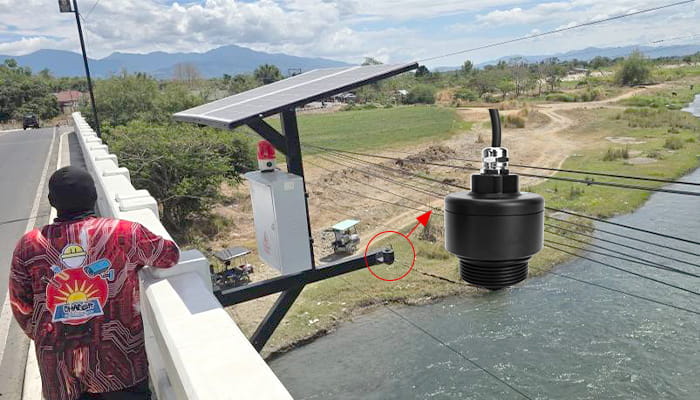
One of the most important advantages of the PWL-R807 is its non-contact measurement principle. Since the radar sensor measures the water surface without touching the liquid, it avoids many common problems associated with submerged sensors and pressure probes. In river environments, traditional contact sensors may suffer from clogging, corrosion, sludge accumulation, or physical damage caused by floating debris and stones. By using radar technology, the customer significantly reduced maintenance requirements and improved long-term monitoring reliability.
The narrow radar beam angle also became a major benefit for the customer’s river monitoring projects. In installations located under bridges or close to channel walls, wide-angle sensors may receive interference from surrounding structures, resulting in unstable measurements. The focused beam design of the PWL-R807 helped reduce unwanted reflections and improved measurement stability even in narrow installation spaces.
Another important feature for South American outdoor applications was the IP68 protection rating. River monitoring stations are often exposed to severe weather conditions including heavy rain, flooding, intense sunlight, and high humidity. The rugged housing structure of the PWL-R807 allows stable long-term operation in demanding outdoor environments, making it suitable for permanent hydrological monitoring stations.
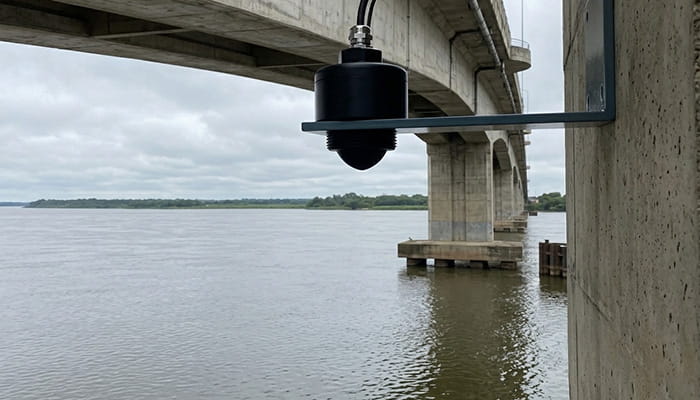
The customer integrated the radar water level meters into several river monitoring systems connected to remote telemetry and SCADA platforms. The RS485 Modbus RTU output simplified communication integration and allowed real-time water level monitoring for flood warning and environmental management applications. Installation and commissioning were straightforward, helping the integrator complete projects more efficiently.
After several months of field operation, the customer reported highly stable monitoring performance compared with previous solutions. The radar sensors maintained reliable readings during rainfall, turbulent river flow, and rapidly changing water levels. Maintenance frequency was also reduced because the non-contact design eliminated many of the issues caused by direct contact with dirty water environments.
Following successful deployment, the South American integrator expanded the use of PWL-R807 radar water level meters into additional projects including dams, reservoirs, urban drainage systems, and open channel monitoring applications. The project demonstrated how modern radar technology can improve the reliability and efficiency of hydrological monitoring systems in harsh outdoor environments.
For river monitoring, flood warning, and smart water management projects requiring accurate outdoor performance and low maintenance, the Pokcenser PWL-R807 Radar Water Level Meter provides an efficient and reliable non-contact monitoring solution.
