 Inglés
 Español
Radar Level Sensor Solution for Tile Manufacturing Plants: PWL-R803 for Powder Silos, Slip Tanks and Clay Tanks
Level measurement in tile manufacturing plants is often more challenging than in ordinary storage tanks. The production process usually involves slurry, ceramic powder, plastic clay, high temperature, dusty atmosphere, metal silos and moving agitators. For these applications, a stable and non-contact level measurement solution is important for inventory control, process automation and production safety.
Pokcenser Sensor de nivel radar de sólidos PWL-R803 is designed for harsh solid and powder applications. With 76–81GHz FMCW radar technology, a narrow 3° beam angle, large lens antenna and universal flange installation, it is suitable for dusty silos, powder storage tanks, plastic pellet tanks, grain silos and similar industrial level measurement applications.
For a tile manufacturing plant requiring level sensors in underground slip tanks, powder silos and plastic clay tanks, PWL-R803 can be recommended as a reliable level measurement solution.
Customer Application Requirements
The customer requires level sensors for three applications in a tile manufacturing plant:
| Aplicación | Medio | Tank / Silo Height | Temperatura | Special Conditions | Quantity |
| Underground slip tank level | Slurry, density 1700 g/L | 3 m | 75–90°C | Dusty atmosphere | 2 pcs |
| Powder silo level sensors | Ceramic powder | 10 m | Max. 90°C | MS square silo, 103 tons capacity | 6 pcs |
| Silo level measurement | Plastic clay | 3 m | 80°C | MS steel tank, slow moving agitator | 6 pcs |
These applications require a level sensor that can handle dust, high temperature, solids, slurry surface changes and internal tank structures.
Why Radar Level Measurement Is Suitable for Tile Manufacturing Plants
Traditional contact-type sensors may face problems in ceramic production environments. Slurry and clay can adhere to probes, powders can create heavy dust, and mechanical level devices may require frequent maintenance.
Radar level measurement is a non-contact technology, which means the sensor does not need to touch the medium directly. This helps reduce wear, material build-up and maintenance requirements.
For tile manufacturing plants, radar level sensors are especially suitable for:
- Ceramic powder silos
- Raw material storage silos
- Plastic clay tanks
- Slip slurry tanks
- Dusty storage environments
- Heated tanks up to around 90°C
- Metal tanks and silos
- Continuous inventory monitoring
PWL-R803 offers 4–20mA, RS485 and HART output options, making it easy to connect with PLC, DCS, remote display or plant automation systems.
Recommended Product: Pokcenser PWL-R803 Solids Radar Level Sensor
The recommended model for this tile manufacturing plant is:
Model: PWL-R803 Solids Radar Level Sensor
PWL-R803 uses 76–81GHz FMCW radar technology and is designed for strong dust, solids, powder and block material applications. It offers high accuracy, narrow beam angle and stable performance in complex installation environments.
Key Features of PWL-R803
- 76–81GHz FMCW radar technology
- Suitable for strong dust, solids, powder and block materials
- Measuring range up to 60m for solids, with longer range options available
- Accuracy options: ±1mm, ±5mm, ±10mm depending on measuring range
- 3° narrow beam angle to reduce interference from tank walls and internal structures
- 4–20mA / RS485 / HART output
- Nivel de protección IP67
- Antena de lente grande
- Universal flange installation
- Optional explosion-proof version
- Working temperature: -30~100°C
These features make it suitable for the customer’s powder silo, plastic clay tank and underground slip tank applications.
Application 1: Underground Slip Tank Level Measurement
Estado de funcionamiento
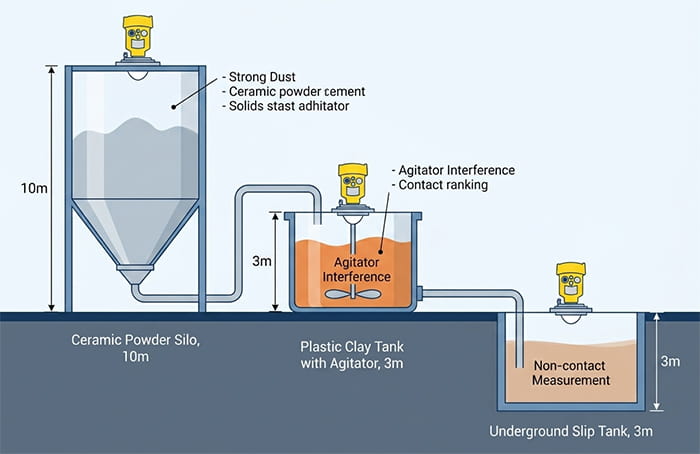
The underground slip tank contains ceramic slurry with a density of 1700 g/L. The tank depth is 3 meters, working temperature is 75–90°C, and the atmosphere is dusty.
Measurement Challenges
Slip slurry is a dense liquid mixture commonly used in ceramic and tile production. In this application, the main challenges include:
- High slurry density
- Possible surface fluctuation
- Dusty surrounding environment
- High process temperature up to 90°C
- Underground tank installation
- Need for reliable continuous level measurement
Contact-type level sensors may suffer from coating or material build-up. Ultrasonic level sensors may be affected by dust, vapor, temperature fluctuation or unstable echo conditions.
Why PWL-R803 Is Suitable
PWL-R803 can be used for liquid applications within the 0.08–35m liquid measuring range. For a 3m underground slip tank, the required measuring range is well within the capability of the sensor. Its working temperature range of -30~100°C also covers the customer’s 75–90°C process temperature.
The non-contact radar design avoids direct contact with dense slurry, reducing maintenance caused by slurry adhesion. The narrow beam angle helps focus the signal on the slurry surface, improving measurement stability in a compact tank.
Recommended Configuration
Recommended model: PWL-R803 Radar Level Sensor
Application: Underground slip slurry tank
Alcance: 3m
Output: 4–20mA or RS485 Modbus RTU
Instalación: Top-mounted universal flange
Quantity: 2 pcs
For this application, it is recommended to confirm whether there is strong steam, condensation or splashing inside the tank. If the tank has heavy condensation or material splashing, antenna protection and proper installation position should be considered.
Application 2: Powder Silo Level Measurement for Ceramic Powder
Estado de funcionamiento
The plant has square MS construction powder silos. Each silo is 10 meters high, with a capacity of 103 tons. The medium is powder, and the maximum temperature is 90°C. The customer wants to calculate the weight by measuring the level of the silo.
Measurement Challenges
Powder silo level measurement is one of the most demanding applications in ceramic production. Common problems include:
- Heavy dust during filling
- Uneven powder surface
- False echoes from silo walls
- Narrow or square silo structure
- High temperature up to 90°C
- Need to estimate material weight from level
Mechanical or contact level sensors can be affected by powder build-up. Ultrasonic sensors can lose signal in heavy dust. For this reason, high-frequency radar is often a better solution for continuous powder level measurement.
Why PWL-R803 Is Suitable
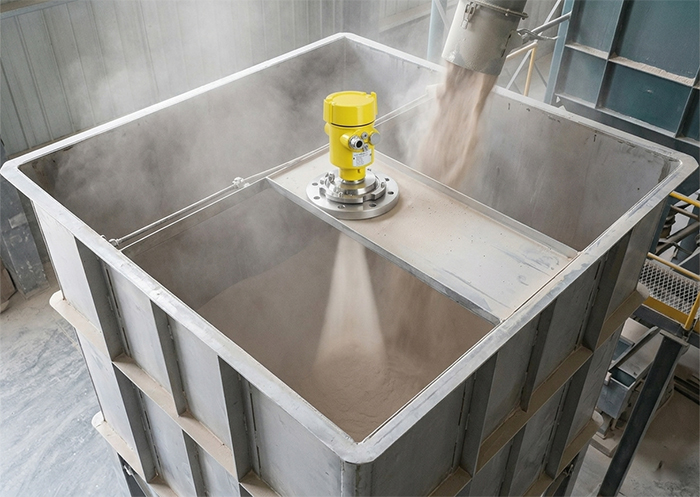
PWL-R803 is specifically designed for strong dust, solids, powder and block material applications. It is also listed for applications such as cement silos, grain silos, plastic pellets tanks and powder environments.
For a 10m powder silo, PWL-R803’s solid measuring range is sufficient. The narrow 3° antenna beam angle helps reduce interference from silo walls, especially important for square MS silos. Its maximum working temperature of 100°C covers the customer’s 90°C powder temperature.
Weight Calculation by Level
The radar level sensor directly measures the level or empty distance inside the silo. To estimate the powder weight, the system can calculate volume based on the silo dimensions and then multiply by bulk density.
For more accurate weight estimation, the following information should be confirmed:
- Silo internal dimensions
- Exact square silo shape
- Cone or flat bottom design
- Powder bulk density
- Material angle of repose
- Required accuracy for inventory control
The radar sensor provides continuous level data, while the PLC or control system can convert level into approximate volume and weight.
Recommended Configuration
Recommended model: Sensor de nivel radar de sólidos PWL-R803
Application: Ceramic powder silo
Silo height: 10m
Output: 4–20mA + HART or RS485 Modbus RTU
Instalación: Top-mounted universal flange
Quantity: 6 pcs
For powder silos, the antenna should be installed away from the filling inlet to reduce direct material impact and avoid false echo from falling powder.
Application 3: Plastic Clay Silo Level Measurement with Slow Moving Agitator
Estado de funcionamiento
The plant needs level measurement for plastic clay tanks. Each tank has a 103-ton capacity, 3m tank height, MS steel construction, slow moving agitator and working temperature of 80°C.
Measurement Challenges
Plastic clay is a difficult medium for level measurement because it can be sticky, uneven and may create an irregular surface. The slow moving agitator also creates internal interference inside the tank.
Main challenges include:
- Sticky plastic clay
- Uneven material surface
- Moving agitator blades
- MS steel tank reflection
- High temperature around 80°C
- Need for stable level data
Contact sensors may be affected by clay adhesion, while mechanical devices can suffer from wear or blockage.
Why PWL-R803 Is Suitable
PWL-R803 offers a 3° narrow beam angle, which helps avoid interference from internal structures when the installation position is selected properly. This is useful for tanks with slow moving agitators. The non-contact radar measurement also avoids direct contact with sticky plastic clay, reducing the risk of coating and maintenance.
The 3m tank height and 80°C working temperature are within the technical range of PWL-R803.
Recommended Configuration
Recommended model: PWL-R803 Radar Level Sensor
Application: Plastic clay tank / silo
Tank height: 3m
Output: 4–20mA or RS485 Modbus RTU
Instalación: Top-mounted universal flange
Quantity: 6 pcs
For tanks with agitators, the sensor should be installed at a position where the radar beam does not directly hit the agitator shaft or blades. If possible, the installation angle and blanking zone should be configured during commissioning.
Why Choose PWL-R803 for Tile Manufacturing Plant Level Measurement
1. Suitable for Dusty Powder Applications
Ceramic powder silos generate dust during filling and discharging. PWL-R803 is designed for strong dust and powder environments, making it suitable for ceramic raw material storage.
2. Non-Contact Measurement Reduces Maintenance
For slurry and plastic clay, contact-type sensors can be easily contaminated. PWL-R803 measures without touching the medium, helping reduce cleaning and maintenance work.
3. Narrow Beam Angle for Complex Tanks
The 3° beam angle helps reduce interference from tank walls, silo structures and internal obstacles. This is especially useful for square silos and tanks with agitators.
4. Suitable for High Temperature up to 90°C
The customer’s applications operate between 75°C and 90°C. PWL-R803 has a working temperature range of -30~100°C, which covers these conditions.
5. Multiple Signal Outputs for Automation
PWL-R803 supports 4–20mA, RS485 and HART communication, allowing easy integration with PLC, DCS, display meters or remote monitoring systems.
Suggested Product Selection Summary
| Customer Application | Recommended Product | Reason |
| Underground slip tank, 3m, slurry, 75–90°C | PWL-R803 Radar Level Sensor | Non-contact measurement, suitable range, temperature within limit |
| Powder silo, 10m, ceramic powder, dusty, 90°C | Sensor de nivel radar de sólidos PWL-R803 | Designed for powder and dust, narrow beam angle, suitable range |
| Plastic clay tank, 3m, agitator, 80°C | PWL-R803 Radar Level Sensor | Non-contact, avoids clay adhesion, narrow beam helps reduce agitator interference |
Installation Notes for Better Performance
To ensure stable measurement performance, the following installation points are recommended:
- Install the radar sensor on the tank or silo top.
- Avoid installing directly above the material inlet.
- Keep the radar beam away from ladders, agitator shafts, support beams or other internal structures.
- For powder silos, avoid direct impact from falling material.
- Confirm the blind zone during installation.
- For tanks with agitators, use echo mapping or false echo suppression during commissioning.
- For weight calculation, confirm silo dimensions and material bulk density.
FAQ: Radar Level Sensor for Tile Manufacturing Plants
Can PWL-R803 measure ceramic powder in a dusty silo?
Yes. PWL-R803 is designed for strong dust, solids, powder and block material applications, making it suitable for ceramic powder silos and similar powder storage tanks.
Can radar level sensors calculate the weight of powder in a silo?
Radar level sensors measure material level. The weight can be calculated by converting level into volume and then multiplying by bulk density. For better accuracy, silo dimensions, bottom shape and powder density should be confirmed.
Is PWL-R803 suitable for slurry tanks?
Yes, for the customer’s 3m underground slip tank, PWL-R803 can be used because its liquid measuring range covers this application. Non-contact radar measurement also helps reduce maintenance caused by slurry adhesion.
Can PWL-R803 work at 90°C?
Yes. The working temperature range of PWL-R803 is -30~100°C, so it can cover applications with temperatures up to 90°C.
Can PWL-R803 be used in tanks with agitators?
Yes, but proper installation is important. The radar beam should avoid directly hitting the agitator shaft or blades. The 3° narrow beam angle helps reduce interference from internal structures.
Conclusión
For tile manufacturing plants, level measurement applications often involve powder, slurry, clay, dust, heat and moving mechanical parts. Pokcenser Sensor de nivel radar de sólidos PWL-R803 provides a reliable non-contact solution for these challenging conditions.
For the customer’s requirements, PWL-R803 is recommended for:
- 2 pcs underground slip tank level measurement
- 6 pcs powder silo level measurement
- 6 pcs plastic clay tank level measurement
With 76–81GHz FMCW radar technology, strong dust application capability, narrow 3° beam angle, IP67 protection and multiple signal outputs, PWL-R803 is a suitable choice for continuous level monitoring and inventory control in ceramic and tile manufacturing plants.
Contact Pokcenser to select the right radar level sensor for your tile manufacturing plant, powder silo, slurry tank or clay storage application.
