 Inglés
 Español
Sanitary Pressure Transmitters: Food, Dairy & Pharmaceutical Applications
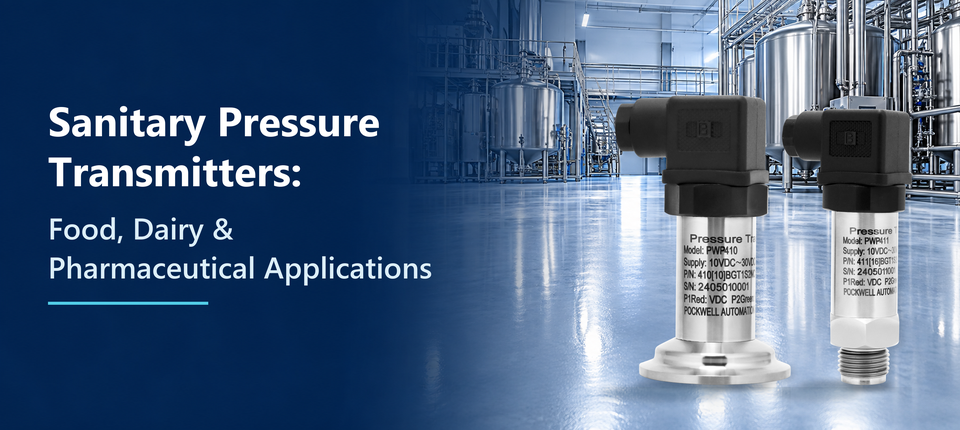
Pressure measurement in food, dairy, and pharmaceutical processing is different from pressure measurement in a refinery or a water plant. The medium is often viscous, paste-like, or crystallizing — yogurt, ketchup, honey, slurries, and pharmaceutical suspensions. The process demands absolute cleanliness: lines must be cleaned in place (CIP) and sometimes steamed in place (SIP), with no dead spaces where product or bacteria can hide. And every wetted component must meet food-grade material standards.
A standard industrial pressure transmitter with a narrow pressure port fails these requirements in two ways: viscous media clog the port, and the dead space traps product that cannot be cleaned. The solution is a sanitary pressure transmitter with a flush diaphragm — a design where the sensing diaphragm sits flush with the process surface, leaving no gaps, no dead volume, and nothing to clog.
This guide explains how flush-diaphragm sanitary pressure transmitters work, where they are used, and how to select the right one for your process.
Why Sanitary Pressure Measurement Is Different
Three requirements separate sanitary pressure measurement from general industrial measurement:
- Hygienic design. Wetted parts are made of stainless steel (316L is the standard), with surface finishes that resist bacterial adhesion. Every component that touches the product must be cleanable and, in many applications, sterilizable.
- No dead space. Any crevice, pocket, or recess in the process connection can trap product, harbour bacteria, and contaminate the next batch. Hygienic instruments are designed to eliminate dead space entirely.
- Clean-in-place compatibility. Modern food and pharma lines are cleaned automatically with aggressive cleaning agents at elevated temperatures. The instrument must survive repeated CIP cycles and, where required, SIP (steam-in-place) temperatures.
The Flush Diaphragm Advantage
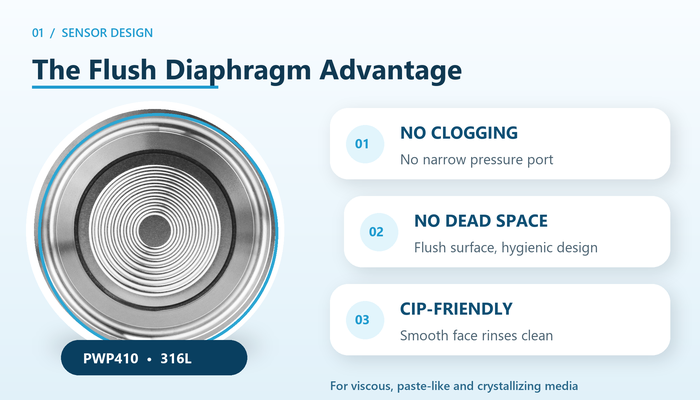
A conventional pressure transmitter measures through a small pressure port or capillary — fine for clean fluids, a problem for anything viscous or particulate. A flush-diaphragm design replaces the port with a welded metal diaphragm that is flush with the process connection face. The process medium pushes directly against the diaphragm; the pressure is transferred to the sensing element behind it.
The benefits are direct:
- No clogging. Viscous, paste-like, crystallizing, or solids-containing media cannot plug a surface that has no opening.
- No dead space. The flush surface leaves no pocket for product or bacteria to hide — it is inherently hygienic and easy to clean.
- Simple cleaning. The smooth, flush face rinses clean during CIP cycles, and media changes do not require disassembly.
- Reliable in tough duty. The welded stainless steel membrane is robust and low-maintenance, which is why flush-diaphragm transmitters are the standard for food-grade pressure sensing.
Key Applications in Food, Dairy & Pharma
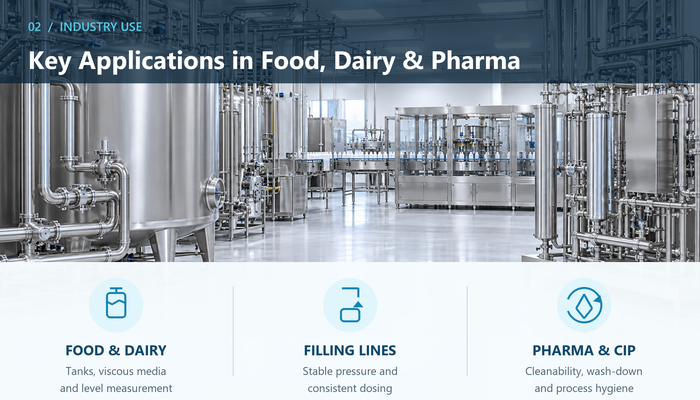
Food and dairy processing. Flush-diaphragm transmitters monitor pressure in fermentation tanks, storage tanks, and process piping for products such as milk, yogurt, cheese slurries, sauces, and syrups. They also serve as level transmitters in tanks, using hydrostatic pressure to indicate fill level — a common and cost-effective solution for viscous products.
Filling and packing machinery. Filling machines dose precise volumes of product under controlled pressure. Sanitary pressure transmitters on filling lines ensure consistent dosing and detect blockages or supply issues before they create waste.
CIP and cleaning systems. Cleaning-in-place systems circulate caustic and acid solutions at elevated temperature and pressure. A sanitary pressure transmitter monitors the cleaning circuit, confirms pump pressure is adequate, and must itself survive the aggressive chemicals and heat of every cycle.
Pharmaceutical and biotech. In pharma, the priorities are sterility and batch consistency. Sanitary transmitters are used on purified water loops, media preparation, bioreactors, and sterile filtration skids, where 316L stainless steel, cleanable design, and high-temperature resistance are mandatory.
Other viscous media. Beyond food and pharma, flush-diaphragm designs are used for glues, adhesives, foams, hydraulic fluids, and wastewater — anywhere a standard pressure port would clog. Level measurement of viscous media is another common application.
Process Connections: Tri-Clamp vs Threaded
The process connection determines how the transmitter mounts and how cleanable the installation is:
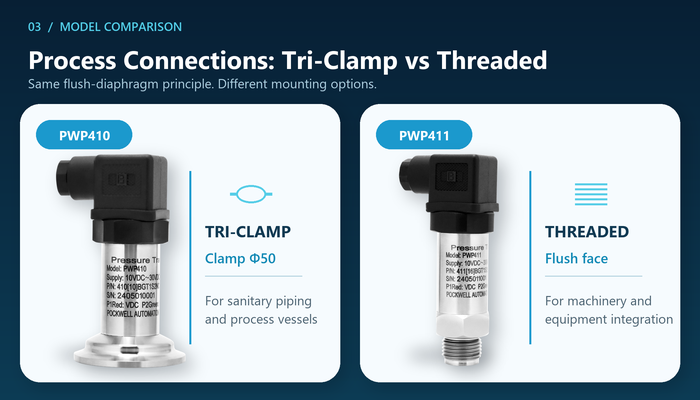
- Tri-clamp (sanitary clamp). The industry standard for food and pharma. The transmitter carries a clamp ferrule (e.g. Tri-clamp 1½″) that mates with a clamp connection on the vessel or pipe, sealed with a sanitary gasket. Tri-clamp connections are quick to assemble and disassemble, and fully cleanable. The Pokcenser PWP410 uses this connection (clamp Φ50), making it the natural choice for dairy, beverage, and pharma lines.
- Threaded. A G½″, G1″, or M20×1.5 male thread with a flush face suits applications where a clamp is not available, such as some machinery and equipment integrations. The Pokcenser PWP411 offers flush-diaphragm measurement with threaded connections.
Both designs use the same flush-diaphragm sensing principle — the choice is about how the instrument mounts in your specific installation.
High-Temperature and CIP Considerations
CIP cycles and certain processes expose the transmitter to temperatures far beyond normal process temperature. Standard electronic components cannot survive sustained heat, so high-temperature sanitary transmitters use cooling elements (cooling fins or heat sinks) between the hot process connection and the electronics. With a cooling element, the transmitter can measure media at up to 150°C while the electronics stay within their operating range.
When selecting for CIP/SIP duty, confirm:
- The transmitter’s temperature rating covers your cleaning cycle temperature and duration.
- The wetted materials (316L diaphragm and gasket) withstand your cleaning chemicals.
- The electrical connection (e.g. DIN43650, M12) and IP rating (IP65/IP67) suit wash-down environments.
How to Select a Sanitary Pressure Transmitter
Work through these points when specifying:
- Pressure range. Choose a range where your normal operating pressure sits in the middle, with headroom for spikes. Flush-diaphragm ranges commonly cover from -0.1 MPa up to 7 MPa, with overload capacity of up to 200% F.S.
- Accuracy. Food and pharma process control typically needs ±0.5% F.S. or better; higher accuracy (±0.25%, ±0.1% F.S.) is available for critical or custody-type measurements.
- Process connection. Tri-clamp for sanitary lines (PWP410), threaded for machinery integration (PWP411). Match the ferrule or thread to your vessel or pipe.
- Temperature. Confirm both the process temperature and the worst-case CIP temperature, and select a version with a cooling element if either exceeds ~85°C.
- Output signal. Choose between 4–20 mA analog and RS485 digital (or other signals such as 0–10V) to match your control system.
- Media compatibility. Verify the diaphragm material (316L standard) and any seal materials are compatible with your product and cleaning chemicals.
- Certifications. For food contact, confirm the instrument meets food-grade requirements applicable in your market.
Pokcenser Sanitary Pressure Transmitters
Pokcenser Automation’s sanitary line covers the two mounting styles used in food, dairy, and pharmaceutical processing:
- PWP410 Hygienic Pressure Transmitter with Tri-Clamp — flush-welded 316L diaphragm, clamp Φ50 process connection, pressure ranges from -0.1 MPa up to 7 MPa, accuracy ±0.5% F.S. typical (±0.25% / ±0.1% F.S. optional), outputs including 4–20 mA, 0–10 V, and RS485, fast ≤3 ms response, and an operating range of -20°C to +150°C with a cooling element. Food-graded and free of dead space, it is designed for food, dairy and beverage processing, filling and packing machinery, and cleaning systems.
- PWP411 Sensor de presión sanitario con diafragma rasante — the same flush-diaphragm technology with G½″, G1″, or M20×1.5 threaded connections for machinery and equipment integration, with the same pressure, accuracy, and temperature capabilities.
Both models are food-grade, CIP-compatible, and built around the flush-welded membrane that eliminates clogging and dead space — the two problems that make ordinary transmitters unsuitable for hygienic processes.
PREGUNTAS FRECUENTES
1. What is the difference between a sanitary and a standard pressure transmitter?
A sanitary (hygienic) transmitter uses a flush-welded 316L stainless steel diaphragm with no dead space, designed for clean-in-place (CIP) duty and food-grade materials. A standard transmitter has a pressure port that can clog with viscous media and cannot be cleaned hygienically.
2. Can these transmitters survive CIP (clean-in-place) cycles?
Yes. They are designed for sanitary and CIP applications, with wetted parts in food-grade stainless steel and no dead spaces where cleaning agents cannot reach. With a cooling element, versions can handle media temperatures up to 150°C.
3. What is the maximum temperature for a flush-diaphragm pressure transmitter?
The standard version operates from -20°C to +85°C. With a cooling element, the transmitter can measure media at up to +150°C while keeping the electronics within their safe range — which covers most CIP cycles.
4. Tri-clamp or threaded — which connection should I choose?
Use a tri-clamp connection (PWP410) for sanitary piping and vessels — it is the industry standard, quick to assemble, and fully cleanable. Use a threaded connection (PWP411) when mounting into machinery or where a clamp ferrule is not available.
