 Inglés
 Español
Ultrasonic Versus Electromagnetic Flow Meters A Comprehensive Industrial Guide
Picking the right flow meter for industrial work isn’t straightforward. Ultrasonic and electromagnetic options each handle fluids differently, and the wrong choice shows up fast in your process data. This piece walks through both technologies side by side, covering how they actually work, where each performs best, and what matters when you’re making the call for a specific application.
How Ultrasonic Flow Meters Actually Work
Ultrasonic flow meters measure fluid velocity by tracking how sound waves behave as they pass through a moving liquid. Two main approaches exist here: transit-time and Doppler.
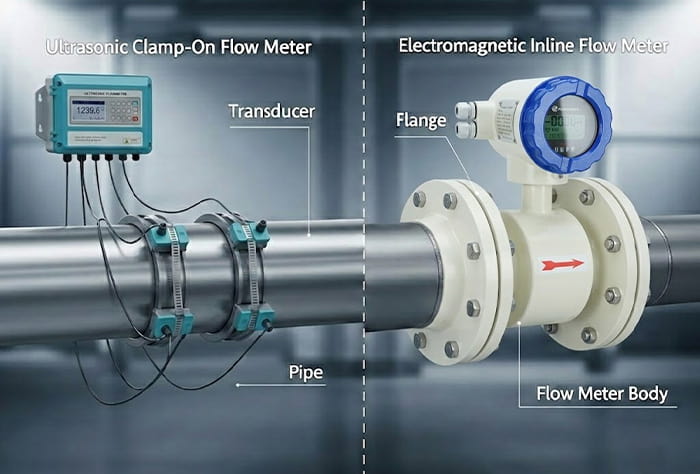
Transit-time meters, like the PWF-U2000MCC Multi-channel Clamp-on Ultrasonic Flowmeter, send ultrasonic signals both upstream and downstream simultaneously. The time difference between these two signals tells you how fast the fluid is moving. Clean, homogeneous liquids work best with this method. Water, seawater, various oils. The clamp-on design means you can install these without touching the process stream at all.
Doppler meters take a different approach. They bounce ultrasonic signals off particles or bubbles suspended in the fluid and measure the frequency shift in the reflected signal. Sewage, slurries, anything with solids or gas mixed in. That’s where Doppler shines.
Both types avoid direct contact with the fluid itself. No pressure drop to worry about, no corrosion concerns from aggressive chemicals. The PWF-U1000 Small Pipe Clamp-on Ultrasonic Flowmeter handles pipes from DN15 to DN40 with ±2% accuracy out of the box, tightening to ±1% after calibration. Water supply systems, building services, food processing. Applications where you can’t afford contamination or extended shutdowns.
Electromagnetic Flow Meter Fundamentals and Operation
Electromagnetic flow meters work on Faraday’s Law of Induction. Move a conductor through a magnetic field, and you generate voltage. In a magmeter, the conductive fluid itself becomes that conductor.
The meter creates a magnetic field perpendicular to flow direction. Electrodes mounted flush with the pipe wall pick up the induced voltage, which scales directly with fluid velocity. Simple relationship, reliable measurement.
Construction typically involves a non-magnetic pipe section with insulating liner material and external coils for the magnetic field. Nothing protrudes into the flow path. No moving parts means negligible pressure drop and solid performance with difficult fluids. Slurries, corrosive chemicals, wastewater. The PWF-E1200 Electromagnetic Flow Meter handles these demanding conditions without complaint. Chemical processing, mining operations, municipal water treatment. Industries where fluid conductivity exists and measurement reliability matters.
Performance Metrics and Application Suitability
Getting the right performance from a flow meter means understanding what each technology actually delivers in practice.
Transit-time ultrasonic meters like the PWF-U2000MCC reach ±0.5% FS accuracy in multi-channel configurations with excellent repeatability on clean liquids. Zero pressure drop since nothing touches the fluid. Electromagnetic meters like the PWF-E1200 hit similar accuracy levels (±0.5% of reading) while ignoring viscosity and density changes completely. Their unobstructed flow path keeps pressure drop minimal too.
| Característica | Caudalímetros ultrasónicos | Caudalímetros electromagnéticos |
|---|---|---|
| Precisión | High (e.g., ±0.5% FS for clean liquids) | High (e.g., ±0.5% of reading) |
| Repetibilidad | Excellent for homogeneous fluids | Excellent, unaffected by fluid properties |
| Caída de presión | Negligible (non-intrusive) | Negligible (unobstructed flow path) |
| Fluid Compatibility | Clean, homogeneous liquids; Doppler for dirty fluids | Conductive liquids, slurries, corrosive fluids |
| Mantenimiento | Low (no moving parts, external sensors possible) | Low (no moving parts, robust design) |
| Instalación | Clamp-on (non-intrusive) or inline | Inline (requires pipe cutting) |
Maintenance tells a different story depending on configuration. Clamp-on ultrasonic units sit outside the pipe entirely. Inline versions of both technologies share the no-moving-parts advantage, which keeps wear and replacement costs down over time.
Installation Considerations and Fluid Compatibility
Where and how you install these meters shapes their long-term performance as much as the technology choice itself.
Clamp-on ultrasonic models like the PWF-U2000MCC attach to existing pipes without cutting anything. No process shutdown, no pipe modifications. Perfect when downtime costs money or when the fluid inside would rather not meet the outside world. The catch? Pipe material, wall thickness, and internal linings all affect signal quality. Calibration needs attention. Insertion-type options like the PWF-U2000MCI split the difference, going into the pipe without requiring a full flow interruption.
Electromagnetic meters go inline. Cut the pipe, install flanges, integrate the meter section directly. More involved upfront, but once it’s in place, you’ve got a stable, permanent measurement point.
Key Differences in Fluid Compatibility Between Ultrasonic and Electromagnetic Flow Meters
The physics behind each technology determines what fluids they can handle.
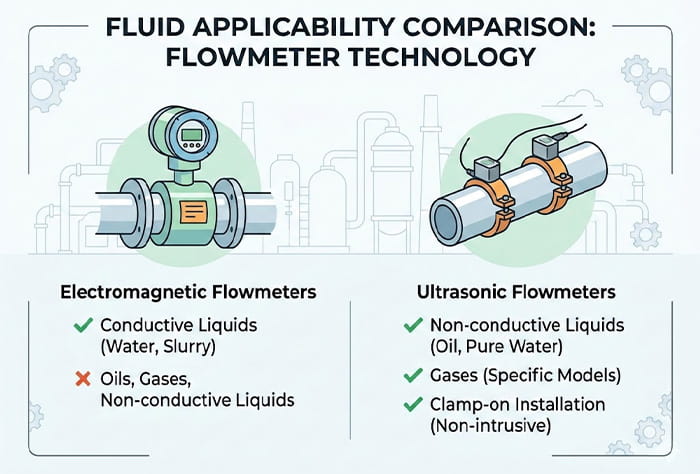
Electromagnetic meters need conductive fluid to generate that measurable voltage. Municipal water, wastewater streams, chemical processing fluids. Anything above roughly 5 µS/cm conductivity works. Below that threshold, the signal disappears.
Ultrasonic meters don’t care about conductivity. Pure water, oils, solvents, non-aqueous solutions. All fair game. When entrained air or suspended solids enter the picture, Doppler technology picks up the slack by bouncing signals off those particles instead of measuring transit time through clean fluid.
Installation Complexity Comparison for Ultrasonic Versus Electromagnetic Flow Meters
The installation effort varies considerably between these options.
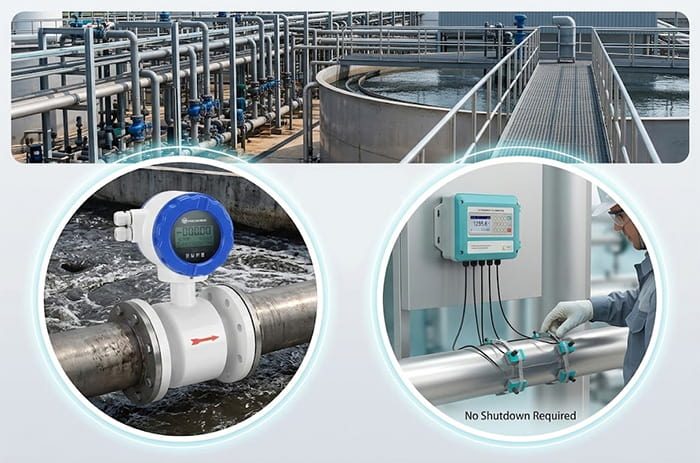
Clamp-on ultrasonic meters represent the simplest path forward. Mount transducers externally, no pipe cutting, no process interruption. Temporary measurements, retrofit situations, applications where you can’t afford downtime. The PWF-U2000MCC goes in quickly and comes off just as easily.
Inline electromagnetic meters demand more planning. Pipe cutting, flange integration, potential downtime during installation. But that flanged setup delivers a highly stable, permanent measurement point once complete. Insertion-type ultrasonic meters like the PWF-U2000MCI offer a middle ground when full shutdown isn’t practical.
Both technologies need proper calibration after installation to hit their accuracy specifications.
Economic Factors and Long Term Value
Purchase price tells only part of the cost story. Installation expenses, operational costs, and total ownership over years matter just as much.
Clamp-on ultrasonic meters often win on installation costs. No pipe work, no production losses during setup. Electromagnetic meters with their inline requirements may cost more to install initially.
Operating costs favor both technologies equally. No moving parts in either design means minimal wear, few replacements, and long service intervals. The return on investment calculation improves steadily over years of reliable operation.
Optimizing Flow Meter Selection for Industrial Processes
Making the right choice comes down to matching technology to application systematically.
Start with the fluid. Conductive or non-conductive? Clean or loaded with solids and bubbles? This single question eliminates half your options immediately.
Then consider the pipe itself. Material, size, wall thickness. These factors affect both installation methods and meter compatibility.
Accuracy requirements matter next. Some processes tolerate ±2%, others need ±0.5% or better. Match the specification to the actual need.
Finally, evaluate the installation environment. Temperature extremes, pressure conditions, hazardous area classifications. ATEX-certified products handle explosive atmospheres safely.
Which Flow Meter Type Offers Better Accuracy for Specific Industrial Applications
Accuracy comparisons depend entirely on what you’re measuring.
Clean, homogeneous liquids? Transit-time ultrasonic meters typically deliver ±0.5% FS accuracy. Multi-channel configurations perform even better when flow profiles get complicated.
Conductive fluids with suspended solids or slurry characteristics? Electromagnetic meters take the lead with ±0.5% of reading accuracy that ignores viscosity, density, and temperature variations completely.
The “better” technology is whichever one matches your fluid properties and measurement requirements. Regular calibration against recognized standards keeps either type performing at specification.
Preguntas frecuentes
What are the primary advantages of ultrasonic flow meters in non-conductive fluid applications?
Ultrasonic flow meters work without requiring electrical conductivity in the fluid. Sound waves pass through the liquid regardless of its conductive properties, making these meters ideal for clean water, oils, and non-aqueous solutions. The clamp-on installation option adds another layer of practicality since you can mount sensors externally, avoiding process interruption and eliminating pressure drop concerns entirely.
When is an electromagnetic flow meter the preferred choice for industrial fluid measurement?
Electromagnetic flow meters make sense when you’re dealing with conductive liquids, slurries, or corrosive fluids. The Faraday’s Law operating principle delivers high accuracy without moving parts, and the measurement stays stable regardless of viscosity, density, or temperature changes. Water and wastewater treatment facilities and chemical processing operations rely heavily on this technology because it handles challenging fluid properties that would trip up other meter types.
How do installation and maintenance requirements differ between ultrasonic and magnetic flow meters?
Clamp-on ultrasonic meters install without touching the pipe interior. No cutting, no downtime, lower installation costs. Sensitivity to pipe material and internal coatings requires careful calibration attention though. Magnetic flow meters need inline installation with pipe cutting and flange work, but once installed they’re remarkably robust. Neither technology has moving parts, so maintenance stays minimal for both. Periodic calibration checks keep accuracy where it should be.
Can both ultrasonic and electromagnetic flow meters be used for hazardous area applications?
Both technologies come in versions certified for hazardous environments. ATEX-approved models meet safety requirements for potentially explosive atmospheres. The specific certification must match the hazard classification of your installation location. Verify the model ratings against your area classification before specifying equipment. For more on this topic, our article on 《Seguridad en zonas peligrosas: Uso de sensores a prueba de explosiones》 covers the details.
What factors influence the total cost of ownership for these industrial flow measurement devices?
Total cost of ownership extends well beyond the purchase price. Installation costs vary significantly between clamp-on and inline options. Calibration frequency, power consumption, maintenance labor, replacement parts, and downtime all contribute to the long-term number. Device lifespan matters too. Selecting the right meter for your specific application conditions optimizes that total cost figure over years of operation.
Asóciese con Pokcenser Automation para sus necesidades de medición de caudal
Pokcenser Automation brings over a decade of experience and 150,000+ solutions delivered across 100+ countries to your flow measurement challenges. Our CE, ATEX, ISO, and RoHS approved flow meters come backed by dedicated pre-sales and after-sales teams ready to evaluate your application and recommend the right solution. Reach us at en**@*******er.com or +86 181 7515 5326.

