 Inglés
 Español
Understanding Sensor Accuracy: What Do ±0.5%, ±0.2%, and ±0.075% Mean?
When comparing industrial sensors, one of the first specifications engineers notice is accuracy.
Manufacturers often advertise specifications such as:
- ±0,5%FS
- ±0,2%FS
- ±0.1%FS
- ±0.075%FS
At first glance, these numbers may seem straightforward. However, many users misunderstand what these accuracy ratings actually mean and how they affect real-world measurements.
In this guide, we’ll explain how sensor accuracy is defined, how to calculate measurement errors, and when investing in a higher-accuracy instrument makes sense.
What Is Sensor Accuracy?
Sensor accuracy describes how close a measured value is to the actual value.
No measurement instrument is perfectly accurate. Every sensor has some degree of error between the measured value and the true value.
For example:
If the actual pressure is:
10.0 bar
And the transmitter displays:
10.1 bar
The measurement error is:
0.1 bar
The smaller the error, the higher the accuracy.
What Does “%FS” Mean?
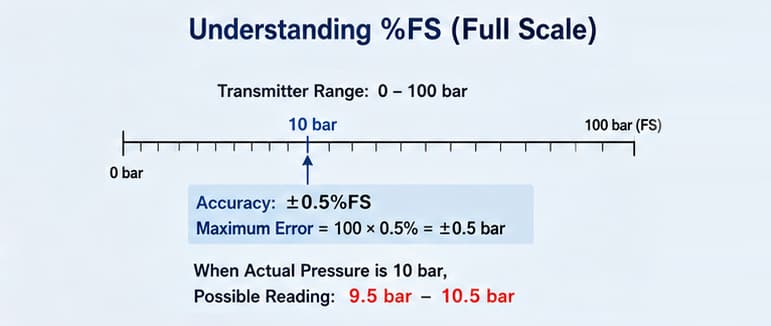
Most industrial transmitters specify accuracy as a percentage of Full Scale (FS).
Full Scale refers to the maximum measurement range of the instrument.
Por ejemplo:
Pressure transmitter range:
0-100 bar
Full Scale (FS):
100 bar
If the accuracy is:
±0,5%FS
The maximum error is:
100 × 0.5%
= ±0.5 bar
This means the transmitter may read:
- 9.5 bar
- 10.0 bar
- 10.5 bar
when the actual pressure is 10 bar.
How Accuracy Changes with Different Specifications
Let’s compare several common accuracy ratings using the same 0-100 bar pressure transmitter.
| Precisión | Maximum Error |
| ±0,5%FS | ±0.5 bar |
| ±0,2%FS | ±0.2 bar |
| ±0.1%FS | ±0.1 bar |
| ±0.075%FS | ±0.075 bar |
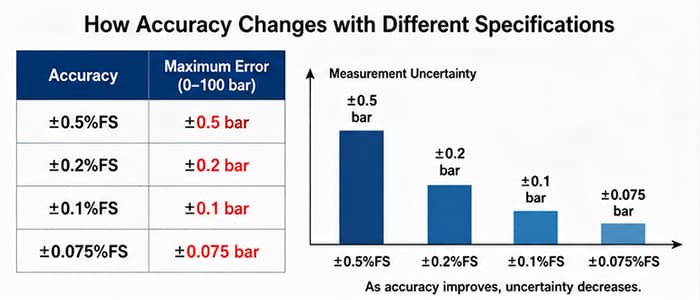
As accuracy improves, measurement uncertainty decreases.
This is especially important in applications requiring precise process control.
Why Accuracy Matters More at Lower Readings
Many users assume that a ±0.5%FS transmitter has a 0.5% error regardless of the measured value.
This is incorrect.
Consider a transmitter with:
Alcance:
0-100 bar
Precisión:
±0,5%FS
Maximum error remains:
±0.5 bar
Whether the measured pressure is:
- 10 bar
- 50 bar
- 90 bar
the error limit remains the same.
Example at 10 bar
Actual pressure:
10 bar
Possible reading:
9.5-10.5 bar
Relative error:
5%
Example at 90 bar
Actual pressure:
90 bar
Possible reading:
89.5-90.5 bar
Relative error:
0.56%
This is why selecting an appropriate measurement range is extremely important.
Accuracy vs Repeatability
These two specifications are often confused.
Precisión
Measures how close a reading is to the true value.
Repetibilidad
Measures how consistently a sensor produces the same reading under identical conditions.
Por ejemplo:
A transmitter repeatedly measures:
- 50.1 bar
- 50.1 bar
- 50.1 bar
Excellent repeatability.
However, if the actual pressure is 49.5 bar, the accuracy is still poor.
A good industrial instrument should provide both high accuracy and good repeatability.
Accuracy vs Resolution
Another common misunderstanding involves resolution.
Resolución
The smallest detectable change in a measurement.
Por ejemplo:
A display showing:
50.01 bar
has higher resolution than a display showing:
50.0 bar
However, higher resolution does not automatically mean higher accuracy.
A sensor can display many decimal places while still having significant measurement error.
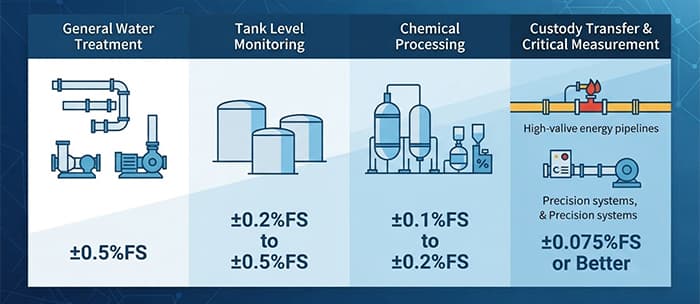
Typical Accuracy Requirements by Application
Different industries require different levels of accuracy.
General Water Treatment
Recommended Accuracy:
±0,5%FS
Suitable for:
- Pump monitoring
- Water distribution systems
- General process control
Tank Level Monitoring
Recommended Accuracy:
±0.2%FS to ±0.5%FS
Suitable for:
- Depósitos de agua
- Wastewater tanks
- Chemical storage tanks
Procesado químico
Recommended Accuracy:
±0.1%FS to ±0.2%FS
Suitable for:
- Dosing systems
- Reactor monitoring
- Process optimization
Custody Transfer and Critical Measurements
Recommended Accuracy:
±0.075%FS or better
Suitable for:
- High-value processes
- Energy applications
- Precision industrial systems
When Is a High-Accuracy Sensor Worth the Investment?
Higher accuracy instruments generally cost more.
However, the additional investment may be justified when:
Product Quality Is Critical
Small measurement errors can affect product consistency.
Process Efficiency Matters
Accurate measurements improve control system performance.
Regulatory Compliance Is Required
Many industries must meet strict measurement standards.
Inventory Management Is Important
Level measurement errors can affect inventory calculations.
Recommended High-Accuracy Solution
Transmisor de presión diferencial de silicio monocristalino inteligente PWP3051DP
En Transmisor de presión diferencial de silicio monocristalino inteligente PWP3051DP offers accuracy up to ±0.075%FS, making it suitable for demanding industrial applications requiring high measurement precision.
Características principales
- Accuracy up to ±0.075%FS
- Excellent long-term stability
- Comunicación HART
- Suitable for liquid, gas, and steam measurement
- Industrial-grade reliability
Aplicaciones típicas
- Process control systems
- Plantas químicas
- Generación de energía
- Instalaciones de tratamiento de aguas
- Industrial automation systems
Common Accuracy Selection Mistakes
Choosing Accuracy Based Only on Price
Lower-cost instruments may not provide the precision required for critical applications.
Overspecifying Accuracy
Not every application needs ±0.075%FS performance.
For many water and wastewater systems, ±0.5%FS is sufficient.
Ignoring Measurement Range
An incorrectly selected range can have a greater impact than the accuracy specification itself.
Overlooking Long-Term Stability
Accuracy should be evaluated together with stability and drift performance.
¿Por qué elegir Pokcenser?
Pokcenser provides industrial measurement solutions for customers in more than 100 countries.
Our product portfolio includes:
- Transmisores de presión
- Differential Pressure Transmitters
- Sensores de nivel radar
- Sensores de nivel ultrasónicos
- Caudalímetros
- Water Quality Instruments
We help customers select the most cost-effective balance between performance, reliability, and accuracy.
Preguntas frecuentes
Q1: Is ±0.075%FS always better than ±0.5%FS?
Yes in terms of measurement precision, but not every application requires such high accuracy.
Q2: Does higher accuracy always mean higher cost?
Generally yes, because higher-accuracy sensors require better sensing elements, calibration, and manufacturing processes.
Q3: What does FS mean?
FS stands for Full Scale, which refers to the maximum measurement range of the instrument.
Q4: Is accuracy more important than resolution?
For industrial process measurement, accuracy is usually more important than display resolution.
Q5: Which industries require high-accuracy transmitters?
Chemical processing, power generation, pharmaceutical manufacturing, and precision industrial applications often require higher accuracy instruments.
