 English
 Spanish
Integrating Temperature Sensors in Industrial Automation Systems
Industrial automation runs on tight environmental control, and after enough time on factory floors, I can tell when temperature starts to wander because quality, throughput, and safety all wobble with it. Temperature is the process variable that quietly decides whether a line hums or struggles. We deal with these integrations daily, so we know where engineers lose time and where systems drift. What follows is a practical walkthrough aimed at engineers and technical managers who want temperature sensing that installs cleanly, plays nicely with controls, and stays accurate over the long haul.
Understanding the Critical Role of Temperature Sensors in Automation
1. The fundamental importance of accurate temperature monitoring in industrial processes
Accurate temperature monitoring is vital for maintaining process integrity across industrial sectors. In manufacturing, precise temperature control stabilizes product quality and prevents material degradation. In chemical reactions, even small deviations shift reaction rates, which impacts yield and purity. In energy production, tracking turbine temperatures prevents overheating and catastrophic failures. These sensors deliver the real-time data needed for sound decisions and automated control actions.
2. How temperature fluctuations impact operational efficiency and product quality
Uncontrolled temperature swings hurt efficiency and undermine product quality. In food processing, inconsistent temperatures cause spoilage or undercooking. In the pharmaceutical industry, strict temperature ranges protect drug stability and efficacy. Fluctuations also drive up energy use as systems overcorrect, which raises operating costs. Keeping temperatures stable cuts waste, optimizes energy use, and supports compliance with quality standards.
3. Key industries benefiting from precise temperature control in automation
Precise temperature control matters across many fields. The chemical sector depends on it for safe reaction kinetics. Food and beverage production uses it for preservation, cooking, and sanitation. Pharmaceuticals require tight control for product integrity and regulatory compliance. HVAC systems balance energy and comfort through accurate temperature management. Even in Water and Wastewater Treatment, temperature affects biological processes and chemical solubility.
Exploring Diverse Types of Temperature Sensors for Automation Systems
1. Thermocouples: Principles, applications, and considerations for industrial use
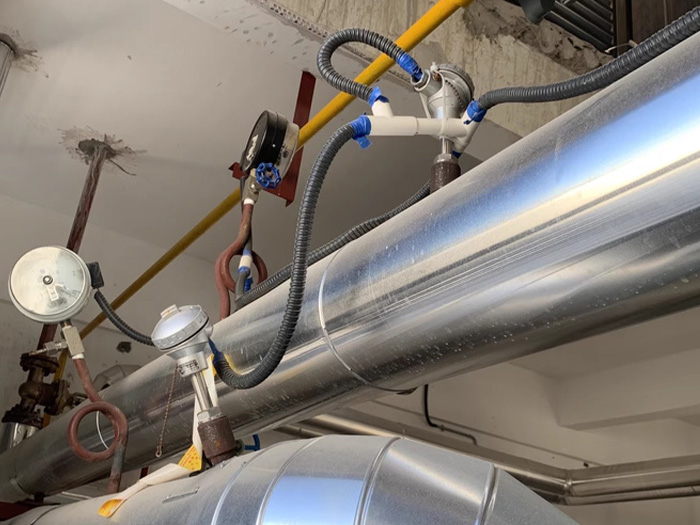
Thermocouples measure temperature via the Seebeck effect, where two dissimilar metals at different temperatures produce a voltage difference. They are rugged, self-powered, and operate across wide temperature spans, often up to 2300°C. Fast response makes them a solid choice for dynamic processes. Accuracy trails RTDs, and you need cold junction compensation for precise readings. Common applications include furnaces, kilns, and engine exhaust systems.
2. RTDs (Resistance Temperature Detectors): Advantages in accuracy and stability
RTDs use the predictable change in a metal’s electrical resistance with temperature. Platinum RTDs (Pt100, Pt1000) are valued for high accuracy, stability, and repeatability over a broad range (-200°C to 850°C). Their linearity outperforms thermocouples, which suits high-precision work such as laboratory equipment, Pharmaceutical manufacturing, and critical processes. While RTDs respond more slowly and are more fragile than thermocouples, their accuracy often outweighs these trade-offs.
3. Thermistors: Their role in specific temperature sensing applications
Thermistors are temperature-sensitive resistors with large resistance changes for small temperature shifts. They are usually made from ceramic or polymer materials. NTC (Negative Temperature Coefficient) thermistors are most common, with resistance decreasing as temperature rises. They offer high sensitivity and fast response within a narrow range, usually -50°C to 150°C. Cost-effective and compact, they fit medical devices, consumer electronics, and temperature compensation circuits.
4. Infrared (Non-Contact) Temperature Sensors: Benefits for extreme or moving environments
Infrared temperature sensors read thermal radiation from a target, which enables non-contact measurement. This approach is key for extreme temperatures, moving targets, or places where contact is unsafe or impractical. Use cases include monitoring molten metals, rotating machinery, and food on conveyor belts. They provide immediate readings without loading the target thermally. Correct emissivity settings and attention to dust or steam are important for accurate results.
5. Integrated Temperature Measurement in Multi-Parameter Sensors (e.g., Pokcenser’s TDS, DO, ORP sensors)
Modern systems increasingly use multi-parameter sensors with built-in temperature measurement. For example, Pokcenser’s PT6500 Online TDS Meter Controller measures Total Dissolved Solids (TDS) and includes automatic or manual temperature compensation, operating within a temperature range of -10 to 150℃. Similarly, the CS5530C Residual Chlorine Electrode and Meter offers optional temperature measurement (PT100/PT1000) for enhanced accuracy in chlorine readings. The PCS3740PCD Digital Conductivity TDS Salinity Sensor also features built-in temperature measurement and compensation. These integrated solutions simplify installation, reduce wiring complexity, and improve the overall accuracy of the primary measurement by accounting for temperature effects. The PCS4773D Digital Dissolved Oxygen Sensor (Diaphragm Electrode Method) and the PCS4760PD Digital Dissolved Oxygen Sensor (Optical) also incorporate built-in temperature measurement and compensation, ensuring precise dissolved oxygen readings.
Key Considerations for Seamless Integration of Temperature Sensors
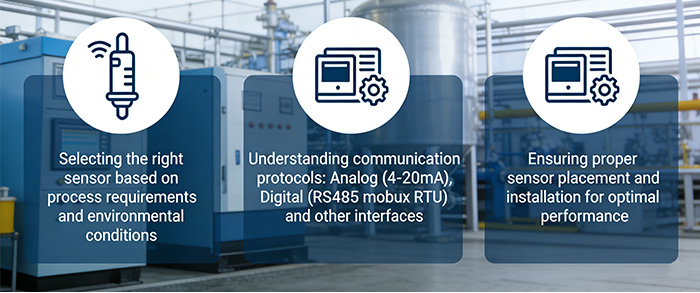
1. Selecting the right sensor based on process requirements and environmental conditions
Choosing the correct temperature sensor starts with a clear view of measurement range, accuracy needs, response time, and environmental stressors. For high temperatures or corrosive media, thermocouples or specialized RTDs may be required. For precision in moderate ranges, RTDs are often the pick. Harsh environments call for the right IP ratings, compatible materials, and vibration resistance. A thorough look at process specifics helps ensure the best fit.
2. Understanding communication protocols: Analog (4-20mA), Digital (RS485 Modbus RTU), and other interfaces
Integration lives or dies on protocol compatibility. Analog 4-20mA remains popular for robustness and long runs, though noise can creep in. Digital RS485 Modbus RTU offers stronger data integrity, multi-drop networking, and simpler wiring. Many of our main products support both 4-20mA and RS485 Modbus RTU, which gives you flexibility across different architectures. Pick the protocol that aligns with plant standards and data needs.
3. Ensuring proper sensor placement and installation for optimal performance
Placement drives accuracy. Poor installation leads to biased readings, sluggish response, and shortened sensor life. Consider thermal gradients, flow profiles, and physical protection. Follow manufacturer guidance on immersion depth, mounting orientation, and thermal contact so the sensor reads the real process temperature.
4. Addressing challenges of harsh industrial environments: Corrosion, pressure, and vibration
Industrial settings can be hard on sensors. Aggressive chemicals, high pressure, and constant vibration degrade performance and cause early failures. We utilize robust materials like 316L stainless steel for wetted parts and design sensors with high IP ratings (e.g., IP68) to handle these conditions. Proper housings, protective coatings, and vibration-dampening mounts support long service life.
5. The importance of calibration and maintenance for long-term accuracy and reliability
Regular calibration and routine maintenance keep sensors honest over time. Drift happens due to aging, environmental exposure, or mechanical stress. Periodic calibration against traceable standards holds measurements within specified tolerances. Maintenance means inspecting for damage, checking connections, and cleaning sensing elements. This approach minimizes downtime, prevents costly errors, and extends sensor life.
Enhancing Automation Systems with Advanced Temperature Sensing Solutions
1. Leveraging data logging and trend analysis for predictive maintenance and process optimization
Advanced temperature sensing often includes data logging and trend analysis. Historical data reveals patterns, flags emerging failures, and supports process tuning. For example, the PT6500 Online TDS Meter Controller includes data logging and trend chart display for real-time monitoring and analysis. This enables predictive maintenance, which cuts unplanned downtime and lifts overall efficiency.
2. Implementing automatic temperature compensation for improved measurement precision
Many measurements are temperature-dependent, so automatic temperature compensation (ATC) is key to accuracy. Our sensors, such as the PT6500 TDS Meter Controller and the PCS3740PCD Digital Conductivity TDS Salinity Sensor, feature built-in ATC. The function adjusts readings to a reference temperature, removing error from temperature variation and delivering more reliable data for control.
3. Integrating temperature data with control systems for real-time process adjustments
Direct integration of temperature data into control systems (e.g., PLCs, DCS) allows real-time adjustments. The system can react to changes, holding conditions where you need them. If a process temperature exceeds a set limit, the control logic can bring on cooling or trim heating elements, which prevents product damage or safety events. This feedback loop is a foundation of modern automation.
4. Utilizing multi-channel systems for comprehensive temperature monitoring across various points
Multi-channel systems gather temperatures from many points at once. The result is a full thermal profile that highlights hot spots, tracks gradients, and verifies uniform heating or cooling. This is particularly useful in large or complex processes where uneven temperature can drag down performance and quality.
5. Customizing solutions for unique industrial applications and OEM/ODM needs
Every plant has quirks. We build customized temperature sensing solutions that match those needs, including specialized sensor designs, tailored interfaces, and custom software integration. Our OEM/ODM capabilities let us deliver sensors that fit the operational and environmental demands of your process and integrate cleanly with your systems.
The Future of Temperature Sensing in Industrial Automation
1. Advancements in sensor technology: Miniaturization, wireless capabilities, and enhanced durability
Progress will bring smaller sensors that fit tight spaces, wireless options that cut wiring and installation time, and tougher designs that survive extreme conditions. These improvements will expand use cases and lift efficiency across automation.
2. The role of AI and machine learning in optimizing temperature control strategies
Artificial intelligence (AI) and machine learning (ML) will reshape temperature control. By analyzing large datasets, they detect subtle patterns and predict optimal parameters. AI-driven control will shift systems from reactive to proactive, reduce energy use, and improve stability and quality beyond traditional PID alone.
3. Meeting evolving industry standards and regulatory compliance for temperature monitoring
Evolving standards and regulations will raise expectations for accuracy, data security, and interoperability. Manufacturers will need to keep pace so temperature sensing remains reliable, compliant, and ready for future integration demands.
Partner with Pokcenser Automation for Advanced Temperature Sensing Solutions
Optimizing your industrial processes with precise and reliable temperature sensing supports efficiency, safety, and quality. Pokcenser Automation offers a wide range of temperature measurement instruments and integrated solutions designed for the demands of modern industrial environments. Our expertise in customized OEM/ODM solutions means your application gets exactly what it needs, from sensor design to system integration.
Contact us today to discuss your temperature sensing requirements and discover how our advanced solutions can enhance your automation systems.
Phone: +86 181 7515 5326
Email: in**@*******er.com
FAQs
1. What are the primary benefits of integrating temperature sensors into automation systems?
You gain tighter process control, which stabilizes product quality and reduces waste. Safety improves because you can prevent overheating and other excursions. You also get better energy performance and the ability to support predictive maintenance, which lowers operating costs and increases uptime.
2. How do I choose the correct type of temperature sensor for my specific application?
Match the sensor to your range, accuracy, response time, and environment. Thermocouples cover wide ranges and tolerate harsh conditions. RTDs deliver high precision. Thermistors are cost-effective within narrow ranges. Infrared sensors are the pick for non-contact or extreme temperature scenarios.
3. What communication protocols are commonly used for temperature sensor integration?
Analog 4-20mA is widely used for long-distance, noise-resistant transmission. RS485 Modbus RTU offers multi-drop networking with stronger data integrity. Depending on your system, you may also see HART, Ethernet/IP, or Profibus, which align with more complex or standardized plant networks.
4. Can temperature sensors be integrated with existing automation infrastructure?
Yes. Most temperature sensors provide standard outputs, such as 4-20mA or RS485 Modbus RTU, which connect directly to PLCs, DCS, and SCADA systems. We also support custom integration to help with legacy systems or mixed architectures.
5. What role does temperature compensation play in sensor accuracy?
Temperature compensation corrects errors caused by ambient or process temperature effects on the sensor or the medium being measured. In conductivity, for instance, temperature strongly influences readings. Built-in compensation, often using NTC10K sensors, adjusts outputs to a standard reference temperature so the primary measurement stays accurate and reliable.

