 English
 Spanish
Seamless Level Sensor Integration in Industrial Water Systems
In industrial water systems, level measurement is the quiet variable that decides whether a shift runs smoothly or turns messy. After more than ten years commissioning controls and troubleshooting tanks, I have watched strong sensor integration prevent overflows and keep pumps out of trouble. Here is how I approach integrating advanced level sensors so they perform reliably, deliver clean data, and support efficiency, safety, and compliance across a range of applications.
Understanding the Criticality of Water Level Monitoring in Industrial Operations
Accurate water level monitoring anchors process control, resource management, and safety. When readings drift, the fallout is familiar, overflow incidents, equipment damage, and production downtime.
1. The importance of precise level measurement for process control
Precise level measurement keeps processes within their specified limits. That precision is key for consistent product quality, tuned chemical dosing, and tidy inventory control. In cooling towers or boiler feed systems, holding the level where it belongs prevents pump cavitation and keeps heat exchange steady.
2. Common challenges in industrial water level management
Industrial water systems can be unforgiving. Corrosive chemicals, extreme temperatures, high pressures, foam, and suspended solids all complicate measurement. Tanks and vessels often have irregular shapes or internal obstructions, such as baffles, which interfere with clean readings. These realities call for sensor technologies that are both robust and adaptable.
Exploring Diverse Level Sensor Technologies for Industrial Water Systems
Different applications demand different sensing principles. Knowing how each works and where it fits makes integration far easier. Below are the workhorses I rely on, hydrostatic and ultrasonic, plus other options that suit specific constraints.
1. Hydrostatic level sensors for submerged applications
Hydrostatic level sensors read the pressure from the liquid column above the sensing element, a value directly proportional to level. They deliver reliable continuous measurement in tanks, wells, and reservoirs. For instance, the PWP412-T3 SDI-12 Hydrostatic Water Level and Temperature Transmitter provides precise measurements up to 200m, with an IP68 rating for submersible applications. These sensors shine in deep tanks or open water where direct contact is practical.
If you’re interested, check Submersible Level Transmitters: Key Specs to Check First.
2. Ultrasonic level sensors for non-contact measurement
Ultrasonic level sensors emit sound waves and time the returning echo. Because they do not touch the medium, they work well with corrosive liquids, wastewater, or anywhere contact is undesirable. They are a smart choice for tanks with agitators or processes that generate foam. Pokcenser offers models like the PWL-U201 Small Range Ultrasonic Level Transmitter and PWL-U202 Small Blind Spot Ultrasonic Level Transmitter, which feature small blind zones and high accuracy for various tank sizes.
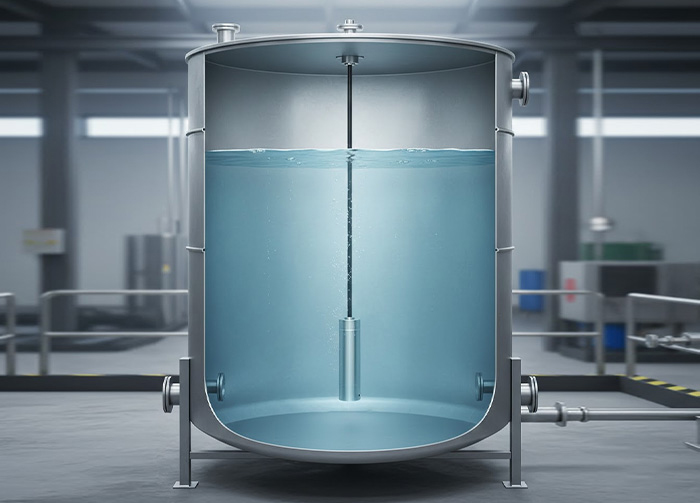
3. Other relevant level sensing technologies and their principles
Beyond hydrostatic and ultrasonic, other options bring distinct advantages. Radar level sensors use microwave pulses and are unaffected by temperature, pressure, or vapor. Capacitive level sensors detect changes in capacitance as the level varies, and they work with both conductive and non-conductive media. Float Sensors offer a simple mechanical solution for point level detection. Magnetostrictive sensors deliver high precision for continuous level measurement, especially in clean liquids. Matching the technology to the application is the key to consistent results.
If you’re interested, check Radar vs. Ultrasonic Level Sensors: A Selection Guide.
Strategic Integration of Level Sensors into Industrial Water Infrastructures
Successful integration starts on the drawing board, continues through careful installation and calibration, and finishes with clean connectivity into control systems. This approach protects performance and extends service life.
1. Planning and design considerations for sensor placement
Placement drives accuracy. Consider vessel geometry, expected obstructions, and the liquid’s behavior. Turbulence, foam, and vapor can skew readings if not accounted for. Plan for mounting positions that reduce interference, allow maintenance access, and stand up to the site conditions.
2. Best practices for installation and calibration of level sensors
Installation and calibration are where accuracy is won or lost. For hydrostatic sensors, ensure full submergence and secure the cable to avoid strain or abrasion. For ultrasonic sensors, set the mounting angle correctly and keep a clear path for the signal. Regular calibration against known reference points verifies performance and corrects drift. In practice, this often calls for the right tools and experienced hands.

3. Connecting sensors to control systems: Analog and digital outputs
Modern level sensors support multiple outputs for integration with control systems. Analog outputs such as 4-20mA provide a continuous signal proportional to level. Digital outputs, including RS485 Modbus RTU or SDI-12, improve data integrity and allow multi-parameter communication. Our PWP412-T3, for instance, provides direct SDI-12 output, which simplifies connections to data loggers and SCADA systems. Choose outputs that match your control architecture and the data resolution you want.
Enhancing Operational Efficiency and Reliability with Advanced Level Sensing
Advanced level sensing tightens operations by feeding real-time data to automation and reducing manual intervention. The result is lower risk and steadier performance.
1. Real-time data acquisition and remote monitoring capabilities
Modern sensors deliver continuous data to a central control room or remote users. This is especially valuable for large facilities or distributed assets. Remote visibility cuts down on site checks, improves safety, and speeds response to alarms. The data stream also supports predictive maintenance plans.

2. Automating processes and preventing overflows or dry runs
Tie level sensors into PLCs or DCSs and you can automate pump starts, valve positions, and alarms using clear thresholds. This prevents overflows and dry runs, keeps operations stable, reduces human error, and uses resources more efficiently.
3. Ensuring compliance and safety through accurate level control
Accurate level control is necessary for regulatory compliance and a safe work environment. Where hazardous liquids or environmental discharge are involved, precise monitoring prevents spills and supports adherence to environmental standards. That proactive stance limits risk and helps avoid penalties.
Selecting the Right Level Sensor Solution for Your Industrial Water System Needs
Choosing the right solution means matching application needs, environmental conditions, and performance targets. A good fit delivers dependable results and solid return on investment.
1. Key factors to consider when choosing a level sensor
When selecting a level sensor, consider several key factors:
1. Liquid Properties: Viscosity, density, corrosiveness, and temperature affect sensor material and technology choice.
2. Measurement Range: Determine the minimum and maximum levels to be measured.
3. Accuracy Requirements: Specify the precision needed for the application.
4. Environmental Conditions: Account for ambient temperature, pressure, vibration, and potential for foam or vapor.
5. Output Signals: Ensure compatibility with existing control systems (e.g., analog, digital, wireless).
6. Installation Constraints: Evaluate available mounting options and space limitations.
7. Maintenance Needs: Consider ease of calibration and cleaning.
8. Cost-Benefit Analysis: Balance initial investment with long-term operational savings and reliability.
2. Pokcenser Automation’s expertise in level measurement solutions
Pokcenser Automation provides robust and accurate level sensors for diverse industrial water applications. Our PWP412-T3 Hydrostatic Water Level and Temperature Transmitter offers high-precision submerged measurement with SDI-12 digital output, ideal for deep wells and tanks. For non-contact solutions, our PWL-U201 and PWL-U202 Ultrasonic sensors feature minimal blind zones and stable readings in challenging environments. We also offer other technologies such as Radar level sensors and magnetostrictive level sensors. Our expertise ensures reliable solutions tailored to specific industrial needs.
3. Customizing solutions for unique industrial water applications
Many industrial water systems present unique challenges that standard offerings cannot fully address. Pokcenser Automation specializes in tailoring level sensor solutions to those requirements. That can include selecting materials for aggressive chemicals, designing mounting hardware for irregular tanks, or integrating advanced communication protocols for complex control architectures. Our engineering team works closely with clients to develop bespoke solutions that optimize performance and reliability.
Request a Consultation for Your Industrial Water System
Optimizing your industrial water system with advanced level sensors can significantly enhance efficiency, safety, and compliance. Contact Pokcenser Automation today to discuss your specific needs and explore our customized solutions. Our team of experts is ready to provide support from initial evaluation to post-installation service.
Phone: +86 181 7515 5326
Email: in**@*******er.com
FAQs
1. What are the primary benefits of integrating advanced level sensors in industrial water systems?
Benefits include tighter process control, lower operating costs through better resource use, improved safety by preventing overflows or dry runs, and stronger compliance with environmental regulations. Real-time data also supports proactive maintenance and faster decision-making.
2. How do environmental factors like temperature and pressure affect level sensor performance?
Environmental conditions can shift performance. Extreme temperatures may cause expansion or contraction in materials, which affects accuracy. High pressure can damage sensor diaphragms. Foam, vapor, and turbulence can interfere with ultrasonic or radar signals. Selecting sensors designed for those conditions reduces these effects.
3. Can existing industrial water systems be upgraded with new level sensor technology?
Yes. Most existing systems can accept new sensors. Modern devices provide flexible integration, including analog 4-20mA and digital RS485 Modbus RTU or SDI-12 outputs that work with many legacy control systems. This allows incremental upgrades without replacing the full system.
4. What kind of maintenance do industrial level sensors require?
Maintenance varies by technology. Hydrostatic sensors may need occasional cleaning to remove buildup on the diaphragm. Ultrasonic sensors benefit from periodic cleaning of the transducer face to keep the signal clear. All types require regular calibration checks to hold accuracy. Set preventive schedules based on the operating environment.
5. How does Pokcenser Automation ensure the accuracy and reliability of its level sensors?
Pokcenser Automation ensures accuracy and reliability through rigorous testing, high-quality material selection, and adherence to international standards. Our sensors include features such as automatic temperature compensation and digital filtering. We also provide thorough technical support and calibration services to maintain performance throughout the sensor’s lifecycle.

