 English
 Spanish
Understanding Level Sensor Response and Diverse Application Scenarios
I have spent enough nights on plant floors to know that level mistakes get expensive fast, whether it is an overflow, an underfill that starves a pump, or a stressed vessel. Accurate level measurement underpins process control, safety, and efficiency across the board. As an industrial automation engineer, I choose sensors by studying how they respond in the real environment they will live in, not just what the datasheet promises. Matching response characteristics to the application is what keeps monitoring reliable and processes running smoothly.
What Are Level Sensors and How Do They Function in Industrial Settings
1. Defining Level Sensors and Their Core Purpose
Level sensors detect and measure the height or presence of liquids, powders, or granular materials in a container or open environment. In industrial settings, their job is to deliver continuous or point-level feedback to control systems so automation can react, spills or shortages are avoided, and operations stay safe. They convert physical level data into electrical signals that a control system can read and act on.
2. Fundamental Principles of Level Measurement Technologies
Level measurement technologies are built on different physical principles, each better suited to certain tasks. You will see hydrostatic pressure, ultrasonic wave propagation, radar signal reflection, electrical capacitance changes, and mechanical displacement. Understanding these mechanisms is key to selecting and deploying the right sensor. Each one interacts differently with the medium and the surrounding environment.
Exploring Key Level Sensor Technologies and Their Response Mechanisms
1. Hydrostatic Level Sensors: Principles, Response, and Applications
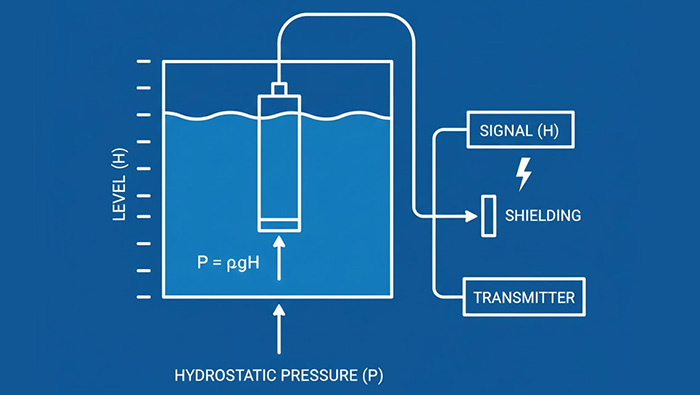
Hydrostatic level sensors measure the pressure from a fluid column, which correlates directly to height. These sensors use a pressure transducer submerged in the liquid. As the liquid level and density rise, the pressure reading increases proportionally. Their response is continuous and highly accurate, especially in calm liquids.
For instance, the PWP412-T3 Hydrostatic Water Level and Temperature Transmitter from Pokcenser Automation uses a diffused piezoresistive silicon sensor to provide precise measurements. This submersible level transmitter is designed for long-term stability in harsh environments, offering IP68 protection and direct SDI-12 output.
Hydrostatic sensors excel in applications like deep well water level monitoring, storage tanks, and reservoirs. They are less affected by foam, vapor, or changes in dielectric constant. However, density variations in the fluid can impact accuracy, requiring compensation if significant. If you’re interested, check 《Submersible Level Transmitters: Key Specs to Check First》.
2. Ultrasonic Level Sensors: Operation, Response Characteristics, and Use Cases
Ultrasonic sensors operate by emitting high-frequency sound waves and measuring the time it takes for the echo to return from the material surface. This time-of-flight reading determines the distance to the surface, and thus the level. These are non-contact sensors, which makes them a strong fit for corrosive, abrasive, or hygienic materials.
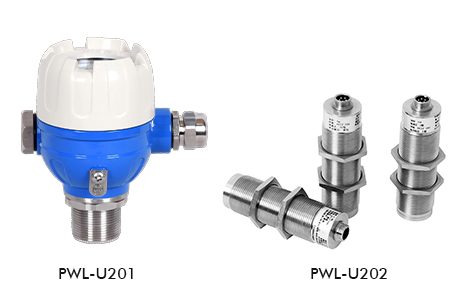
The response of ultrasonic level sensors is generally fast and provides continuous measurement. Accuracy can be influenced by foam on the liquid surface, turbulence, vapor, or notable temperature changes in the air gap above the material. The PWL-U201 and PWL-U202 Small Range Ultrasonic Level Transmitters from Pokcenser Automation are designed with extremely small blind zones and integrated temperature compensation to address these issues, delivering accurate readings even in compact tanks.
ultrasonic level sensors are widely used in Water and Wastewater Treatment plants, food processing, and chemical storage.
3. Other Common Level Sensor Types: Capacitive, Radar, and Float Sensors
Beyond hydrostatic and ultrasonic, several other technologies offer specialized level measurement solutions:
* Capacitive Level Sensors: These sensors measure changes in electrical capacitance caused by the presence of a material between two electrodes or between an electrode and the tank wall. They are robust, have no moving parts, and can detect both point and continuous levels. They are sensitive to changes in the dielectric constant of the material, which can vary with temperature or composition. capacitive level sensors are often chosen for applications involving powders, granules, and liquids with stable dielectric properties. For more information, please refer to 《Capacitive Level Sensors: Principles & Best Use Cases》.
* Radar Level Sensors: Radar level sensors emit microwave pulses toward the material surface and measure the time-of-flight of the reflected signal. Like ultrasonic, they are non-contact but are less affected by temperature, pressure, and vapor. They perform well with challenging media like corrosive liquids or slurries and can penetrate foam. Their performance can be influenced by the dielectric constant of the material and tank obstructions.
* Float Sensors: These are mechanical devices with a buoyant element that rises and falls with the liquid level. The float’s movement actuates a switch or changes a resistive output, providing point or continuous level indication. Float Sensors are simple, reliable, and cost-effective for many liquid applications, especially in non-corrosive environments. They are ideal for basic level alarms or pump control. For a detailed comparison, read 《Hydrostatic vs. Float Sensors: A Cost vs. Accuracy Guide》.
Critical Factors Influencing Level Sensor Selection and Performance
1. Analyzing Environmental Conditions and Material Properties
The operating environment and the properties of the material being measured drive sensor selection. Temperature, pressure, humidity, and the presence of corrosive agents or foam affect durability and accuracy. High-temperature applications call for sensors built with materials and designs that handle heat. Corrosive liquids need sensors with chemically resistant wetted parts.
2. Evaluating Accuracy, Resolution, and Response Time Requirements
Accuracy is how close the reading is to the true level, resolution is the smallest detectable change, and response time is how fast the sensor reacts to changes. Tight processes often demand high accuracy and fast response to keep control within limits and avoid deviations. Less demanding applications may accept lower specifications and lower cost.
3. Considering Installation, Maintenance, and Calibration Needs
Installation effort, maintenance, and calibration frequency shape the total cost of ownership. Non-contact sensors, like radar or ultrasonic level sensors, can be easier to install and maintain than intrusive types. Regular calibration keeps accuracy on target over time, especially where precision matters. The decision between contact and non-contact approaches often comes down to these operational factors.
Real-World Application Scenarios for Various Level Sensor Technologies
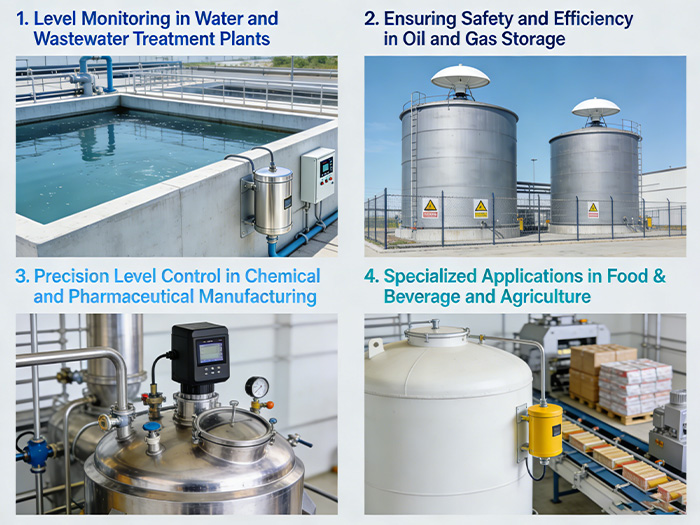
1. Level Monitoring in Water and Wastewater Treatment Plants
In Water and Wastewater Treatment plants, level sensors anchor operations from raw water intake to treated effluent discharge. Hydrostatic sensors are common in clarifiers and sumps because they stay reliable in dirty water, while ultrasonic level sensors watch open channels and chemical dosing tanks. Precise level control prevents overflows, optimizes chemical usage, and supports regulatory compliance.
2. Ensuring Safety and Efficiency in Oil and Gas Storage
The oil and gas industry leans on accurate level measurement for safety, inventory management, and operational efficiency. Radar level sensors are preferred for crude oil and refined product storage tanks because they handle high pressures, extreme temperatures, and hazardous media. These sensors provide continuous, non-contact measurement, necessary for preventing spills and optimizing tank utilization. In hazardous area sensors, explosion-proof certifications are often mandatory.
3. Precision Level Control in Chemical and Pharmaceutical Manufacturing
Chemical and Pharmaceutical manufacturing demand tight precision and hygiene. For corrosive chemicals, non-contact radar or specialized capacitive sensors with chemically resistant materials are a strong fit. In Pharmaceutical Industries, sterile processes often use non-invasive ultrasonic or radar sensors to prevent contamination. Accurate level control keeps ingredient ratios correct and protects product quality.
4. Specialized Applications in Food & Beverage and Agriculture
The food and beverage industry applies level sensors to ingredient tanks, mixing vessels, and finished product storage. Hygienic designs and easy-to-clean materials are non-negotiable. Ultrasonic and capacitive sensors are frequent picks for their non-contact or flush-mount configurations. In agriculture, sensors monitor irrigation water tanks, feed silos, and fertilizer storage to keep resources in check.
Pokcenser Automation’s Advanced Level Sensing Solutions
Pokcenser Automation offers a wide range of level sensing solutions tailored for diverse industrial needs. Our expertise comes from over a decade dedicated to industrial process control automation. We provide robust and reliable instruments that deliver precision and efficiency in your operations.
1. High-Precision Hydrostatic Water Level Transmitters for Submersible Applications
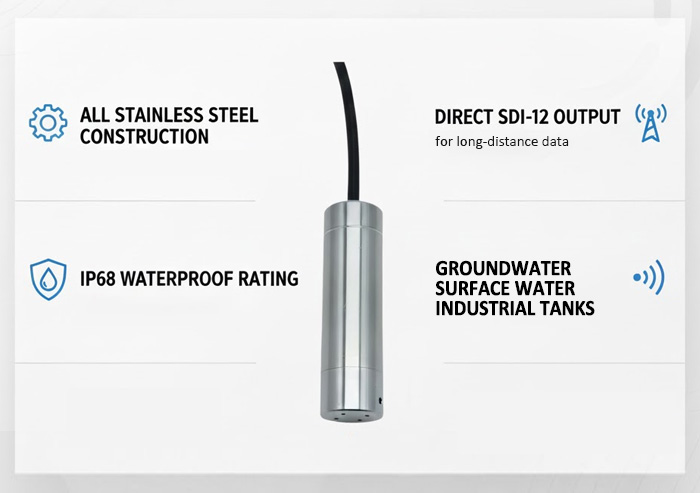
Our PWP412-T3 Hydrostatic Sensors are engineered for demanding submersible applications. These devices provide high-precision water level and temperature measurements with excellent long-term stability. Featuring all-stainless-steel construction and an IP68 submersible level sensors rating, they resist corrosion and moisture, making them ideal for groundwater, surface water, and industrial tanks. The direct SDI-12 output ensures reliable digital communication over long cable lengths.
2. Ultrasonic Level Transmitters for Small Tanks and Challenging Environments
For compact tanks and environments where contact with the medium is undesirable, our PWL-U201 and PWL-U202 Ultrasonic sensors offer strong performance. These transmitters feature an extremely small blind zone, ensuring accurate liquid and solid level measurements even in confined spaces. Integrated temperature compensation and advanced echo recognition algorithms provide stable readings under varying conditions, making them suitable for Chemical Tanks, beverage monitoring, and soap bins.
3. Tailored OEM and ODM Services for Unique Industrial Requirements
We understand that many industrial applications have unique requirements that off-the-shelf solutions cannot meet. Pokcenser Automation specializes in OEM (Original Equipment Manufacturer) and ODM (Original Design Manufacturer) services. Our experienced team collaborates closely with clients to develop customized level sensing solutions, integrating specific features, materials, and communication protocols to match their operational demands. We are committed to creating value and contributing to industrial automation worldwide.
Partner with Pokcenser Automation for Reliable Level Sensing Solutions
Choosing the correct level sensor is critical for optimizing your industrial processes, ensuring safety, and maximizing efficiency. At Pokcenser Automation, we combine over a decade of expertise in sensor manufacturing with a client-centric approach to deliver high-quality, reliable, and customized solutions. Our dedicated pre-sales and after-sales teams provide full support, from initial application evaluation to post-installation service. We aim for long-term partnerships, ensuring you receive the best possible instrumentation for your specific needs.
Contact us today to discuss your level sensing requirements and discover how our advanced solutions can benefit your operations.
Email: in**@*******er.com
Phone: +86 181 7515 5326
FAQs
1. What is the primary difference between contact and non-contact level sensors?
Contact level sensors physically touch the material they measure, such as float or hydrostatic sensors. Non-contact sensors, like ultrasonic or radar, measure levels without direct physical interaction, which suits corrosive, abrasive, or hygienic applications.
2. How does temperature affect the accuracy of level sensor readings?
Temperature can impact accuracy by changing material density for hydrostatic sensors, sound wave velocity for ultrasonic sensors, or dielectric constants for capacitive sensors. Many modern sensors include built-in temperature compensation to reduce these effects.
3. Can level sensors be used for both liquid and solid materials?
Yes, many types can measure both liquids and solids. Ultrasonic and radar sensors are versatile for both, while hydrostatic sensors are primarily for liquids. Capacitive sensors can handle both, but material properties like dielectric constant matter for solids.
4. What communication protocols are commonly supported by modern level sensors?
Modern level sensors often support various communication protocols for easy integration into control systems. Common options include 4-20mA analog output, RS485 Modbus RTU, HART, and increasingly, wireless choices like NB-IoT or LoRa for remote monitoring.
5. How often should industrial level sensors be calibrated?
Calibration frequency depends on sensor type, application criticality, environmental conditions, and required accuracy. High-precision applications or harsh environments may require more frequent calibration, for example annually, while others can go longer. Regular checks and manufacturer guidelines should set the schedule.

