 English
 Spanish
Achieving Precision: High-Accuracy Flow Meters for Automation Control
In the field of industrial automation, I have come to understand that accurate flow measurement is a crucial, behind-the-scenes factor in ensuring uninterrupted production processes and stable product quality. Even a single incorrect reading—for example, in a critical ingredient mixing stage—can trigger a chain reaction throughout the entire factory, leading to wasted materials and time. Therefore, when our clients select and integrate the appropriate equipment, they see smaller deviations, more predictable processes, and reduced operating costs—results that are not only reflected on the control panel but also translate directly into tangible profits.
The crucial role of flow meters in industrial automation
1.Understanding the need for precise flow measurement
Modern automation technology demands extremely high precision, especially in the field of fluid dynamics. Accurate flow measurement enables optimized resource utilization, ensures consistent product performance, and meets stringent control standards. Industries such as chemical, pharmaceutical, and water treatment all rely on accurate flow meters to reduce waste and comply with relevant regulations. Any deviation in flow data is not expected to be localized but rather to snowball, leading to conflicts, inventory losses, and product losses. As automation systems become increasingly complex, the demand for high-quality flow meters is growing rapidly.
2. How does inaccurate data flow affect automated control systems
Unreliable flow data severely undermines the foundation of automated systems: the control loop. Failure to input accurate data leads to loop instability, resulting in over- or under-dosing in reactions and imbalanced mixing ratios. The consequences are significant: product quality issues, increased energy consumption, and unnecessary equipment damage. Furthermore, it disrupts predictive maintenance, increasing the risk of unexpected failures and prolonged downtime. In our experience, reliable measurement is the cornerstone of reliable automation.
Explore types of flow meters suitable for various applications
1.Flow meter: Non-invasive access solution
Electromagnetic flowmeters provide a non-invasive, gapless measurement method, particularly suitable for situations where pipe cutting is not possible. They operate by transmitting through the fluid and calculating flow based on time-of-flight differences or frequency shifts. The clamp-on design simplifies installation and maintenance. Pokcenser Automation offers two models, the PWF-U2000MCC (multi-channel clamp-on) and PWF-U2000MCI (multi-channel insertion type), pre-calibrated to ±0.5% FS in dual-channel and four-channel configurations. For small diameter pipes (DN15–DN40), the PWF-U1000 is specifically designed for such applications, with an accuracy of ±2% (adjustable to ±1%). These instruments can measure a variety of liquids, including water, seawater, wastewater, acids, alkalis, alcohol, beer, and oils, with a measurement temperature range of -30 ℃ to 160 ℃.
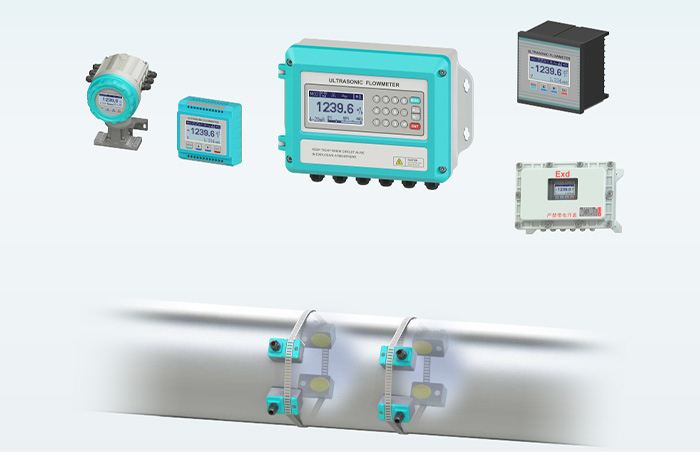
2.Metal tube flow meter: Reliable measurement suitable for database environments
Metal tube flow meters are designed for demanding operating conditions and can withstand high temperatures, high pressures, and corrosive media. Pokcenser Automation’s LZ metal tube flow meters offer an accuracy of 1.5% or 2.5% and can handle flow rates up to 100,000 liters per hour for water and up to 1000 cubic meters per hour. Optional configurations include an LCD display for showing instantaneous and cumulative flow rates. These flow meters are widely used in industries such as petroleum, power generation, and metallurgy, providing long-lasting durability and stable performance even under stringent operating conditions.
3.Plastic tube flow meters: an economical, efficient, and corrosion-resistant option
For cost-sensitive applications requiring resistance to chemical corrosion, LZS series plastic tube flow meters are an ideal choice. Made from AS or PC tubing, they are robust, durable, and have a long service life. The transparent tube allows for visual inspection. With a typical accuracy of ±4%, they are well-suited for industries such as chemical, light industry, pharmaceutical, food processing, and wastewater treatment. Furthermore, they are resistant to acids, alkalis, and general corrosion, ensuring reliable operation even in applications where high integrity is not critical or in complex operating environments.
Key characteristics and technologies affecting the accuracy of flow meters
1.Advanced sensor technology for reliable data acquisition
Current flow meters utilize precise sensing elements and signal processing techniques to reduce phase and improve stability. For example, targeted flow measurement employs mixed-signal processing techniques to protect against interference. Similarly, the PCS3740PCD digital conductivity/total dissolved solids/salinity sensor uses a 2-electrode or 4-electrode design to reduce ion cloud interference, thereby obtaining accurate conductivity, total dissolved solids, and salinity readings. These technological advancements provide a reliable data foundation for automated systems.
2. The importance of communication protocols in automation integration
Successful integration depends on communication. Industrial standards such as Modbus RTU and 4–20 mA ensure real-time data transmission between PLC and DCS platforms. Pokcenser’s PWF-U2000MCC and PWF-U2000MCI nozzle flow meters are equipped with isolated RS485 interfaces, supporting the MODBUS protocol for stable and reliable data transmission. This connectivity enables centralized monitoring, remote control, and data logging, thereby improving response speed and overall efficiency.
3.Temperature compensation and adjustment are performed to ensure consistent performance
Temperature fluctuations can alter fluid properties and potentially lead to inaccurate measurement results. Therefore, temperature compensation is crucial for gap flow meters. Devices such as the PT6500 inline flow meter controller and the PCS1753CD plastic pH sensor offer automatic or manual temperature compensation to ensure consistent readings under varying operating conditions. Regular wiring checks (usually automated) help maintain long-term connections and protect data integrity.
If you are interested, please refer to “13 Reasons Why High-Accuracy Gas Measurement with Thermal Mass Flow Meters Matters in Modern Industry“.
How to choose the right flow meter for your automation needs?
1. Evaluate specific application requirements and environmental factors
The best instrument is the one that matches the application. Fluid type, temperature, pressure, and chemical compatibility should be considered first. Corrosive media require corrosion-resistant materials; high-temperature environments typically require metal construction. Environmental factors—such as electromagnetic interference sources, hazardous areas, and installation limitations—also influence instrument selection. Considering these factors first helps ensure safer, more reliable, and more accurate performance.
2. Consider integration with existing automated control systems
Seamless operation depends on good integration. Please ensure that the instrumentation and control systems use the same protocol—4-20 mA and RS485 Modbus RTU remain common standards. Explicit control logic requires specific output types—analog, pulse, or relay outputs—for easy commissioning, and clear data can be used immediately in your PLC, DCS, or SCADA environment.
3.The value of expert support and customization in flow meter selection.
Complex problems require expert guidance. Experienced suppliers can help you weigh the pros and cons, mitigate risks, and customize configurations. Pokcenser Automation has over ten years of experience providing end-to-end support for customer processes—from evaluating applications and recommending solutions to offering OEM and ODM options when special needs require custom design. This is the difference between “suitable” and “perfect.”
Using flow meters to improve operational efficiency
1.Optimize process control and resource management
Flow meters, by providing accurate real-time data, enable more precise control of dosing, mixing, and consumption. Their advantages primarily include: reduced raw material waste, improved energy efficiency, and increased production efficiency. For example, in the water and wastewater treatment sector, accurate flow data can guide smarter chemical dosing and aeration strategies, thereby improving treatment effectiveness while lowering operating costs.
2.Reduce maintenance and repair time through reliable measurements
Continuous and stable measurements help detect anomalies early, preventing them from escalating into failures that disrupt production. Furthermore, the inherent durability of high-quality instruments such as LZ metal tube flowmeters reduces unplanned maintenance and extends maintenance cycles. This minimizes unexpected incidents and increases uptime.
3.Ensuring compliance and safety in industrial operations
Accuracy is also crucial for safety and compliance. Many processes involve hazardous materials, and wastewater treatment procedures are very stringent. Accurate flow data helps maintain these wastewater processes, thereby protecting both people and the environment. For example, in chemical processing, maintaining precise control of reactant flow can prevent dangerous exothermic reactions. Our flow meters are designed to meet our rigorous standards, supporting safer and more compliant operations.
If you are interested, please refer to “Safety in Hazardous Areas: Using Explosion-Proof Sensors“.
Partner with Pokcenser Automation to obtain precise fluid solutions
Reliable flow measurement is key to the precise operation of your industrial automation. Pokcenser Automation offers a full range of flow measurement products and expert solutions to meet your specific needs. Our team is dedicated to providing a one-stop, worry-free service, from initial application assessment to ongoing support. Contact us to optimize your automation processes with our advanced flow measurement technology.
Email: in**@*******er.com
Phone: +86 181 7515 5326
FAQs
1. In industrial automation, what is a “process” flow meter?
In-line flow meters typically offer a measurement uncertainty of ±1%, or even as low as ±0.5% or ±0.1% of full scale or reading. This accuracy is crucial, as even small errors can impact quality, safety, or cost. Repeatability, linearity, and long-term stability are also essential minimum standards.
2.What are the differences in accuracy and applications between different types of flow meters (welded flow meters, metal tube flow meters, and plastic tube flow meters)?
Nozzle flow meters offer high accuracy (e.g., ±0.5% FS), require specific installation, and are suitable for various liquids and pipe sizes. Metal pipe flow meters prioritize durability, capable of handling harsh environments (temperature/pressure/corrosion), with an accuracy of approximately 1.5% to 2.5%. Plastic pipe flow meters are more economical, highly corrosion-resistant, and typically have an accuracy of around ±4%, suitable for applications with less stringent chemical requirements but more complex operating conditions.
3. Can the traffic management plan be integrated with existing automated control systems?
Most high-precision instruments support 4-20 mA analog output and industrial protocols such as RS485 Modbus RTU, enabling real-time communication with PLCs, DCSs, and SCADA systems for centralized monitoring.
4. What factors should be considered when selecting a data plan?
Factors to consider include fluid type (liquid, gas, or steam), operating temperature and pressure, required accuracy, compatibility with the contact medium, pipe size, installation constraints (intrusive or non-intrusive), supported communication protocols, and budget. Environmental factors—such as hazardous area classification or electromagnetic interference—also influence the selection.
5. How does temperature affect the accuracy of a flow meter? How can this be compensated for?
Temperature changes can alter the density and viscosity of the fluid, leading to inaccurate readings. Differential pressure flow meters address this problem through built-in temperature compensation, typically using integrated sensors (such as PT100/PT1000) that transmit real-time temperature data to a correction algorithm. Regular adjustments ensure the long-term stability of the flow meter’s performance.

