 Inglés
 Español
Common Causes of Pressure Transmitter Failure and How to Prevent Them
Pressure transmitters are among the most widely used instruments in industrial automation. They provide continuous pressure measurement for liquids, gases, and steam across industries such as water treatment, oil and gas, chemical processing, food and beverage, and power generation.
Although modern pressure transmitters are highly reliable, improper installation, harsh operating conditions, or inadequate maintenance can lead to premature failure. Understanding the common causes of failure can help reduce downtime, lower maintenance costs, and improve overall system reliability.
In this guide, we’ll examine the most frequent pressure transmitter problems and explain how to prevent them.
How Does a Pressure Transmitter Work?
A pressure transmitter converts the pressure of a process medium into an electrical signal, such as 4–20mA, RS485 Modbus RTUo Comunicación HART, allowing the measurement to be transmitted to PLCs, SCADA systems, or controllers.
Inside the transmitter, a sensing element detects pressure changes and converts them into a stable electrical output. Because the sensing element is highly sensitive, proper protection and installation are essential.
Failure Cause 1: Overpressure
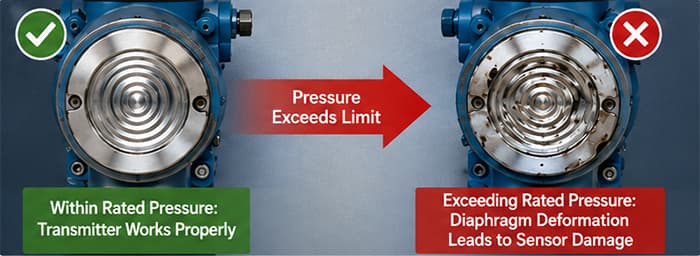
Overpressure is one of the most common reasons for pressure transmitter damage.
When process pressure exceeds the transmitter’s maximum rated pressure, the sensing diaphragm may become permanently deformed, resulting in inaccurate readings or complete failure.
Common Causes
- Incorrect pressure range selection
- Pressure spikes during system startup
- Pump discharge surges
- Valve switching operations
Prevention Tips
- Select a transmitter with an appropriate pressure range.
- Install pressure snubbers or surge protectors where pressure spikes are expected.
- Avoid exposing the transmitter to pressures beyond its overload rating.
Failure Cause 2: Water Hammer
Water hammer occurs when a flowing liquid suddenly stops or changes direction, creating a pressure shock wave inside the pipeline.
This sudden pressure surge can exceed the normal operating pressure many times over.
Typical Situations
- Rapid valve closure
- Pump start/stop
- Long pipeline systems
- Fast-acting solenoid valves
Prevention Tips
- Close valves gradually whenever possible.
- Install water hammer arrestors.
- Position pressure transmitters away from areas prone to severe hydraulic shock.
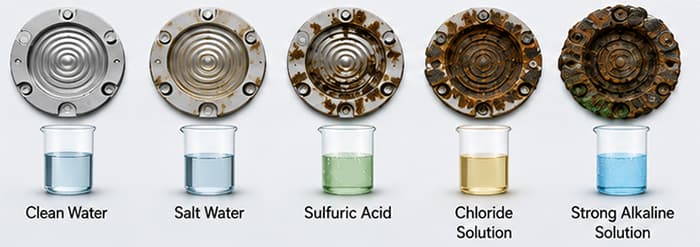
Failure Cause 3: Corrosive Process Media
Not every pressure transmitter is suitable for corrosive liquids or gases.
Aggressive chemicals may damage diaphragms, seals, or process connections, leading to leakage and inaccurate measurements.
Typical Corrosive Media
- Sulfuric acid
- Hydrochloric acid
- Sodium hydroxide
- Chlorine-containing solutions
- Agua de mar
Prevention Tips
- Choose diaphragm materials compatible with the process medium.
- Consider remote diaphragm seal transmitters for highly corrosive applications.
- Review chemical compatibility before installation.
Failure Cause 4: Incorrect Installation Location
Installation location has a significant impact on measurement stability and sensor lifespan.
Common Installation Mistakes
- Mounting near strong vibration sources
- Installing close to high-temperature equipment without protection
- Exposing electrical connections to standing water
- Mounting where maintenance access is difficult
Prevention Tips
- Follow the manufacturer’s installation recommendations.
- Keep transmitters away from excessive vibration.
- Use sunshields or insulation where high ambient temperatures are present.
- Ensure cable glands and conduit entries are properly sealed.
Failure Cause 5: Electrical Problems
Electrical issues can damage transmitters or cause unstable output signals.
Typical Problems
- Incorrect wiring
- Reversed polarity
- Unstable power supply
- Mala conexión a tierra
- Electromagnetic interference (EMI)
Prevention Tips
- Follow the wiring diagram carefully.
- Use shielded cables where required.
- Ensure proper grounding.
- Verify supply voltage before energizing the transmitter.
Failure Cause 6: Moisture Ingress
Moisture entering the housing can lead to corrosion of electronic components, communication failures, and sensor damage.
This problem is especially common in:
- Outdoor installations
- Depuradoras de aguas residuales
- Coastal environments
- High-humidity process areas
Prevention Tips
- Select transmitters with an appropriate IP protection rating.
- Tighten cable glands correctly.
- Inspect seals regularly during maintenance.
- Replace damaged gaskets promptly.
Failure Cause 7: Process Temperature Beyond Specification
Pressure transmitters are designed to operate within specified process and ambient temperature limits.
Excessive temperatures may affect:
- Precisión de la medición
- Sensor stability
- Electronic components
- Seal materials
Prevention Tips
- Verify process temperature before selecting a transmitter.
- Use cooling elements or impulse lines for high-temperature steam applications.
- Choose models designed for elevated temperatures when necessary.
Failure Cause 8: Lack of Periodic Calibration
Even high-quality pressure transmitters may experience slight measurement drift over time.
Without calibration, accumulated errors can affect product quality and process control.
Recommended Practice
Calibration intervals depend on:
- Process criticality
- Industry regulations
- Operating environment
- Manufacturer recommendations
For critical applications, annual calibration is commonly recommended.
Signs That a Pressure Transmitter May Be Failing
Watch for these warning signs:
- Unstable readings
- Output signal fluctuations
- Slow response time
- Unexpected zero shift
- Communication errors
- Frequent alarm activation
- Output remaining fixed despite pressure changes
Early detection helps prevent costly downtime.
Recommended Pressure Transmitter Solutions
PWP3051 Smart Pressure Transmitter
Suitable for demanding industrial process control applications requiring high accuracy and long-term stability.
Typical applications include:
- Tratamiento químico
- Tratamiento del agua
- Producción de alimentos y bebidas
- Petróleo y gas
- General industrial automation
Transmisor de presión diferencial de silicio monocristalino inteligente PWP3051DP
Recommended for:
- Differential pressure measurement
- Filter monitoring
- Closed tank level measurement
- Steam applications
- Process control systems
Its high accuracy and excellent long-term stability make it suitable for critical industrial processes.
Best Practices to Extend Pressure Transmitter Service Life
To maximize reliability:
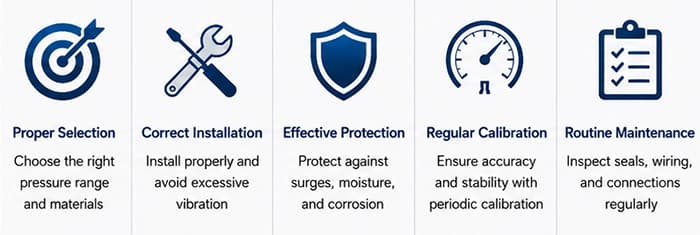
- Select the correct pressure range.
- Choose materials compatible with the process medium.
- Protect against pressure surges.
- Avoid excessive vibration.
- Prevent moisture ingress.
- Calibrate periodically.
- Inspect wiring and electrical connections during routine maintenance.
- Follow the manufacturer’s installation guidelines.
A properly selected and maintained transmitter can provide many years of reliable operation.
¿Por qué elegir Pokcenser?
Pokcenser manufactures industrial pressure measurement solutions for customers worldwide.
Our pressure transmitters are widely used in:
- Tratamiento del agua y de las aguas residuales
- Tratamiento químico
- Petróleo y gas
- Alimentación y bebidas
- Sistemas de calefacción, ventilación y aire acondicionado
- General industrial automation
Proporcionamos:
- CE-certified products
- Servicios OEM y ODM
- Professional application support
- Precios de fábrica competitivos
- Technical assistance before and after sales
Preguntas frecuentes
Q1: What is the most common cause of pressure transmitter failure?
Overpressure is one of the leading causes, followed by corrosion, water hammer, moisture ingress, and improper installation.
Q2: How often should pressure transmitters be calibrated?
Calibration frequency depends on the application. Critical industrial processes often require annual calibration, while less demanding applications may allow longer intervals.
Q3: Can water hammer permanently damage a pressure transmitter?
Yes. Repeated hydraulic shock can deform the sensing diaphragm and shorten the transmitter’s service life.
Q4: How can I protect a pressure transmitter from corrosion?
Select wetted materials compatible with the process medium and consider diaphragm seal transmitters for highly corrosive applications.
Q5: How can I extend the lifespan of a pressure transmitter?
Proper range selection, correct installation, surge protection, routine inspection, and regular calibration are the most effective ways to maximize service life.
