 Inglés
 Español
Radar Level Sensor vs Ultrasonic Level Sensor: Which Is the Better Choice for Industrial Level Measurement?
When selecting a non-contact level measurement solution, engineers and procurement managers often face a common question:
Should I choose a Radar Level Sensor or an Ultrasonic Level Sensor?
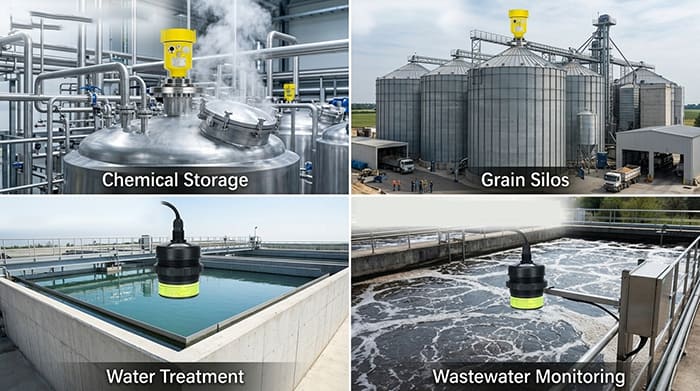
Both technologies are widely used in industrial applications such as water treatment, chemical storage, fuel tanks, grain silos, and wastewater monitoring. However, their performance can vary significantly depending on environmental conditions, measurement range, and process requirements.
Choosing the wrong technology may result in inaccurate readings, increased maintenance costs, process downtime, and unnecessary equipment replacement.
In this guide, Pokcenser compares Radar Level Sensors and Ultrasonic Level Sensors in detail, helping you determine which solution is best suited for your application.
What Is a Radar Level Sensor?
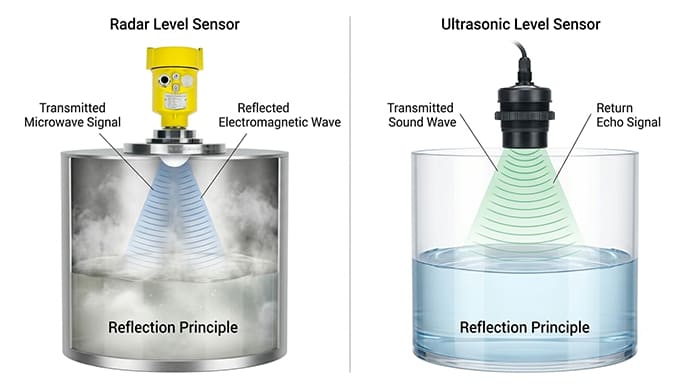
A Radar Level Sensor measures level by transmitting high-frequency microwave signals toward the surface of a liquid or solid material. The sensor receives the reflected signal and calculates the distance based on the time-of-flight principle.
Modern 80GHz FMCW radar technology has become the preferred solution for demanding industrial applications due to its:
- Gran precisión de medición
- Strong resistance to vapor and dust
- Long measuring range
- Stable performance in harsh environments
- Low maintenance requirements
Radar level sensors are commonly used in:
- Chemical storage tanks
- Depósitos de combustible
- Pharmaceutical processing
- Producción de alimentos y bebidas
- Silos de cemento
- Grain storage facilities
- Water resource monitoring
What Is an Ultrasonic Level Sensor?
An Ultrasonic Level Sensor uses sound waves instead of microwaves. The sensor emits ultrasonic pulses toward the material surface and calculates the level by measuring the return time of the echo.
Ultrasonic sensors are popular because they offer:
- Menor inversión inicial
- Fácil instalación
- Reliable performance in clean environments
- Simple maintenance
Typical applications include:
- Depósitos de agua
- Depuradoras de aguas residuales
- Embalses
- Sistemas de riego
- Open channel monitoring
- Lift stations
For many municipal and environmental projects, ultrasonic technology remains a highly cost-effective solution.
Radar Level Sensor vs Ultrasonic Level Sensor: Key Differences
| Característica | Sensor de nivel radar | Sensor de nivel ultrasónico |
| Measuring Technology | Microwave | Sound Wave |
| Typical Accuracy | Up to ±1 mm | ±0,5% FS |
| Effect of Temperature | Mínimo | Moderado |
| Effect of Vapor | Muy bajo | Alta |
| Effect of Dust | Muy bajo | Alta |
| Foam Resistance | Excelente | Limitado |
| Pressure Vessel Applications | Suitable | No recomendado |
| Long Distance Measurement | Excelente | Moderado |
| Frecuencia de mantenimiento | Muy bajo | Bajo |
| Coste de compra inicial | Más alto | Lower |
While ultrasonic sensors offer attractive pricing, radar sensors generally provide better long-term performance and reliability in industrial environments.
How Environmental Conditions Affect Performance
One of the biggest differences between radar and ultrasonic technologies is their response to environmental factors.
Vapor and Steam
In chemical processing plants, food manufacturing facilities, and heated storage tanks, steam and vapor are common.
Because ultrasonic sensors rely on sound waves traveling through air, changes in air density can significantly affect measurement accuracy.
Radar sensors use electromagnetic waves and are largely unaffected by vapor, making them the preferred choice for these environments.
Dust and Powder
Applications such as:
- Silos de cemento
- Fly ash storage
- Grain silos
- Plastic pellet storage
often generate large amounts of dust.
Dust can weaken ultrasonic signals and create unstable readings. Radar sensors are far more resistant to dust interference and provide reliable measurements even in challenging bulk solids applications.
Condensation and Foam
Foam and condensation are common in wastewater treatment and chemical storage.
Radar technology generally performs much better under these conditions, reducing false echoes and measurement errors.
Application Comparison: Which Technology Fits Your Industry?
Tratamiento de aguas y aguas residuales
Recommended Solution: Ultrasonic Level Sensor
For open tanks, reservoirs, sewage systems, and municipal water facilities, ultrasonic sensors offer excellent value.
Advantages include:
- Lower equipment cost
- Fácil instalación
- Sufficient accuracy for most water applications
Chemical Storage Tanks
Recommended Solution: Radar Level Sensor
Chemical tanks frequently contain:
- Corrosive vapors
- Condensation
- Temperature fluctuations
Radar sensors maintain stable performance despite these challenges.
Oil and Fuel Storage
Recommended Solution: Radar Level Sensor
Fuel storage tanks often experience:
- Vapor accumulation
- Pressure variations
- Condensation
Radar technology provides greater reliability and accuracy over time.
Grain and Cement Silos
Recommended Solution: Radar Level Sensor
Dust and uneven material surfaces make radar the preferred technology for bulk solids level measurement.
Rivers, Reservoirs, and Environmental Monitoring
Both technologies can be effective.
Choose:
- Ultrasonic sensors for budget-sensitive projects
- Radar sensors when maximum accuracy and long-term stability are required
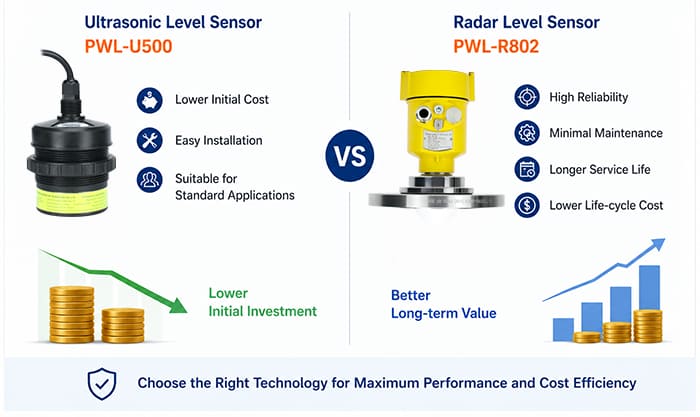
Radar vs Ultrasonic Level Sensor Cost Comparison
Many buyers focus only on the purchase price, but evaluating the Total Cost of Ownership (TCO) provides a more accurate comparison.
Ultrasonic Sensor Costs
Ventajas:
- Lower initial purchase cost
- Simple setup
- Cost-effective for standard applications
Potential drawbacks:
- More susceptible to environmental interference
- Increased maintenance in difficult conditions
- Potential measurement instability
Radar Sensor Costs
Ventajas:
- Mantenimiento mínimo
- Longer service life
- Higher reliability
- Reducción del tiempo de inactividad
Potential drawbacks:
- Higher upfront investment
For critical industrial processes, radar sensors often deliver a lower overall lifecycle cost despite the higher initial purchase price.
How to Choose the Right Level Sensor
Before making a purchasing decision, consider the following questions:
Choose an Ultrasonic Level Sensor If:
✓ Your budget is limited
✓ Measuring clean water or wastewater
✓ No significant vapor or dust is present
✓ Tank pressure is atmospheric
✓ Measurement distance is relatively short
Choose a Radar Level Sensor If:
✓ High accuracy is required
✓ Vapor, steam, or condensation exists
✓ Dusty environments are present
✓ Long measurement range is needed
✓ Measuring chemicals, fuels, or bulk solids
✓ Process reliability is critical
Recommended Pokcenser Solutions
Pokcenser Radar Level Sensors
Ideal for:
- Depósitos químicos
- Fuel storage
- Bulk solids silos
- High-temperature applications
- Industrial process automation
Key benefits:
- 80GHz FMCW technology
- Alta precisión
- Strong anti-interference capability
- Multiple communication options
Pokcenser Ultrasonic Level Sensors
Ideal for:
- Tratamiento del agua
- Reservoir monitoring
- Proyectos medioambientales
- Sistemas de riego
Key benefits:
- Rentable
- Fácil instalación
- Reliable operation
- Bajo mantenimiento
¿Por qué elegir Pokcenser?
Pokcenser has more than 10 years of experience in industrial process automation and level measurement solutions.
Customers worldwide choose Pokcenser because we provide:
- Factory-direct pricing
- Professional technical support
- Servicios OEM y ODM
- Fast delivery
- CE-compliant products
- Reliable quality control
Whether you need a radar level sensor for a chemical tank or an ultrasonic sensor for a water treatment facility, our engineering team can help you select the most suitable solution.
Preguntas frecuentes
Which is more accurate: radar or ultrasonic?
Radar sensors generally provide higher accuracy. Modern 80GHz radar technology can achieve accuracy as high as ±1 mm.
Can ultrasonic sensors work in steam environments?
Steam can significantly affect ultrasonic measurements. Radar sensors are recommended for these applications.
Are radar level sensors worth the higher price?
For demanding industrial environments, radar sensors often provide lower maintenance costs and greater reliability, resulting in a better long-term return on investment.
Which sensor is best for grain silos?
Radar level sensors are strongly recommended because they are less affected by dust and uneven material surfaces.
Which sensor should I choose for wastewater treatment?
For most wastewater applications, ultrasonic sensors provide excellent performance and value. However, radar may be preferred where foam, condensation, or high accuracy requirements exist.
Request a Quote from Pokcenser
Selecting the right level measurement technology can improve process efficiency, reduce maintenance costs, and increase operational reliability.
Whether you need an 80GHz Radar Level Sensor for a chemical storage tank or an Ultrasonic Level Sensor for a water treatment project, Pokcenser can provide a tailored solution based on your specific application requirements.
Contact Pokcenser today to discuss your project and receive a customized quotation from our engineering team.
