 Inglés
 Español
Water Quality Monitoring in Food and Beverage Production: Why Accurate pH Measurement Matters
In the food and beverage industry, product quality and food safety depend heavily on precise process control. Among the many parameters monitored during production, pH is one of the most important.
Whether producing dairy products, soft drinks, beer, bottled water, sauces, or processed foods, accurate pH measurement helps manufacturers maintain product consistency, optimize cleaning processes, and comply with strict food safety standards.
This article explains why pH monitoring is critical in food and beverage manufacturing and how Pokcenser industrial pH sensors help ensure reliable and accurate measurements.
Why pH Monitoring Is Important in Food Processing
pH directly affects many aspects of food production.
Product Quality
Incorrect pH values can impact:
- Flavor
- Color
- Texture
- Shelf life
Even small pH variations may lead to product inconsistency and customer complaints.
Food Safety
Many harmful microorganisms grow more easily within specific pH ranges.
Accurate pH control helps manufacturers:
✔ Maintain food safety standards
✔ Reduce contamination risks
✔ Meet HACCP requirements
✔ Improve production consistency
Cumplimiento de la normativa
Food manufacturers must often document and control critical process parameters, including pH values, to comply with local and international regulations.
Common pH Monitoring Applications in Food and Beverage Plants
Beverage Production
In products such as:
- Soft drinks
- Zumo de frutas
- Energy drinks
- Beer
- Wine
pH measurement ensures consistent taste and product stability.
Dairy Processing
Milk, yogurt, cheese, and fermented products require precise pH control throughout production.
Sauce and Condiment Manufacturing
Products such as ketchup, soy sauce, and salad dressing rely on controlled acidity levels for flavor and preservation.
Water Treatment Systems
Many food factories monitor pH within:
- Process water systems
- Purified water systems
- Wastewater treatment facilities
CIP Cleaning Systems
One of the most critical applications is Clean-In-Place (CIP) cleaning.
Accurate pH monitoring helps verify cleaning effectiveness and optimize chemical consumption.
Challenges of pH Measurement in Food Production
Food manufacturing environments can be demanding.
Common challenges include:
Frequent Cleaning Cycles
Sensors are repeatedly exposed to:
- Acid cleaning agents
- Alkali cleaning solutions
- Hot water
Product Residue
Food particles may accumulate on sensor surfaces and affect measurement accuracy.
High Temperature Processes
Many production lines operate at elevated temperatures.
Strict Hygiene Requirements
Sensors must support sanitary operation and easy cleaning.
For these reasons, selecting the right industrial pH electrode is essential.
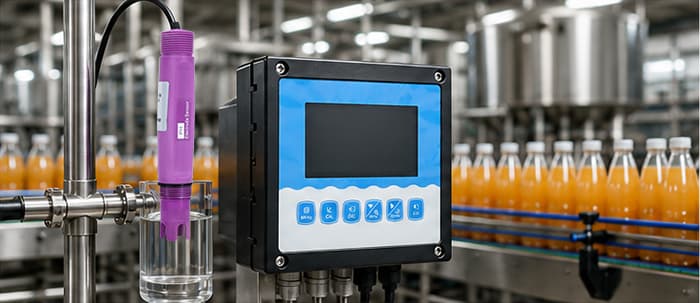
Recommended Product: Pokcenser PCS1755C Flat pH Electrode
The PCS1755C is designed for demanding industrial process applications where reliability and long-term stability are required.
Características principales
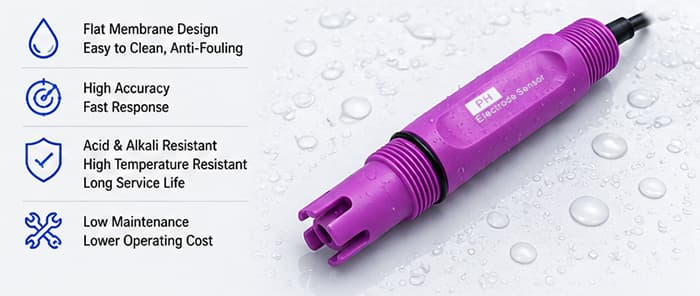
- Flat membrane design
- Excellent anti-fouling performance
- Fast response time
- Gran precisión de medición
- Suitable for wastewater and food processing applications
- Easy maintenance
Aplicaciones típicas
- Food processing plants
- Beverage production lines
- Sistemas de tratamiento de aguas residuales
- CIP cleaning systems
- Industrial process monitoring
The flat electrode structure helps reduce fouling from product residues, making it particularly suitable for food manufacturing environments.
Why Flat pH Electrodes Are Better for Food Applications
Traditional bulb-type pH electrodes can accumulate deposits during operation.
Flat-surface electrodes provide several advantages:
Easier Cleaning
The flat sensing surface reduces buildup and simplifies maintenance.
Improved Hygiene
The design supports cleaner operation in sanitary applications.
Better Resistance to Fouling
Food particles and process residues are less likely to affect measurement accuracy.
Longer Service Life
Reduced contamination helps extend sensor performance and reliability.
These benefits make flat pH electrodes increasingly popular in food and beverage facilities.
pH Monitoring in CIP Cleaning Systems
Clean-In-Place systems are used extensively throughout the food industry.
A typical CIP cycle involves:
- Pre-rinse
- Caustic cleaning
- Intermediate rinse
- Acid cleaning
- Final rinse
Accurate pH measurement helps operators:
✔ Verify cleaning chemical concentration
✔ Ensure complete rinsing
✔ Reduce chemical consumption
✔ Improve cleaning efficiency
✔ Minimize production downtime
Using a reliable industrial pH sensor significantly improves CIP process control.
Benefits of Continuous Online pH Monitoring
Many facilities still rely on manual sampling.
Online monitoring provides several advantages:
Real-Time Data
Operators receive immediate process information.
Improved Product Consistency
Continuous monitoring helps maintain stable production conditions.
Reduced Labor Costs
Automated monitoring minimizes manual testing requirements.
Better Process Control
Real-time feedback supports faster operational decisions.
Cumplimiento de la normativa
Automatic data collection simplifies documentation and auditing.
¿Por qué elegir Pokcenser?
Pokcenser has specialized in industrial process automation and sensor manufacturing for over 10 years.
Today, our products are used in more than 100 countries across industries including:
- Alimentación y bebidas
- Tratamiento del agua
- Tratamiento químico
- Pharmaceutical manufacturing
- Control medioambiental
Advantages of Working with Pokcenser
✔ CE, ISO, ATEX, and RoHS certified products
✔ OEM & ODM support
✔ Professional technical consultation
✔ Fast response from pre-sales and after-sales teams
✔ Competitive factory-direct pricing
✔ One-stop instrumentation solutions
Preguntas frecuentes
Q1: Why is pH important in food production?
pH affects product quality, flavor, shelf life, and food safety. Maintaining accurate pH values helps ensure consistent production results.
Q2: What is the advantage of a flat pH electrode?
Flat pH electrodes are easier to clean, resist fouling, and perform better in applications containing suspended solids or sticky residues.
Q3: Can the PCS1755C be used in CIP systems?
Yes. The PCS1755C Flat pH Electrode is suitable for CIP cleaning process monitoring and industrial wastewater applications.
Q4: How often should a pH electrode be calibrated?
Calibration frequency depends on process conditions, but regular calibration is recommended to maintain measurement accuracy.
Q5: Can pH sensors be integrated with PLC systems?
Yes. Pokcenser pH monitoring solutions can be integrated with industrial control systems through standard transmitter outputs.
Conclusión
Accurate pH monitoring is essential for maintaining product quality, food safety, and operational efficiency in food and beverage manufacturing.
From beverage production and dairy processing to CIP cleaning systems, reliable pH measurement helps manufacturers reduce costs, improve consistency, and comply with industry regulations.
For demanding food processing applications, the PCS1755C Electrodo plano de pH offers excellent anti-fouling performance, reliable accuracy, and long-term stability.
Contact Pokcenser today to discuss your food processing application and receive a customized pH monitoring solution.
