 Inglés
 Español
Electromagnetic Flow Meter vs Ultrasonic Flow Meter: Which One Should You Choose?
Flow measurement is essential in industries such as water treatment, wastewater management, chemical processing, food production, HVAC systems, and energy management.
Two of the most widely used technologies today are electromagnetic flow meters and ultrasonic flow meters.
Although both can provide accurate flow measurement, they operate differently and are suitable for different applications.
In this guide, we compare electromagnetic and ultrasonic flow meters to help engineers, plant managers, and purchasing professionals choose the best solution for their projects.
What Is an Electromagnetic Flow Meter?
An electromagnetic flow meter (Mag Meter) measures the flow of conductive liquids using Faraday’s Law of Electromagnetic Induction.
When a conductive liquid flows through a magnetic field, a voltage signal is generated and converted into a flow rate measurement.
Recommended Product
Caudalímetro electromagnético de inserción PWF-E1700
Main Advantages
✔ High accuracy
✔ No moving parts
✔ No pressure loss
✔ Excellent for wastewater
✔ Suitable for dirty liquids
✔ Low maintenance
Aplicaciones típicas
- Municipal water systems
- Depuradoras de aguas residuales
- Industrial sewage
- Tratamiento químico
What Is an Ultrasonic Flow Meter?
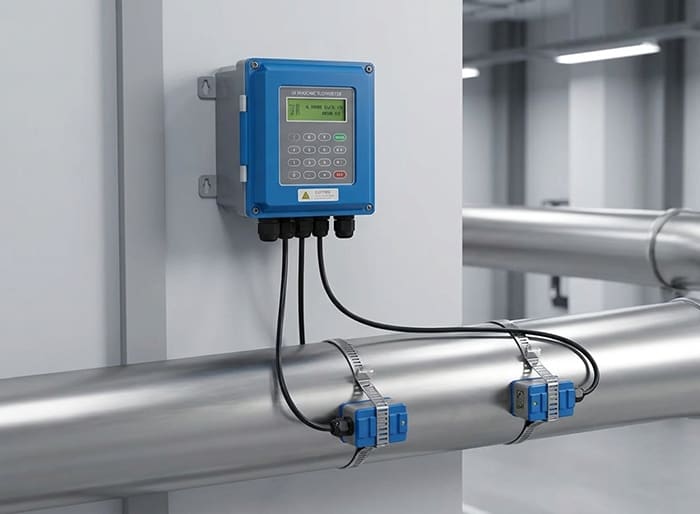
Ultrasonic flow meters use sound waves to calculate flow velocity.
The sensor measures the transit time difference between upstream and downstream ultrasonic signals.
Recommended Product
PWF-U2000B Wall Mount Ultrasonic Flow Meter
Main Advantages
✔ Non-invasive installation
✔ No pipeline modification required
✔ Suitable for large pipes
✔ Easy retrofit installation
✔ No pressure loss
Aplicaciones típicas
- Clean water systems
- Sistemas de calefacción, ventilación y aire acondicionado
- Chilled water monitoring
- Building management systems
- Temporary flow measurement projects
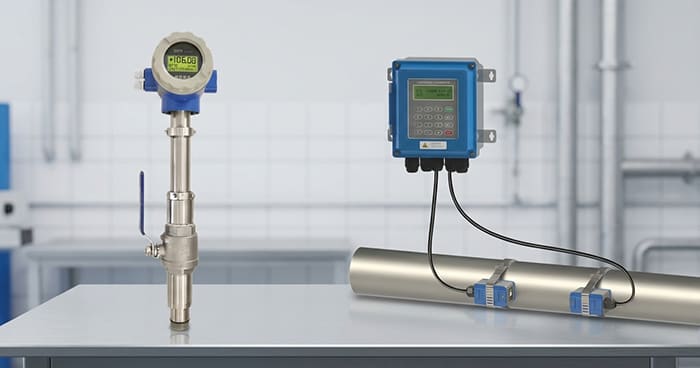
Key Differences Between Electromagnetic and Ultrasonic Flow Meters
| Característica | Caudalímetro electromagnético | Caudalímetro ultrasónico |
| Conductive Liquid Required | Sí | No |
| Pipe Cutting Required | Sí | No (Clamp-on type) |
| Precisión | Muy alta | Alta |
| Suitable for Wastewater | Excelente | Bien |
| Suitable for Clean Water | Excelente | Excelente |
| Complejidad de la instalación | Medio | Easy |
| Mantenimiento | Muy bajo | Muy bajo |
| Retrofit Projects | Moderado | Excelente |
When Should You Choose an Electromagnetic Flow Meter?
Electromagnetic flow meters are ideal when:
Measuring Conductive Liquids
Examples include:
- Agua
- Wastewater
- Sludge
- Chemical solutions
High Accuracy Is Required
Mag meters typically achieve accuracy levels of ±0.5% or better.
Solid Content Is Present
Because there are no moving parts, suspended solids do not significantly affect performance.
Long-Term Fixed Installations
They are commonly selected for permanent industrial installations.
When Should You Choose an Ultrasonic Flow Meter?
Ultrasonic flow meters are often preferred when:
Pipeline Shutdown Is Not Possible
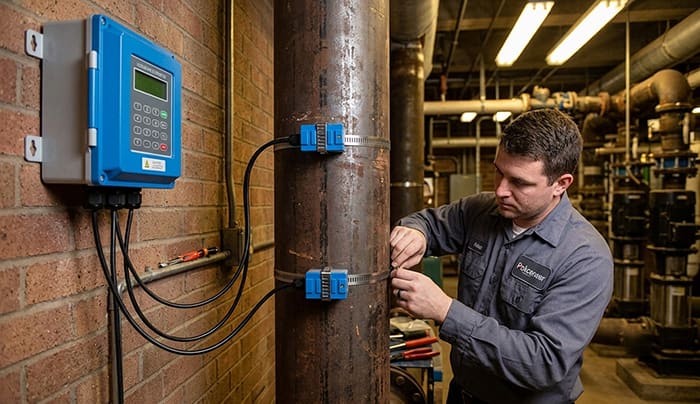
Clamp-on sensors can be installed without interrupting production.
Pipe Modification Is Undesirable
No drilling or cutting is required.
Temporary Monitoring Is Needed
Ultrasonic meters are widely used for:
- Energy audits
- Detección de fugas
- Flow verification projects
Large Diameter Pipelines
Installation is often easier than large-size magnetic flow meters.
Wastewater Treatment: Which Technology Is Better?
For wastewater applications, electromagnetic flow meters generally provide superior performance.
Advantages include:
✔ Better handling of suspended solids
✔ Higher accuracy
✔ Stable long-term measurement
✔ Proven wastewater industry performance
Building HVAC Systems: Which Technology Is Better?
For HVAC systems, ultrasonic flow meters are often preferred.
Advantages include:
✔ Non-invasive installation
✔ No interruption to operations
✔ Suitable for chilled water systems
✔ Easy retrofit capability
Recommended Product:
PWF-U2000B Wall Mount Ultrasonic Flow Meter
¿Por qué elegir Pokcenser?
Pokcenser has over 10 years of experience in industrial automation and flow measurement technology.
Today, our products serve customers in more than 100 countries worldwide.
What We Offer
✔ CE, ISO, ATEX, RoHS certified products
✔ OEM & ODM support
✔ Professional application engineering
✔ Fast technical support
✔ Competitive factory pricing
✔ One-stop automation solutions
Preguntas frecuentes
Q1: Can electromagnetic flow meters measure pure water?
Yes, provided the liquid has sufficient conductivity.
Q2: Can ultrasonic flow meters measure wastewater?
Yes, but excessive air bubbles or heavy solids may affect accuracy.
Q3: Which flow meter requires less installation work?
Clamp-on ultrasonic flow meters generally require less installation effort.
Q4: Which technology is more accurate?
Electromagnetic flow meters typically offer slightly higher accuracy in conductive liquid applications.
Q5: Which is better for retrofit projects?
Ultrasonic flow meters are often preferred because they can be installed without cutting the pipeline.
