 English
 Spanish
High-Temp vs. Standard Pressure Sensors: A Comprehensive Comparison
Selecting the right pressure sensor can make or break a control loop—I’ve seen otherwise well‑tuned systems stumble simply because the sensor wasn’t built for the heat. Temperature, more than almost any other factor, shapes accuracy, lifespan, and safety. In the following sections, I’ll lay out how standard and high‑temperature pressure sensors differ in design and materials, where each excels, what to compare (from operating range and stability to construction, maintenance, and cost), and how to match a sensor to your process. I’ll also touch on what’s next for sensor tech and where smart, connected designs are headed.
Understanding the Fundamental Differences in Pressure Sensor Technology
Pressure sensors sit at the heart of countless industrial processes, translating physical pressure into an electrical signal for monitoring, control, and automation. The core difference between standard and high‑temperature sensors comes down to design decisions and material choices—factors that set their safe operating temperature windows and, in turn, their performance under real‑world conditions.
1. Defining Standard Pressure Sensors and Their Typical Applications
Standard pressure sensors are built for moderate environments, typically operating from -20°C to 85°C. Housings are commonly stainless steel, with seals made from familiar elastomers. Sensing elements—often silicon‑based piezoresistive diaphragms or ceramic cells—deliver their best accuracy and stability around ambient temperatures. You’ll see them everywhere: HVAC, general industrial machinery, and hydraulic systems that don’t encounter extreme heat. For example, monitoring hydraulic line pressure at room temperature is a textbook fit for a standard sensor.
2. Exploring High-Temperature Pressure Sensors and Their Specialized Use Cases
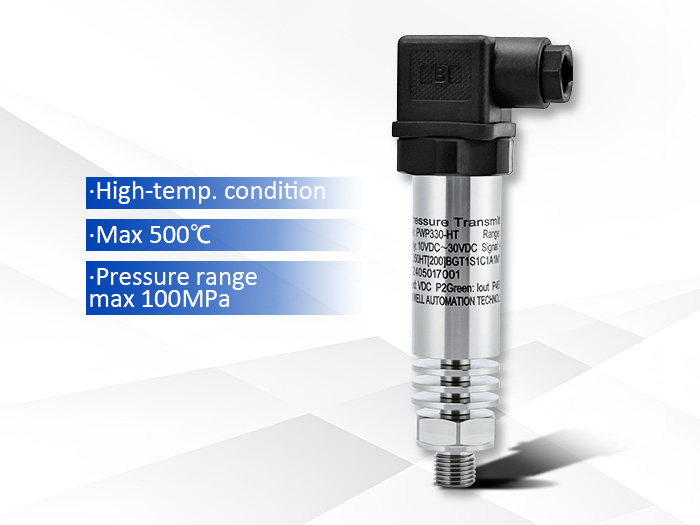
High-temperature pressure sensors are engineered to stay accurate and intact well beyond 85°C, with many designs handling up to 500°C or more. They use specialized materials and thermal‑resilient architectures to counteract expansion, degradation, and drift that heat can introduce. They’re essential in aerospace, power generation, chemical processing, and oil and gas—where superheated steam, molten metals, or high‑temperature reactors are the norm. Take a steam boiler: only a sensor designed for sustained high heat will hold calibration and structural integrity over time.
3. Key Operational Principles and Design Variations in Pressure Measurement
Both standard and high‑temperature sensors often rely on piezoresistive, capacitive, or strain‑gauge principles, but the way those principles are implemented diverges as temperatures climb. Piezoresistive designs, which detect resistance changes under stress, may swap or shield the silicon diaphragm in high‑temperature models and relocate electronics away from heat. Capacitive sensors measure changes in capacitance and favor low thermal expansion materials to keep readings steady at elevated temperatures. Strain‑gauge sensors need high‑temperature alloys and robust bonding so their measurements don’t drift as components fatigue. The sensing element and how it’s integrated into the body ultimately determine performance across the stated temperature range. We offer various pressure transmitters, including Piezoresistive Pressure Sensors and Ceramic Pressure Sensors. If you’re interested, check Piezoresistive Pressure Sensors vs. Ceramic Pressure Sensors: A Comprehensive Comparison.
Critical Factors for Comparing High-Temperature and Standard Pressure Sensors
Selecting a pressure sensor isn’t just about the pressure range. Temperature, accuracy, construction materials, durability, and total cost all shape whether a given sensor will deliver dependable data over the long haul.
1. Analyzing Temperature Ranges and Environmental Resilience
Temperature window is the headline difference: standard sensors generally operate from -20°C to 85°C, while high‑temperature versions work from 85°C up to several hundred degrees Celsius. Environmental resilience also means handling thermal shock, vibration, and humidity. High‑temperature sensors often add thermal isolation or remote electronics to shield the most sensitive components, ensuring consistent performance under rapid swings or persistent heat.
2. Evaluating Accuracy, Stability, and Performance Across Operating Conditions
Temperature changes can expand or contract materials, altering the mechanics of the sensing element and introducing error. Standard sensors include compensation for their intended range; high‑temperature sensors go further, combining material choices with advanced compensation to limit thermal drift. Their performance is typically characterized across wider spans so accuracy and repeatability hold up under extreme conditions. For critical services, pay close attention to the thermal error band.
3. Material Science and Construction: Withstanding Extreme Environments
Material selection is decisive in high‑temperature work. Standard sensors might rely on 304 stainless steel and seals like Viton. High‑temperature designs often turn to Inconel, Hastelloy, or specialized ceramics for wetted parts and diaphragms—materials that resist oxidation, corrosion, and creep when hot. Sealing may use graphite, metal gaskets, or high‑temperature polymers such as polyimide. Cables and electronics must also be heat‑rated, sometimes requiring ceramic insulation or remote mounting.
4. Considering Sensor Lifespan, Durability, and Maintenance Requirements
Heat accelerates wear. High‑temperature sensors counter that with tougher materials and construction, extending life despite harsh conditions. Even so, they may need more frequent calibration or checks than standard sensors. In critical plants, the cost of downtime justifies investing upfront in a more durable high‑temperature model. Routine inspections for thermal stress, corrosion, and seal condition help catch issues before they cascade.
5. Assessing Cost Implications and Return on Investment for Each Type
High‑temperature sensors cost more initially because of their specialized materials, manufacturing, and testing. Standard sensors are the better value when used within their limits. But total cost of ownership—replacement cycles, maintenance, and downtime—often tips the ROI toward high‑temperature units when heat is part of the process. Using a standard sensor where it runs too hot guarantees premature failure and higher operating expense.
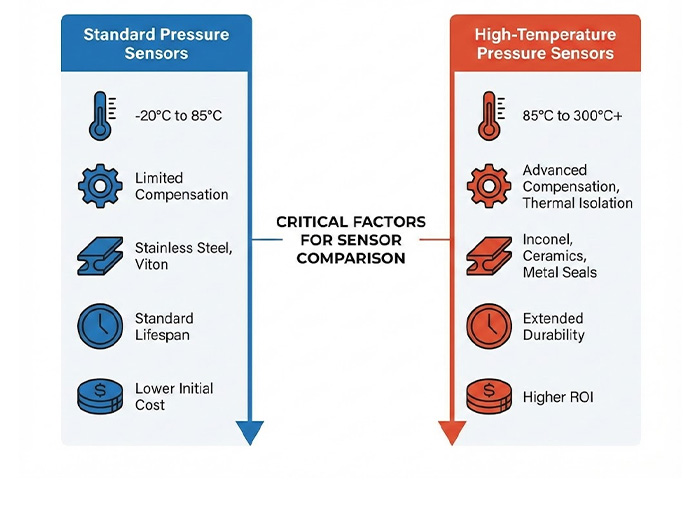
Here is a comparison table summarizing the key differences:
| Feature | Standard Pressure Sensors | High-Temperature Pressure Sensors |
|---|---|---|
| Operating Temperature | -20°C to 85°C (typical) | 85°C to 500°C+ (specialized models can exceed 1000°C) |
| Materials | Stainless steel (304/316), common elastomers, silicon | Exotic alloys (Inconel, Hastelloy), ceramics, metal seals |
| Accuracy & Stability | Good within specified range, less thermal drift concern | Requires advanced compensation, designed for minimal thermal drift at high temps |
| Lifespan & Durability | Long lifespan in moderate conditions | Optimized for durability in harsh heat, potentially shorter lifespan in extreme continuous use |
| Cost | Lower initial cost | Higher initial cost |
| Typical Applications | HVAC, hydraulics, general manufacturing | Aerospace, power generation, chemical processing, molten metals |
Selecting the Optimal Pressure Sensor for Your Industrial Application
Choosing well starts with a clear picture of the process, the environment, and what accuracy and uptime actually mean for your operation. A poor fit leads to bad data, avoidable trips, and unplanned costs.
1. Matching Sensor Specifications to Process Requirements and Environmental Demands
First, define maximum and minimum temperatures and pressures—plus startup and shutdown conditions that may create short‑term extremes. Know your medium and its behavior at temperature, including corrosivity. In Chemical Tanks or reactors, for example, the sensor must handle both heat and chemical attack. Don’t overlook vibration, shock, or EMI, which can undermine readings.
2. The Impact of Media Compatibility and Chemical Resistance on Sensor Choice
Media compatibility is non‑negotiable, especially at elevated temperatures where reactions accelerate. Wetted parts must resist the process fluid to avoid corrosion, erosion, or contamination. In highly corrosive services, ceramic diaphragms or protective coatings can be preferable. For food and beverage, choose sanitary connections and compliant materials that withstand hot clean‑in‑place cycles. We ensure that our sensors are designed with appropriate materials for diverse applications.
You might also be interested in Safety in Hazardous Areas: Using Explosion-Proof Sensors.
3. Installation Considerations and Integration with Existing Control Systems
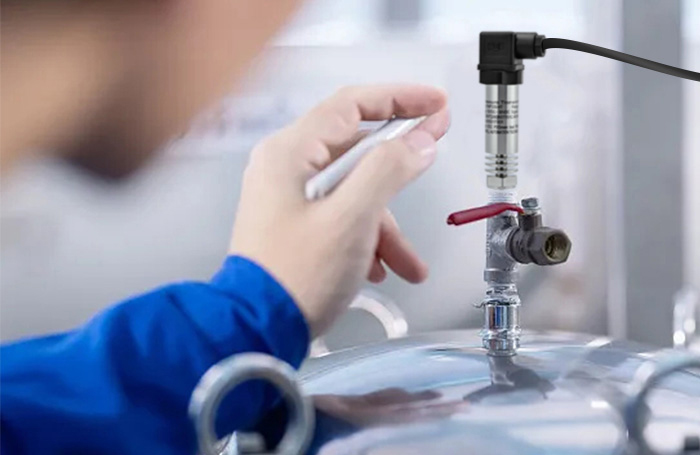
Installation quality is a big lever for performance and life. In high‑temperature sites, consider heat sinks, remote capillaries, or mounting strategies that keep electronics cooler. Match the output signal (e.g., 4‑20mA, Modbus RTU) to your PLC or DCS, and make sure cabling, connectors, and junctions are rated for the ambient environment. For high‑reliability systems, consider redundancy and on‑board diagnostics. Our main products include a range of pressure transmitters suitable for various integration needs.
4. Mitigating Common Challenges in High-Temperature and Standard Pressure Sensing
Common high‑temperature pitfalls include thermal drift, material fatigue, and noise pickup. Mitigations span better alloys and ceramics, advanced temperature compensation, and isolating or relocating electronics. For standard sensors, the usual trouble spots are media compatibility in mildly corrosive services and sensitivity to vibration. The cure is disciplined selection, scheduled calibration, and following the manufacturer’s installation and operation guidance.
The Future Landscape of Pressure Sensor Technology and Innovation
Pressure sensing is moving toward tighter accuracy, smaller footprints, and smarter connectivity—changes that are reshaping how plants automate and optimize.
1. Advancements in Materials and Miniaturization for Enhanced Performance
Research into advanced ceramics and composites promises higher thermal stability and chemical resistance, keeping sensors accurate in ever harsher conditions. Miniaturization places sensors closer to the action—or even embedded within equipment—cutting installation complexity and improving response time. Together, these gains open up applications that previously pushed sensors past their limits.
2. Integrating Smart Features and IoT Capabilities for Predictive Maintenance
Built‑in diagnostics and self‑calibration are rapidly becoming standard, improving reliability while trimming maintenance. With IoT connectivity, sensors enable remote monitoring, data logging, and predictive maintenance, so teams can anticipate failures and plan interventions before they affect production. The result is less downtime and a more resilient process.
3. Emerging Trends in Industrial Automation Driving Sensor Development
Industry 4.0, AI, and machine learning are steering sensors toward delivering not just measurements but context and insights. That shift demands higher accuracy, rock‑solid reliability, and seamless integration with digital ecosystems. Pokcenser Automation is investing in these capabilities to meet evolving industrial requirements.
Partner with Pokcenser Automation for Your Pressure Sensing Needs
Choosing the right pressure sensor directly impacts the efficiency and safety of your operations. At Pokcenser Automation, we provide high‑quality, reliable pressure transmitters and complete industrial process control solutions. With 10+ years of experience and a customer‑first approach, we’ll help you select the best fit—standard or high‑temperature—and support you through the entire lifecycle.
Contact us today to discuss your requirements and see how our technologies can optimize your processes. Our dedicated 6‑person pre‑sales and after‑sales team delivers one‑stop, worry‑free service—from application evaluation and solution recommendations to ongoing support.
Email: in**@*******er.com
Phone: +86 181 7515 5326
About the Author
Li Chengxuan is a senior industrial automation expert at Pokcenser Automation, specializing in flow, level, pressure, and temperature sensors, as well as industrial process control solutions.
FAQs
1. What are the primary indicators that a high-temperature pressure sensor is needed instead of a standard one?
Choose a high‑temperature sensor when the process fluid or ambient consistently exceeds 85°C. Clues include visible steam, noticeable radiant heat, or documented operating temperatures above that threshold. In such conditions, standard sensors drift, fail early, or both.
2. How does temperature affect the accuracy and lifespan of a pressure sensor?
Heat drives material expansion and internal stresses that cause signal drift and degrade accuracy. Prolonged high temperatures also accelerate wear of diaphragms, seals, and electronics, shortening the sensor’s service life.
3. Can a standard pressure sensor be adapted for higher temperature applications?
Generally, no. While external cooling may buy limited time, standard sensor internals aren’t designed for sustained heat. Expect unreliable readings and elevated failure risk if used outside their rated range.
4. What maintenance considerations are unique to high-temperature pressure sensors?
Plan for more frequent calibration checks to track thermal drift, and routinely inspect for fatigue, oxidation, and seal integrity. Replacement intervals may be shorter in especially severe environments, even with robust designs.
5. What role do material choices play in the performance of pressure sensors in extreme temperatures?
They’re pivotal. Alloys such as Inconel or Hastelloy and ceramic components resist thermal expansion, corrosion, and creep, preserving mechanical strength and measurement stability. The right materials prevent early failure and help maintain accuracy in sustained heat.

