 English
 Spanish
Monocrystalline vs. Diffused Silicon Sensors: A Deep Dive for Industrial Control
I get asked a lot about which sensor technology fits a given job, and for good reason. Picking the right silicon sensor type can make or break performance and lifespan. The choice really comes down to how monocrystalline and diffused silicon sensors are built and how they behave under real operating conditions. We will look at their principles, strengths, trade-offs, and where each one shines, then map that to practical selection tips, future developments, and common questions.
Understanding Silicon-Based Sensor Technology in Industrial Automation
Silicon-based sensors sit at the core of modern automation, delivering precise readings for pressure, temperature, and other critical parameters. Their popularity grows from silicon’s strong mechanical behavior and semiconductor properties. These devices convert physical quantities into electrical signals that drive control and monitoring. We count on them for reliability and accuracy across varied industrial environments.
The Fundamental Principles of Monocrystalline Silicon Sensors
Monocrystalline silicon sensors are known for standout performance that tracks back to their uniform atomic structure. A single-crystal lattice gives them stable mechanical and electrical behavior.
How Monocrystalline Silicon Achieves High Precision and Stability
With a uniform crystal structure, monocrystalline silicon sensors exhibit excellent linearity and very low hysteresis. When pressure is applied, electrical resistance shifts predictably through the piezoresistive effect. This structural integrity supports high accuracy and long-term stability in demanding industrial conditions.
Exploring the Characteristics and Advantages of Diffused Silicon Sensors
Diffused silicon sensors offer a cost-effective, durable option for many industrial needs. Their production methods support flexible designs.
Manufacturing Processes and Performance Benefits of Diffused Silicon
Diffused silicon sensors are produced by introducing impurities into a silicon wafer to form piezoresistive elements. This approach keeps costs down and allows design flexibility. The diffusion process yields a robust sensing element with good temperature characteristics and strong suitability for mass production, which is why they are widely used across industrial applications. If you’re interested, check 《8 Things You Should Know About Diffused Piezoresistive Silicon Sensors》.
Direct Comparison: Monocrystalline vs. Diffused Silicon in Key Performance Metrics
Understanding how these two sensor types trade off helps narrow the selection to what the application actually needs. Below we compare their behavior across key metrics.
Analyzing Accuracy, Stability, and Temperature Compensation Capabilities
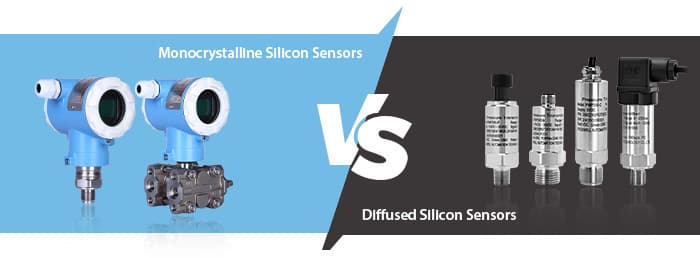
Here we put monocrystalline and diffused silicon sensors side by side on core performance indicators. We compare their accuracy, long-term stability in varied conditions, and the approaches used for temperature compensation. Seeing these differences clearly supports choosing the right sensor for specific industrial requirements.
| Feature | Monocrystalline Silicon Sensors | Diffused Silicon Sensors |
|---|---|---|
| Accuracy | High (e.g., ±0.05% FS) | Moderate to High (e.g., ±0.1% to ±0.5% FS) |
| Stability | Excellent, minimal drift over time | Good, suitable for long-term monitoring |
| Temperature Range | Wider operating range, often with precise compensation | Good, effective temperature compensation for industrial use |
| Hysteresis | Very low | Low |
| Cost | Higher due to complex manufacturing | Lower, cost-effective for mass production |
| Applications | High-precision scientific instruments, critical process control | General industrial pressure monitoring, automotive, medical |
Evaluating Durability, Response Time, and Environmental Suitability
Performance is not only about accuracy. We compare how each sensor type handles vibration, shock, and corrosive media, and how quickly they register changes. We also touch on practical considerations for installation and maintenance in industrial settings.
Application-Specific Selection: When to Choose Each Silicon Sensor Type
The right choice depends on the specific demands of the job. Matching sensor capabilities to how the system is used is the key.
Optimizing Sensor Choice for Precision, Cost, and Operational Needs
This section walks through decisions between monocrystalline and diffused silicon sensors based on application requirements. We outline cases where the superior precision of monocrystalline sensors is non-negotiable, such as high-accuracy pressure measurement in critical processes. We also outline cases where the cost-effectiveness and robustness of diffused silicon sensors carry more weight, such as general industrial pressure monitoring. For example, the PWP412-T3 uses a diffused silicon sensor and is ideal for deep well water level monitoring. If you’re interested, check 《Deep Well Monitoring with Submersible Pressure Transmitters》.
Monocrystalline silicon sensors excel where the highest accuracy and long-term stability are required. These include precision instrumentation, aerospace, and high-end research. Their consistency helps reduce measurement errors in critical systems. Diffused silicon sensors provide a strong balance of performance and cost. They are widely used in automotive, HVAC, and general industrial automation, and their robustness suits harsh conditions.
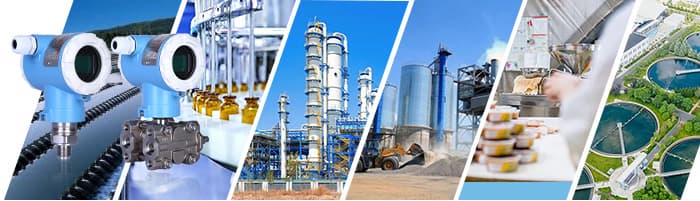
For applications in Water and Wastewater Treatment where reliable, continuous monitoring is needed, diffused silicon sensors often deliver the required accuracy without excessive cost. In Environmental Monitoring and Rivers, sensors face temperature swings and contaminants, and diffused silicon technology offers the needed resilience. In the Pharmaceutical Industries, where precision and hygiene matter, monocrystalline sensors may be preferred for critical steps, while diffused silicon sensors can handle less stringent monitoring.
When selecting sensors, consider the required accuracy, environmental conditions, budget constraints, and expected lifespan. Align the sensor’s capabilities with the application’s demands to get the best performance and cost efficiency. Our team can assist in evaluating your specific needs and recommending the most suitable silicon sensor technology.
Future Trends and Innovations in Silicon Sensor Technology
Silicon sensor technology keeps advancing. We see steady progress in miniaturization, integration, and added features. Expect higher accuracy, lower power consumption, and richer communication options. Research efforts are aiming at AI and machine learning integration for predictive maintenance and smarter data analysis. These steps will improve process optimization and widen where sensors can be used. New materials and manufacturing techniques are on the horizon and will expand the current performance envelope.
Frequently Asked Questions
What is the primary difference between monocrystalline and diffused silicon sensors?
The main difference comes from their manufacturing and crystal structure. Monocrystalline silicon sensors use a single, highly uniform crystal structure, which supports superior precision and stability. Diffused silicon sensors are built by diffusing impurities into a silicon wafer to create piezoresistive elements, making them generally more cost-effective and robust for a broad range of industrial applications.
Which type of silicon sensor offers better accuracy and long-term stability?
Monocrystalline silicon sensors usually provide better accuracy and long-term stability because their uniform crystal lattice yields more predictable and consistent piezoresistive behavior. They are often chosen for applications that demand the highest precision.
Are diffused silicon sensors suitable for harsh industrial environments?
Yes. Diffused silicon sensors are well suited to many harsh environments. Their robust construction and cost-effectiveness make them a strong choice where good performance is needed without the extreme precision of monocrystalline sensors. With appropriate housing and materials, they can handle significant pressure, temperature variations, and corrosive media.
How does temperature compensation work in silicon-based sensors?
Temperature compensation usually involves integrating temperature-sensing elements, such as thermistors, into the sensor design. These measure ambient temperature, and the internal electronics apply a correction algorithm to the pressure reading, offsetting temperature-induced changes in the silicon’s piezoresistive properties. This maintains accuracy across varying temperatures.
Can Pokcenser Automation provide customized silicon sensor solutions?
Yes. Pokcenser Automation offers OEM&ODM services for customized silicon sensor solutions tailored to specific application requirements. With over 10 years of experience and a dedicated pre-sales and after-sales team, we can evaluate your application and recommend or design suitable solutions that balance performance and value.
Optimize Your Industrial Processes with Pokcenser Automation
Optimize your industrial processes with the right sensor technology. Contact Pokcenser Automation today for expert consultation and to explore our range of high-performance silicon-based sensors tailored to your specific application needs. Our 10+ years of experience and certified solutions ensure reliable and accurate measurements. Email: in**@*******er.com | Phone: +86 181 7515 5326

