 English
 Spanish
Non-Invasive Flow Meters: Applications, Selection, and Benefits
Accurate flow measurement keeps operations on track in everything from water treatment to petrochemicals, and we’ve seen how much reliability affects uptime and quality. Non-invasive flow meters read flow from outside the pipe, delivering precise results without touching the fluid, so there’s no contamination, no pressure loss, and no shutdown for installation. Here we lay out how the technology works, where it’s used, what to consider when selecting a meter, and which models in our lineup match different pipe sizes and conditions, then touch on the innovations that are reshaping accuracy and connectivity.
Understanding Non-Invasive Flow Meters: Principles and Advantages
Non-invasive flow meters operate on principles that allow fluid flow measurement without physical contact with the medium. This approach offers distinct benefits over traditional intrusive methods. We focus on technologies that enhance operational continuity and data integrity.
1. The Core Concept of Non-Invasive Flow Measurement
In this approach, sensors are mounted on the outside of a pipe and emit signals that interact with the moving fluid. The instrument analyzes those interactions to determine the flow rate. No pipe modifications are required, and there is no direct contact with the process fluid.
2. How Ultrasonic Technology Powers Non-Invasive Flow Meters
Ultrasonic flow meters are a prominent type of non-invasive technology. They utilize acoustic waves to measure fluid velocity. Transducers send and receive ultrasonic pulses through the pipe wall and the fluid. The time difference between upstream and downstream signals correlates directly with the fluid’s velocity. This principle allows for highly accurate and repeatable measurements.
3. Key Advantages of Non-Invasive Flow Measurement for Industrial Processes
Non-invasive flow meters offer several critical advantages. They prevent fluid contamination, which matters for sanitary or hazardous applications. Installation is simplified, avoiding costly shutdowns and pipe alterations. Maintenance requirements are significantly reduced, as sensors do not contact the fluid. This leads to lower operational costs and enhanced safety.
If you’re interested, check 《Flow Meter Selection: Turbine vs. Electromagnetic vs. Ultrasonic Flow Meters》.
Diverse Applications of Non-Invasive Flow Meters Across Industries
Non-invasive flow meters are versatile instruments, finding application in a wide array of industrial sectors. Their ability to measure flow without process interruption makes them invaluable for various challenging environments. We integrate these meters into solutions that address specific industry needs.
1. Water and Wastewater Management: Ensuring Efficiency and Compliance
In [[Water and Wastewater Treatment Water and Wastewater Treatment]] facilities, non-invasive flow meters monitor raw water intake, treated water distribution, and [[wastewater treatment wastewater treatment]] processes. They help optimize chemical dosing and ensure regulatory compliance. Their non-contact nature prevents sensor fouling, common in these applications. [[Environmental Monitoring and Rivers Environmental Monitoring and Rivers]] also benefit from these reliable measurement solutions.
2. Chemical and Petrochemical Industries: Handling Corrosive and Hazardous Fluids
The [[chemical sector chemical sector]] frequently handles corrosive, abrasive, or toxic fluids. Non-invasive flow meters are ideal here, as they eliminate direct contact with such substances. This protects personnel and equipment, ensuring safe and reliable operations. They are particularly useful for [[Chemical Tanks Chemical Tanks]] and complex [[chemical processing chemical processing]] lines.
3. Other Industrial Applications: From HVAC to Food and Beverage
Non-invasive flow meters also serve other critical sectors. In HVAC systems, they monitor chilled water and condenser water flows for energy efficiency. The [[food industry food industry]] and [[Pharmaceutical Industries Pharmaceutical Industries]] use them for sanitary applications where fluid purity is paramount. Their adaptability makes them suitable for diverse industrial fluid management needs.
Critical Factors for Selecting the Right Non-Invasive Flow Meter
Choosing the optimal non-invasive flow meter requires careful consideration of various technical and operational parameters. We guide clients through this selection process to ensure the best fit for their specific applications.
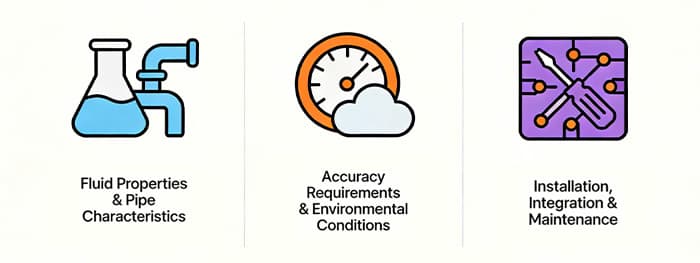
1. Evaluating Fluid Properties and Pipe Characteristics for Accurate Measurement
The fluid type, temperature, pressure, and presence of solids or gases significantly influence meter selection. Pipe material, diameter, and wall thickness are also crucial. For example, [[Ultrasonic Flow Meters Ultrasonic Flow Meters]] perform best with homogeneous liquids. Understanding these properties ensures accurate and reliable measurements.
2. Assessing Accuracy Requirements and Environmental Conditions
Application-specific accuracy demands dictate the appropriate meter technology. Environmental factors like temperature extremes, vibration, and potential for [[hazardous area sensors hazardous area sensors]] must be evaluated. We ensure the selected meter meets both performance and safety standards.
3. Considering Installation, Integration, and Maintenance Needs
Ease of installation, compatibility with existing control systems (e.g., 4-20mA, RS485 Modbus RTU), and long-term maintenance are practical considerations. Non-invasive meters generally offer simpler installation and lower maintenance than intrusive alternatives. This contributes to reduced total cost of ownership.
If you’re interested, check 《Radar vs. Ultrasonic Level Sensors: A Selection Guide》.
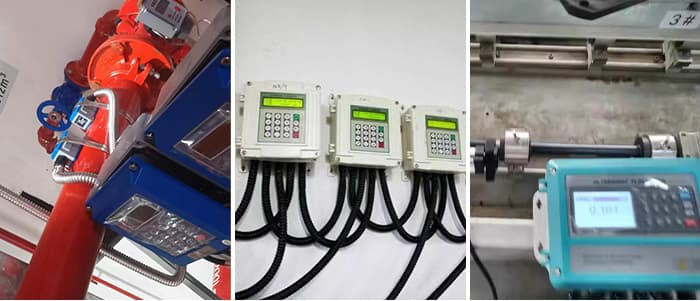
Pokcenser Automation’s Non-Invasive Flow Meter Solutions
Pokcenser Automation offers a broad range of non-invasive flow meters designed for precision and reliability. Our [[main products main products]] are engineered to meet the stringent demands of various industrial applications.
1. Clamp-On Ultrasonic Flow Meters for Various Pipe Sizes
Our clamp-on [[Ultrasonic Flow Meter Ultrasonic Flow Meter]] solutions, like the PWF-U2000MCC Multi-channel Clamp-on Ultrasonic Flowmeter, offer high accuracy (±0.5% FS) for pipe diameters from DN50 to DN6000. These meters are ideal for water distribution, leak detection, and general fluid monitoring. The PWF-U1000 Small Pipe Clamp-on Ultrasonic Flowmeter is specifically designed for smaller pipes (DN15–DN40), providing quick, non-invasive installation for applications like [[Medical devices Medical devices]] and [[food industry food industry]].
| Feature | PWF-U2000MCC Multi-channel Clamp-on Ultrasonic Flowmeter | PWF-U1000 Small Pipe Clamp-on Ultrasonic Flowmeter |
|---|---|---|
| Accuracy | ±0.5% FS (two/four-channel), ±1.0% FS (one-channel) | ±2% (±1% after calibration) |
| Pipe Diameter | DN50–DN6000 | DN15–DN40 |
| Liquid Temperature | -30℃ to 160℃ | 0–75℃ |
| Communication | Isolated RS485 MODBUS protocol | 4–20mA + RS485 Modbus, optional OCT |
| Protection Class | IP67 (Converter/Host); IP68 (Sensors) | IP65 |
| Key Applications | Water distribution, leak detection, industrial fluids | Water supply, medical, food/beverage |
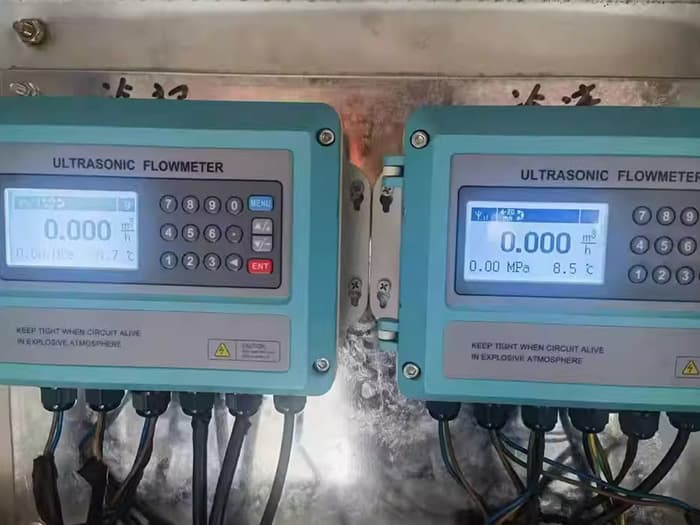
2. Insertion Ultrasonic Flow Meters for Specific Measurement Needs
For applications requiring high precision without system shutdown, our PWF-U2000MCI Multi-channel Insertion Ultrasonic Flowmeter is an excellent choice. It offers high accuracy (±0.5% FS) and can be installed without interrupting water flow using specialized tools. This makes it suitable for process control, [[wastewater treatment wastewater treatment]], and energy monitoring. These meters feature durable stainless steel transducers and advanced mixed-signal processing technology.
| Feature | PWF-U2000MCI Multi-channel Insertion Ultrasonic Flowmeter |
|---|---|
| Accuracy | ±0.5% FS (two/four-channel), ±1.0% FS (one-channel) |
| Pipe Diameter | DN50–DN6000 |
| Liquid Temperature | -30℃ to 160℃ |
| Installation | Without cutting off water (special tool) |
| Communication | Isolated RS485 MODBUS protocol |
| Protection Class | IP67 (Converter/Host); IP68 (Sensors) |
| Key Applications | Process control, wastewater, energy monitoring |
The Future of Flow Measurement: Innovations and Trends
Non-invasive flow measurement continues to advance quickly. Work centers on improving accuracy, broadening application ranges, and strengthening data integration. We expect gains in sensor technology, including better signal processing for difficult fluids and stronger wireless communication options. Miniaturization and higher energy efficiency are also on the horizon. Together, these shifts reinforce non-invasive meters as core tools in modern industrial automation.
Call to Action
Ready to optimize your flow measurement processes with reliable, non-invasive technology? Contact Pokcenser Automation Technology Company Limited today for expert consultation and to explore our full range of flow meters. Our 6-person pre-sales and after-sales team is dedicated to providing one-stop, worry-free services, from application evaluation to recommending suitable solutions.
Phone: +86 181 7515 5326
Email: in**@*******er.com
FAQs
What is the primary benefit of a non-invasive flow meter compared to an invasive one?
Non-invasive flow meters, like clamp-on ultrasonic types, measure flow from outside the pipe, eliminating the need to cut into the pipeline. This prevents process interruption, reduces installation costs, avoids pressure drops, and minimizes the risk of leaks or contamination, making them ideal for critical or hazardous fluids.
How accurate are non-invasive ultrasonic flow meters?
Modern non-invasive ultrasonic flow meters, such as Pokcenser’s PWF-U2000MCC, can achieve high accuracy, often ±0.5% to ±1.0% FS, depending on the model and application. Factors like proper installation, fluid homogeneity, and pipe material can influence overall accuracy.
Can non-invasive flow meters be used for all types of liquids?
Non-invasive ultrasonic flow meters are highly versatile but perform best with single-phase, homogeneous liquids that can transmit ultrasonic waves. This includes water, sewage, acids, alkalis, and many oils. They may be less suitable for liquids with high concentrations of solids or air bubbles, which can scatter the ultrasonic signal.
What maintenance is required for a clamp-on ultrasonic flow meter?
One of the key advantages of clamp-on ultrasonic flow meters is their low maintenance. Since they are external to the pipe, there’s no contact with the fluid, reducing wear and tear. Regular checks involve ensuring proper transducer coupling and verifying cable integrity.
How do I choose between a clamp-on and an insertion ultrasonic flow meter?
The choice depends on factors like pipe size, fluid conditions, and the ability to interrupt the process. Clamp-on meters (e.g., Pokcenser’s PWF-U2000MCC, PWF-U1000) are ideal for quick, non-invasive installation on existing pipes. Insertion meters (e.g., Pokcenser’s PWF-U2000MCI) offer high accuracy for larger pipes and can sometimes be installed without shutting down the system using special tools, providing a balance between invasiveness and measurement stability.

