 English
 Spanish
PT100 vs PT1000 Temperature Sensor Comparison Guide
Selecting the appropriate temperature sensor is central to solid process control. Precision and reliability carry real weight across environmental monitoring and complex chemical processes alike. Here, PT100 and PT1000 RTD sensors are compared in depth, with their operating principles, key differences, and where each one fits best. The aim is practical: help you make a confident choice for your setup.
Understanding RTD Temperature Sensors
Resistance Temperature Detectors (RTDs) are temperature sensors that exploit the predictable change in electrical resistance of certain materials with temperature. Platinum is the most common material due to its stable and linear resistance-temperature relationship. These sensors offer high accuracy and repeatability across a wide temperature range, making them indispensable in various industrial settings.
1 How RTDs Work Basic Principles
RTDs operate on the principle that electrical resistance varies with temperature. As the temperature of the platinum element increases, its electrical resistance also increases in a known, repeatable manner. This change in resistance is then measured and converted into a temperature reading by a connected instrument. This method provides a highly stable and accurate temperature measurement.
2 Key Characteristics of RTDs
RTDs are characterized by their material (typically platinum), nominal resistance at 0°C, and temperature coefficient. Platinum RTDs, like PT100 and PT1000, are known for their excellent linearity, long-term stability, and wide operating temperature range. They offer superior accuracy compared to thermocouples in many applications.
PT100 Temperature Sensors Explained
The PT100 sensor is a widely recognized platinum RTD with a nominal resistance of 100 ohms at 0°C. Its robust design and established performance make it a standard in industrial temperature measurement. We have extensive experience integrating PT100 sensors into demanding process control systems.
1 PT100 Resistance and Sensitivity
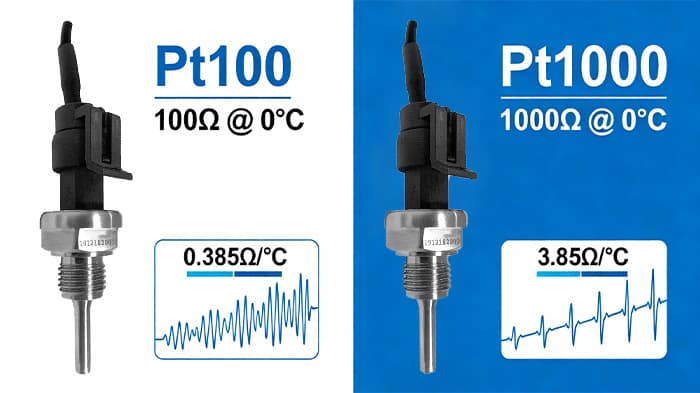
The PT100 sensor exhibits a resistance of 100 ohms at 0°C and approximately 138.5 ohms at 100°C. This resistance change is consistent, allowing for precise temperature calculations. The sensitivity of a PT100 is around 0.385 ohms per degree Celsius.
| Temperature (°C) | Resistance (Ω) |
|---|---|
| 0 | 100.0 |
| 100 | 138.5 |
| 200 | 175.8 |
2 Common PT100 Applications
PT100 sensors are prevalent in diverse industrial applications requiring accurate temperature monitoring. They are frequently used in HVAC systems, machinery, and various manufacturing processes. Their reliability makes them suitable for critical control loops.
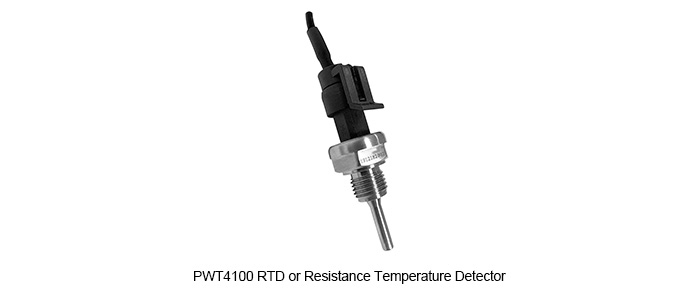
PT1000 Temperature Sensors Explained
The PT1000 sensor is another platinum RTD, distinguished by its nominal resistance of 1000 ohms at 0°C. This higher base resistance offers distinct advantages in specific measurement scenarios. Our team leverages PT1000 technology for enhanced signal integrity.
1 PT1000 Resistance and Sensitivity
A PT1000 sensor has a resistance of 1000 ohms at 0°C and approximately 1385 ohms at 100°C. This provides a larger signal output per degree Celsius compared to a PT100. The sensitivity of a PT1000 is approximately 3.85 ohms per degree Celsius.
| Temperature (°C) | Resistance (Ω) |
|---|---|
| 0 | 1000.0 |
| 100 | 1385.0 |
| 200 | 1758.0 |
2 Common PT1000 Applications
PT1000 sensors are increasingly adopted in applications where lead wire resistance errors are a concern, such as remote monitoring and battery management systems. Their higher output signal improves noise immunity, making them ideal for long cable runs.
PT100 vs PT1000 Direct Comparison
Understanding the fundamental differences between PT100 and PT1000 sensors is crucial for optimal system design. We analyze these distinctions to guide our clients toward the most effective solution.
1 Key Differences in Resistance and Output
The primary difference lies in their nominal resistance at 0°C: 100 ohms for PT100 and 1000 ohms for PT1000. This tenfold difference directly impacts the sensor’s output signal. A PT1000 provides a stronger signal, which can be advantageous for signal-to-noise ratio.
2 Wiring Configurations and Lead Wire Resistance
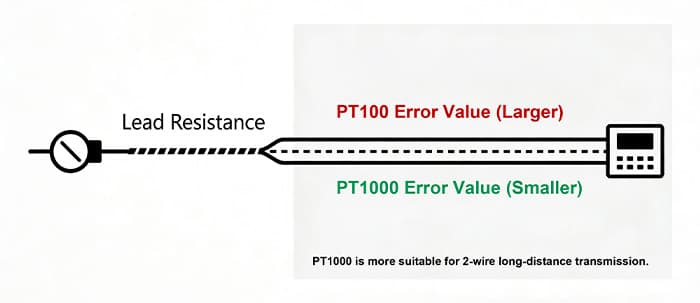
Both PT100 and PT1000 sensors can use 2-wire, 3-wire, or 4-wire configurations. However, the impact of lead wire resistance differs significantly. For a PT100, lead wire resistance can introduce substantial errors, necessitating 3-wire or 4-wire compensation for accuracy. A PT1000’s higher resistance makes it less susceptible to these errors, often allowing for accurate measurements with simpler 2-wire setups. We recommend reviewing 《How do Magnetostrictive Sensors Work?》 for further insights into sensor wiring.
3 Accuracy and Noise Immunity
While both sensor types can achieve high accuracy (e.g., Class A or B), the PT1000 generally offers better noise immunity due to its higher resistance. The larger signal voltage generated by a PT1000 makes it less susceptible to interference over long cable runs. This inherent advantage can lead to more reliable measurements in electrically noisy environments.
4 Cost and Availability Considerations
Historically, PT100 sensors have been more widely available and often slightly less expensive. However, the cost difference has narrowed, and PT1000s are becoming increasingly common. The overall system cost might be lower for PT1000s if simpler 2-wire configurations can be used, reducing cabling and installation expenses. For detailed pricing, we encourage you to request a quote.
| Feature | PT100 | PT1000 |
|---|---|---|
| Resistance at 0°C | 100 Ω | 1000 Ω |
| Sensitivity | 0.385 Ω/°C | 3.85 Ω/°C |
| Lead Wire Effect | Significant, often requires 3- or 4-wire | Less significant, 2-wire often sufficient |
| Noise Immunity | Moderate | High |
| Preferred Applications | General industrial, shorter runs | Long runs, remote, noisy environments |
Choosing the Right Sensor PT100 or PT1000
Selecting between a PT100 and a PT1000 depends on several application-specific factors. Our expertise ensures you choose the most suitable sensor for your operational needs.
1 Factors Influencing Your Decision
Consider the length of your lead wires; longer runs benefit from PT1000s to minimize lead wire resistance errors. Evaluate the level of electrical noise in your environment, as PT1000s offer better noise immunity. Finally, assess the required accuracy and overall budget, including installation costs. For applications involving hazardous areas, be sure to consider 《Safety in Hazardous Areas: Using Explosion-Proof Sensors》.
2 Pokcenser Automation Solutions
Pokcenser Automation offers a broad range of temperature sensors, including both PT100 and PT1000 models. Our products are designed for reliability and precision, meeting various industrial demands. We also provide OEM and ODM services, tailoring solutions to your unique specifications.
Call to Action
Ready to find the perfect temperature sensor for your application? Contact Pokcenser Automation Technology Company Limited today for expert consultation and customized solutions. Our 10+ years of experience and certified products ensure reliable performance. Email us at in**@*******er.com or call +86 181 7515 5326.
FAQs
1 Can I replace a PT100 with a PT1000 directly?
No, direct replacement is generally not possible without changes to the measurement circuitry. PT100 and PT1000 sensors have different resistance values at 0°C (100 ohms vs. 1000 ohms), requiring different signal conditioning and input ranges from your transmitter or PLC. Always check compatibility and recalibrate if necessary.
2 Which sensor is more accurate, PT100 or PT1000?
Both PT100 and PT1000 sensors can offer high accuracy, often specified by their tolerance classes (e.g., Class A, Class B). However, PT1000 sensors inherently have a higher output signal (10 times higher resistance change per degree Celsius), making them less susceptible to lead wire resistance errors and electrical noise, which can effectively lead to better overall system accuracy in certain applications, especially with long cable runs or 2-wire configurations.
3 What are the advantages of using a PT1000 in a 2-wire configuration?
The primary advantage of a PT1000 in a 2-wire configuration is its significantly higher base resistance (1000 ohms at 0°C) compared to a PT100 (100 ohms at 0°C). This higher resistance means that the resistance of the lead wires becomes a much smaller percentage of the total measured resistance, thus reducing the error caused by lead wire resistance in a 2-wire setup. This often eliminates the need for more complex 3-wire or 4-wire configurations in applications where cost or space is a concern.
4 Are PT100 and PT1000 interchangeable?
No, PT100 and PT1000 sensors are not directly interchangeable. While both are platinum RTDs and follow similar resistance-temperature characteristics, their nominal resistance at 0°C differs significantly (100Ω vs. 1000Ω). This difference requires specific input circuitry and calibration for each type. Using the wrong sensor with incompatible electronics will result in incorrect temperature readings.
5 Does Pokcenser Automation offer custom PT100 and PT1000 sensors?
Yes, Pokcenser Automation provides OEM and ODM services for both PT100 and PT1000 temperature sensors. With over 10 years of experience and a dedicated R&D team, we can design and manufacture customized sensors to meet your specific industrial requirements, ensuring optimal performance and seamless integration into your process control systems.

