 English
 Spanish
Ultrasonic Level Meter Fault Analysis
The ultrasonic level meter is a digital level meter with a microprocessor controller. During the measurement, the ultrasonic pulse is emitted by the sensor (transducer), and the sound wave is reflected by the liquid surface and received by the same sensor. It is converted into an electrical signal by the piezoelectric crystal, and the distance from the sensor to the surface of the measured liquid is calculated by the time between the emission and reception of the sound wave. Due to the use of non-contact measurement, the measured medium is almost unlimited, and it can be widely used to measure the height of various liquids and solid materials.
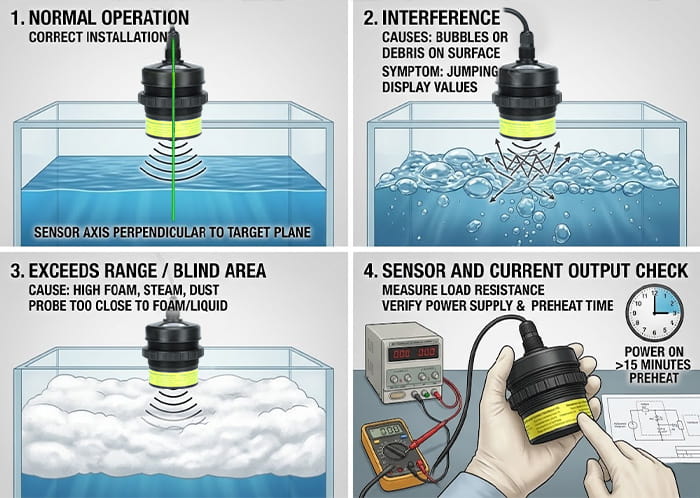
The ultrasonic level meter value jumps randomly:
There is a display, a sound, and the measured value jumps randomly or the value does not change with the distance:
Cause of the fault:
- The ultrasonic level meter is installed at a too large inclination;
- The pulse intensity is improperly set;
- It causes large residual vibration or diffraction;
- There are more than two ultrasonic level meters working at the same time;
- It causes mutual interference;
- The electromagnetic interference on site is too large;
- There are bubbles or debris on the liquid surface.
Fault handling:
- Adjust the sensor axis to be perpendicular to the target plane;
- Generally, the range is within 1-3m, and the emission pulse intensity is 2-5;
- Try to eliminate mutual interference;
- Find the interference source and shield the interference;
- Eliminate bubbles and debris on the liquid surface.
The ultrasonic level meter displays a blind area or exceeds the range
Common faults: The sensor makes a sound, and the display shows a blind area or exceeds the range:
Cause of fault:
- Exceeding the range of the ultrasonic level meter;
- The measuring surface is too close to the probe;
- Improper use in high dust, high foam, high steam environment or the working temperature is too high or too low;
- Improper pulse intensity setting.
Fault handling:
- Adjust the actual range of the ultrasonic level meter to within the working range of the instrument;
- Adjust the application environment to the required range;
- Modify the emission pulse intensity until the display is stable.
Abnormal current output of ultrasonic level meter
Common faults: 4-20mA output is abnormal; current output is too high, too low, and jumps.
Causes of fault:
- Load resistance is too large;
- The range “end point” is modified, and the output fine-tuning parameter “output low-end fine-tuning” or “output high-end fine-tuning” is modified;
- Power supply rectification and filtering are not good;
- Insufficient power-on time.
Fault handling:
- Reduce load resistance;
- Re-adjust relevant parameters by yourself;
- Replace a DC regulated power supply with a larger capacity;
- Power on for >15 minutes to preheat.
Ultrasonic level meter sensor does not work
Common faults: does not work after power on, no display, no sound from the sensor…
Causes of fault:
- The power supply is not connected, or the positive and negative poles are connected in reverse;
- The working voltage is too low, the instrument does not work, or the working voltage is too high, and the ultrasonic level meter is damaged.
Fault handling:
Check the circuit and connect the wires according to the instructions.
The ultrasonic level meter does not change the value of the counter
Common faults: The ultrasonic level meter has a display and sound, but the number does not change with the distance.
Cause of the fault:
- The input working voltage is too low, and the ultrasonic level meter does not work properly;
- The ultrasonic level meter sensor or power driver is damaged.
Fault handling:
Use a 12-24V DC power supply.
The ultrasonic level meter control output is abnormal
Common faults: The control output does not work.
Cause of the fault:
- Incorrect parameter settings;
- The external current limiting resistor is too large;
- The external current limiting resistor is too small, and the ultrasonic level meter has been damaged.
Fault handling:
- Reset parameters;
- Reduce the current limiting resistor.
In modern industries such as water treatment, oil & gas, agriculture, and manufacturing, accurate level measurement is critical for safety, automation, and cost control.
Pokcenser ultrasonic level sensors provide a high-precision, maintenance-free, and cost-effective solution for liquid and material level monitoring.
👉 Whether you need tank level measurement, water depth monitoring, or harsh environment solutions, Pokcenser offers reliable products for global OEM/ODM projects.
Why Choose Pokcenser Ultrasonic Sensors?
High Accuracy
Up to ±0.25% FS, ensuring precise measurement
Non-Contact & Safe
Perfect for:
- Corrosive liquids
- High temperature tanks
- Hazardous environments
Strong Anti-Interference
Stable even with:
- Foam
- Vapor
- Electromagnetic interference
Low Maintenance
- No moving parts
- Easy installation
- Long service life
Hot-Selling Models from Pokcenser
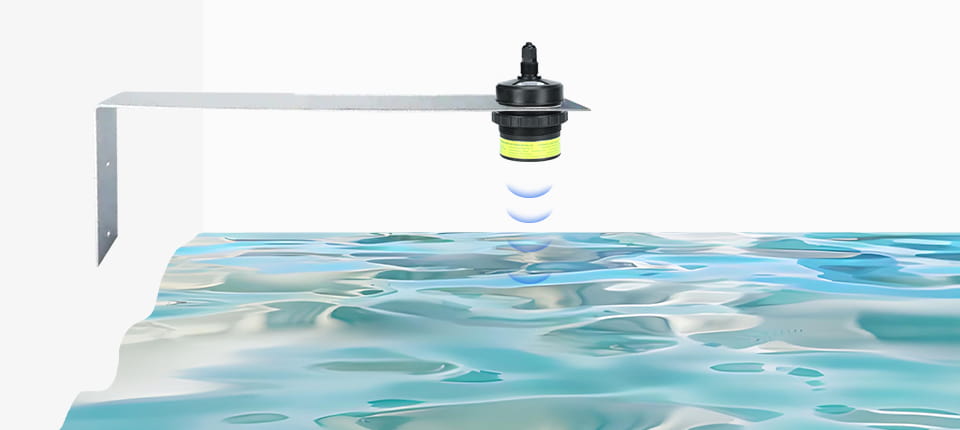
PWL-U500 Ultrasonic Level Sensor (Best for Tanks & Industrial Use)
A compact and intelligent ultrasonic level transmitter designed for stable long-term operation.
Key Features
- 4–20mA + RS485 output
- Measuring range: 5m / 7m / 10m / 15m
- Accuracy: 0.5% FS (0.25% customizable)
- IP66 (IP68 optional)
- Optional intrinsically safe explosion-proof
Core Advantages
- Non-contact measurement
- Compact structure with high stability
- Cost-effective for bulk projects
- Full-range automatic temperature compensation
- Intelligent anti-interference & error correction
Typical Applications
- Water tanks
- Diesel fuel tanks
- Reservoirs / rivers / lakes
- Food industry
- Wastewater treatment
👉 Widely used as a fuel level sensor and industrial tank level transmitter.
FAQ
1. What is the difference between ultrasonic and radar level sensors?
Ultrasonic sensors are more cost-effective, while radar is better for extreme conditions like high pressure or heavy vapor.
2. Can ultrasonic sensors measure diesel or fuel?
Yes. The PWL-U500 is widely used for diesel tank level measurement due to its non-contact and safe design.
3. What affects measurement accuracy?
- Temperature changes
- Foam or vapor
- Improper installation
4. Do you support OEM/ODM?
Yes. Pokcenser provides full OEM/ODM customization.
Get a Quote from Pokcenser
Looking for a reliable ultrasonic level sensor supplier?
👉 Contact Pokcenser today to get:
- Fast quotation
- Technical consultation
- Custom solutions

