 English
 Spanish
Water Flow Meter Selection: Industrial Applications Guide
Accurate flow measurement keeps industrial processes running smoothly, maintains quality standards, and prevents resource waste. But picking the right water flow meter isn’t straightforward—fluid properties, operating conditions, and installation constraints all pull in different directions. Pokcenser Automation has spent over a decade in process control automation, developing flow meter solutions that handle these variables reliably across demanding industrial environments.
How Different Water Flow Meter Technologies Actually Work
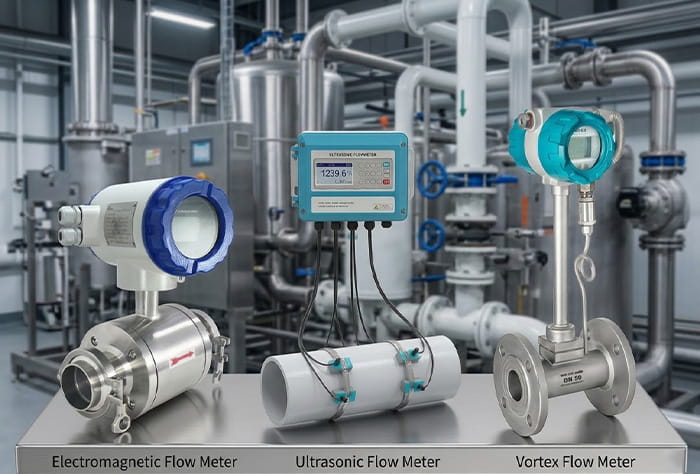
Industrial water flow meters rely on distinct physical principles, and each approach suits certain applications better than others. We supply magnetic, ultrasonic, and vortex flow meters, each built around different measurement mechanics.
Magnetic Flow Meters Measure Conductive Liquids Through Electromagnetic Induction
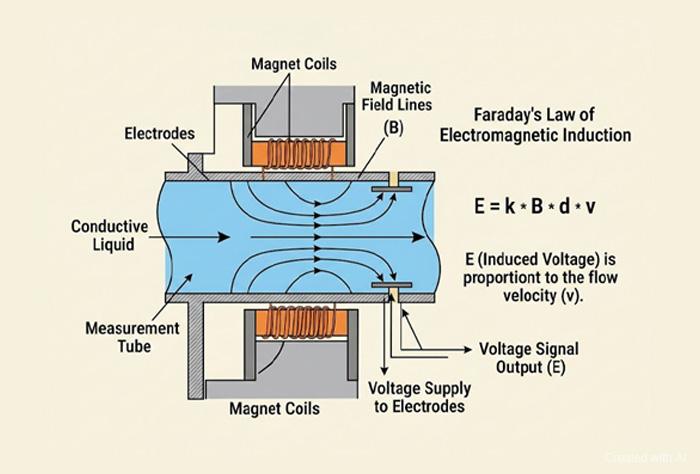
Magnetic flow meters—often called mag meters—apply Faraday’s Law of Electromagnetic Induction. A magnetic field surrounds the measuring tube, and as conductive fluid passes through, it generates a voltage proportional to flow velocity. This makes mag meters well-suited for water, wastewater, and slurries where conductivity is present. Pokcenser’s magnetic flow meters carry CE, ATEX, ISO, and RoHS certifications, which matters when installations face corrosive chemicals or explosive atmospheres. The technology handles dirty and abrasive fluids without the wear issues that affect mechanical meters. Our PWF-E1200 series electromagnetic flow meter (magmeter) products deliver consistent performance across a range of industrial conditions.
Ultrasonic Flow Meters Offer Non-Invasive Measurement Without Breaking the Pipe
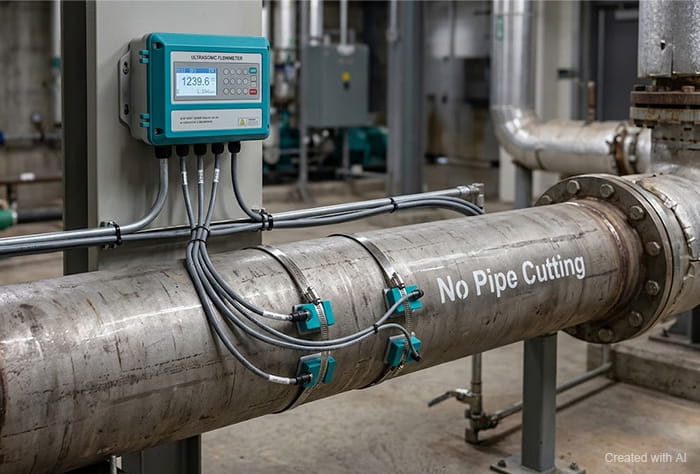
Ultrasonic flow meters use sound waves rather than direct fluid contact. Transit-time models measure how long ultrasonic pulses take to travel upstream versus downstream—the difference reveals flow velocity. Doppler models detect frequency shifts caused by particles or bubbles suspended in the fluid. Because sensors mount externally, these meters work well where you can’t interrupt the pipeline or where the fluid would damage internal components. Our PWF-U2000MCC and PWF-U2000MCI models achieve high accuracy without cutting into the process line. The PWF-U1000 handles small-diameter pipes specifically, installing quickly without shutting down flow.
For a deeper look at how these technologies stack up against turbine meters, see 《Flow Meter Selection: Turbine vs. Electromagnetic vs. Ultrasonic Flow Meters》.
What Actually Matters When Selecting a Water Flow Meter
Choosing the right flow meter means weighing accuracy needs against practical constraints like installation space and budget. We’ve delivered over 150,000 solutions to clients in more than 100 countries, and that experience shapes how we approach each application. Fluid behavior, operating ranges, and site conditions all factor into the recommendation.
What factors should be considered when selecting a flow meter for specific industrial processes?
- Fluid Characteristics: The fluid type drives technology selection. Magnetic flow meters need conductive liquids—typically above 5 µS/cm—while ultrasonic meters work with both clean and particle-laden water. Viscosity, temperature, and pressure also constrain which meters perform reliably.
- Flow Rate Range: The meter must handle both minimum and maximum expected flows. Undersizing causes inaccuracy at low flows; oversizing creates resolution problems.
- Accuracy Requirements: Some processes tolerate ±2% error; others demand ±0.5% or better. Higher accuracy typically costs more, so matching precision to actual needs avoids overspending.
- Pipe Size and Material: Certain meters fit specific diameter ranges. Non-invasive ultrasonic options avoid pipe modifications entirely, which simplifies retrofits.
- Installation Requirements: Available space, pipe orientation, and access for maintenance all affect which meter types are practical. Straight pipe runs upstream and downstream influence accuracy for most technologies.
- Environmental Conditions: Temperature extremes, humidity, vibration, and hazardous area classifications narrow the field. Pokcenser offers explosion-proof sensors for environments where standard electronics aren’t permitted.
- Cost of Ownership: Purchase price is just the start. Installation labor, calibration intervals, and replacement parts add up over the meter’s service life.
- Output and Communication: Integration with existing control systems requires compatible signals—4-20 mA analog, RS485 Modbus RTU, or other protocols depending on the plant’s infrastructure.
Where Water Flow Meters Prove Essential Across Industries
Water flow meters show up wherever process control and resource management matter. Pokcenser Automation works across oil and gas, Water and Wastewater Treatment, chemical and petrochemical, and food and beverage sectors, providing integrated support from specification through commissioning.
- Water and Wastewater Treatment: Municipal plants track raw water intake, chemical dosing, filtration throughput, and effluent discharge. Electromagnetic flow meter products handle the corrosive and abrasive fluids common in wastewater treatment without the maintenance burden of mechanical alternatives.
- Oil and Gas: Refineries and offshore platforms monitor water injection, produced water, and cooling circuits. Accurate measurement prevents injection imbalances and cooling system failures.
- Chemical Processing: Precise flow data ensures correct blending ratios and reaction control. In chemical processing, even small measurement errors compound into product quality problems.
- Food and Beverage: Sanitary electromagnetic flow meters meet hygiene requirements while measuring ingredients, cleaning solutions, and process water.
- Power Generation: Cooling water, boiler feedwater, and condensate return all require monitoring to maintain efficiency and protect equipment from thermal stress.
- Agriculture: Modern irrigation systems depend on accurate water flow measurement to optimize water use and prevent over- or under-watering.
Getting Installation, Calibration, and Maintenance Right
Even the best water flow meter underperforms if installed incorrectly or neglected over time. Our pre-sales and after-sales teams work with clients to establish practices that keep meters accurate throughout their service life.
How do different flow meter technologies compare in terms of accuracy, cost, and maintenance?
| Technology | Accuracy (Typical) | Initial Cost (Relative) | Maintenance (Relative) |
|---|---|---|---|
| Magnetic | High (0.2-1%) | Medium-High | Low |
| Ultrasonic | High (0.5-2%) | Medium-High | Very Low (non-invasive) |
| Vortex | Medium (0.5-2%) | Medium | Low |
| Coriolis | Very High (0.1-0.5%) | High | Low |
| Thermal Mass | High (1-2%) | Medium | Low |
- Installation: Manufacturer guidelines exist for good reason. Upstream and downstream straight pipe requirements vary by technology—magnetic meters typically need 5 diameters upstream and 2 downstream, while ultrasonic meters may require more. Proper grounding prevents electrical interference in mag meters. Sensor placement on ultrasonic devices affects signal quality.
- Calibration: Accuracy drifts over time, so regular calibration keeps measurements trustworthy. Some facilities calibrate in place; others send meters to certified labs. We help clients determine appropriate intervals based on their process criticality and regulatory environment.
- Maintenance: Preventative inspections catch wear, corrosion, and debris buildup before they cause failures. Addressing early warning signs avoids unplanned downtime and the costs that come with it.
Where Industrial Water Flow Measurement Is Heading
Flow measurement technology continues advancing as industries push for better efficiency, connectivity, and environmental performance. Pokcenser Automation tracks these developments and incorporates relevant innovations into our product lines.
- Smart Flow Meters and IoT Integration: Modern water flow meters increasingly include onboard diagnostics and communication capabilities like RS485 Modbus RTU. Real-time data feeds enable remote monitoring and predictive maintenance, catching problems before they disrupt production.
- Wireless Connectivity: Wireless sensors reduce cabling costs and simplify installation in hard-to-reach locations. Data reaches centralized control systems without the infrastructure investment that wired networks require.
- AI and Machine Learning: Pattern recognition algorithms analyze flow data to detect anomalies and predict equipment issues. These tools complement human judgment rather than replacing it, flagging conditions that warrant investigation.
- Sustainable Solutions: Lower power consumption and reduced material use align with environmental goals. Battery-powered meters and solar options expand deployment possibilities in remote locations.
Frequently Asked Questions About Water Flow Meters
What is the typical lifespan of an industrial water flow meter?
Industrial water flow meters generally last 10 to 20 years when properly installed and maintained, though actual lifespan depends heavily on operating conditions. Corrosive fluids, temperature cycling, and pressure spikes all accelerate wear. Magnetic and ultrasonic meters tend toward the longer end of that range because they lack moving parts. Following manufacturer maintenance schedules and calibrating regularly helps meters reach their full service potential.
How often should industrial flow meters be calibrated?
Calibration intervals depend on how critical the measurement is and what regulations apply. High-stakes processes—custody transfer, environmental compliance, pharmaceutical production—often require annual calibration. Less critical applications might stretch to three or five years. The meter’s historical stability matters too; some units drift more than others. We work with clients to establish calibration schedules that balance accuracy requirements against operational disruption.
What are the signs of a malfunctioning water flow meter?
Erratic readings, sudden jumps or drops in measured flow, and complete signal loss all point to potential problems. Indirect signs include unexplained process variations, product yield discrepancies, or system imbalances that don’t match other instrumentation. Visible damage to sensors or housings warrants immediate attention. When something seems off, investigating promptly prevents small issues from becoming expensive failures. Our after-sales team helps diagnose problems and determine whether repair or replacement makes more sense.
Partner with Pokcenser Automation for Your Flow Measurement Needs
For reliable industrial flow measurement and process control automation, trust Pokcenser Automation. Our 10+ years of experience and commitment to quality ensure we deliver precise, durable, and certified solutions. Contact us today for expert consultation and customized industrial flow meter solutions tailored to your specific application. Our dedicated team is ready to provide one-stop worry-free services.
Email: in**@*******er.com
Phone: +86 181 7515 5326

