 English
 Spanish
Absolute Pressure vs Negative Pressure: How to Choose the Right Sensor
When selecting a pressure measurement solution, one of the most common questions engineers face is:
Should you choose an absolute pressure transmitter or a negative (vacuum) pressure transmitter?
At Pokcenser, we specialize in industrial pressure sensing solutions. This guide will help you clearly understand the differences, applications, and how to choose the right product for your system.
What Is an Absolute Pressure Transmitter?
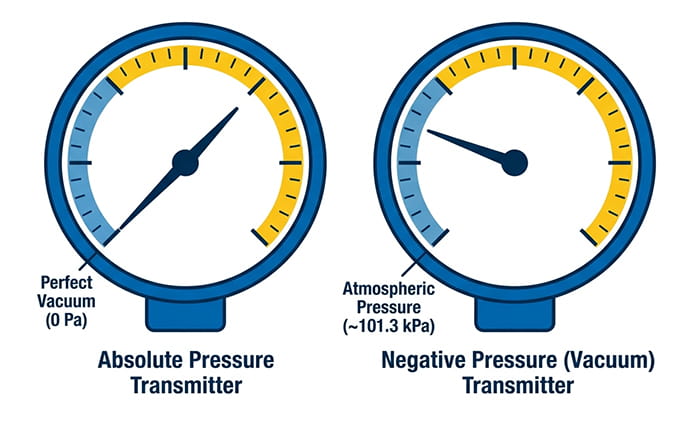
An absolute pressure transmitter measures pressure relative to a perfect vacuum (0 Pa).
- Reference point: Absolute vacuum
- Measurement range: 0 Pa to full scale (e.g., 0–100 kPa)
- Key advantage: Not affected by atmospheric pressure fluctuations
This makes it ideal for high-precision and closed systems.
What Is a Negative Pressure (Vacuum) Transmitter?
A negative pressure transmitter measures pressure below atmospheric pressure.
- Reference point: Atmospheric pressure (≈101.325 kPa)
- Measurement range: Typically -100 kPa to 0 kPa
- Output characteristic: Negative values indicate vacuum
Best suited for applications involving suction or vacuum conditions.
Key Differences Between Absolute and Negative Pressure
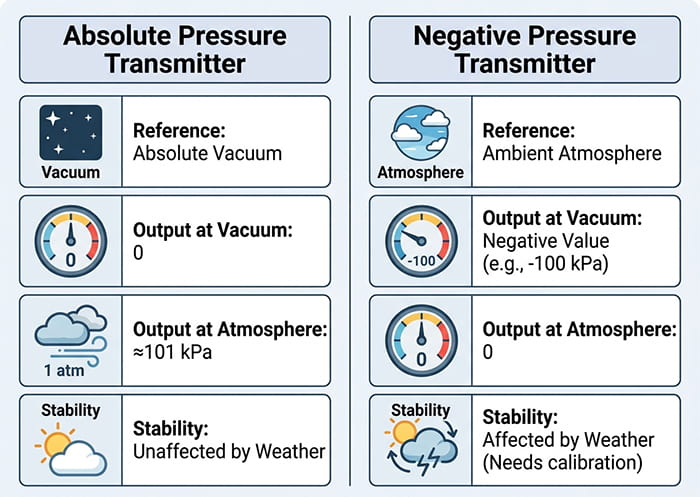
| Feature | Absolute Pressure | Negative Pressure |
| Reference | Absolute vacuum | Atmospheric pressure |
| Output | 0 = vacuum | 0 = atmosphere |
| Stability | Immune to atmospheric changes | Affected by atmospheric fluctuations |
| Use Case | Precision & closed systems | Vacuum & ventilation systems |
Typical Applications
Absolute Pressure Transmitter Applications
- Sealed systems (reactors, distillation columns)
- Semiconductor vacuum processes
- Meteorology and altitude measurement
- Subsea or underground pressure monitoring
Pokcenser absolute pressure sensors ensure stable readings even under changing environmental conditions.
Negative Pressure Transmitter Applications
- Vacuum packaging machines
- Central vacuum systems
- Medical ventilators & negative pressure rooms
- HVAC and ventilation pipelines
Pokcenser vacuum transmitters deliver reliable performance for industrial and medical vacuum control.
How to Choose the Right Pressure Transmitter?
Choose Absolute Pressure if:
- You need measurements independent of atmospheric pressure
- Your system is sealed or highly sensitive
- You work in high-precision industries (chemical, semiconductor)
Choose Negative Pressure if:
- You are measuring vacuum or suction
- Atmospheric pressure variation is acceptable
- Your application involves airflow or ventilation
Important Considerations
- Absolute pressure transmitters are factory-calibrated to vacuum
- Negative pressure transmitters require regular calibration due to atmospheric changes
- Material compatibility matters in corrosive environments
- Common materials: 316L stainless steel, Hastelloy diaphragm
Why Choose Pokcenser?
At Pokcenser, we provide:
- High-precision pressure transmitters
- Customizable measurement ranges
- OEM/ODM support for global clients
Contact Pokcenser today to get the best pressure measurement solution for your application.
FAQ
1. What is the main difference between absolute and negative pressure?
Absolute pressure uses a vacuum reference, while negative pressure is based on atmospheric pressure.
2. Which is more accurate?
Absolute pressure transmitters are generally more stable because they are not affected by atmospheric pressure changes.
3. Can I use a negative pressure sensor for vacuum systems?
Yes, but only for low to medium vacuum ranges. For high vacuum, absolute pressure is recommended.
4. Do pressure transmitters require calibration?
- Absolute pressure: rarely (factory calibrated)
- Negative pressure: requires periodic calibration
5. How do I choose the right material?
For corrosive environments, choose sensors with 316L stainless steel or Hastelloy diaphragms.
