 English
 Spanish
Acetone Tank Level Measurement Solution: High-Frequency Radar Level Sensor + Digital Display Controller
In modern chemical production, accurate liquid level monitoring is essential for both process safety and operational efficiency. Among various chemical solvents, acetone (CH₃COCH₃) presents unique measurement challenges due to its high volatility and flammable nature. Traditional measurement technologies often struggle in such demanding environments.
To address these issues, Pokcenser offers a reliable and industry-proven solution: 80GHz high-frequency radar level sensors combined with digital display controllers. This solution delivers stable, accurate, and safe liquid level monitoring for acetone storage tanks and other volatile organic solvents.
Why Acetone Level Measurement Is Challenging
Acetone is one of the most commonly used industrial organic solvents, widely applied in chemical manufacturing, pharmaceuticals, coatings, and cleaning processes. However, its physical properties create several obstacles for level measurement systems.
1. High Volatility
Acetone evaporates easily, generating dense vapor inside storage tanks. These vapors can significantly interfere with instruments based on acoustic principles, such as ultrasonic level sensors, causing unstable or inaccurate readings.
2. Flammable and Explosive Environment
Acetone vapor can form explosive mixtures when combined with air. Therefore, all instruments installed in the tank area must meet strict explosion-proof safety requirements.
3. Signal Stability Requirements
Although acetone has a relatively favorable dielectric constant for radar measurement, improper frequency selection may still lead to signal attenuation and unreliable readings. This is especially important in chemical storage applications requiring continuous and precise monitoring.
Why 80GHz Radar Level Sensors Are Ideal for Acetone Tanks
Compared with traditional ultrasonic or contact-type level instruments, high-frequency radar technology provides superior reliability in volatile chemical environments.
Non-Contact Measurement Technology
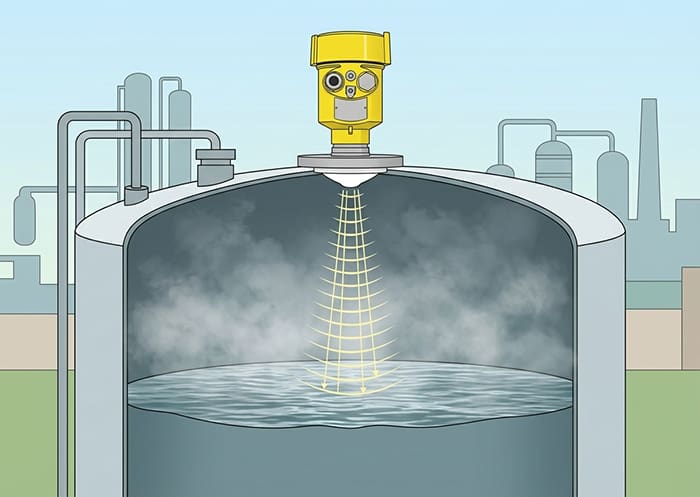
Radar level sensors emit microwave signals toward the liquid surface and receive the reflected signals through the antenna. By calculating the travel time of the signal, the instrument accurately determines the liquid level.
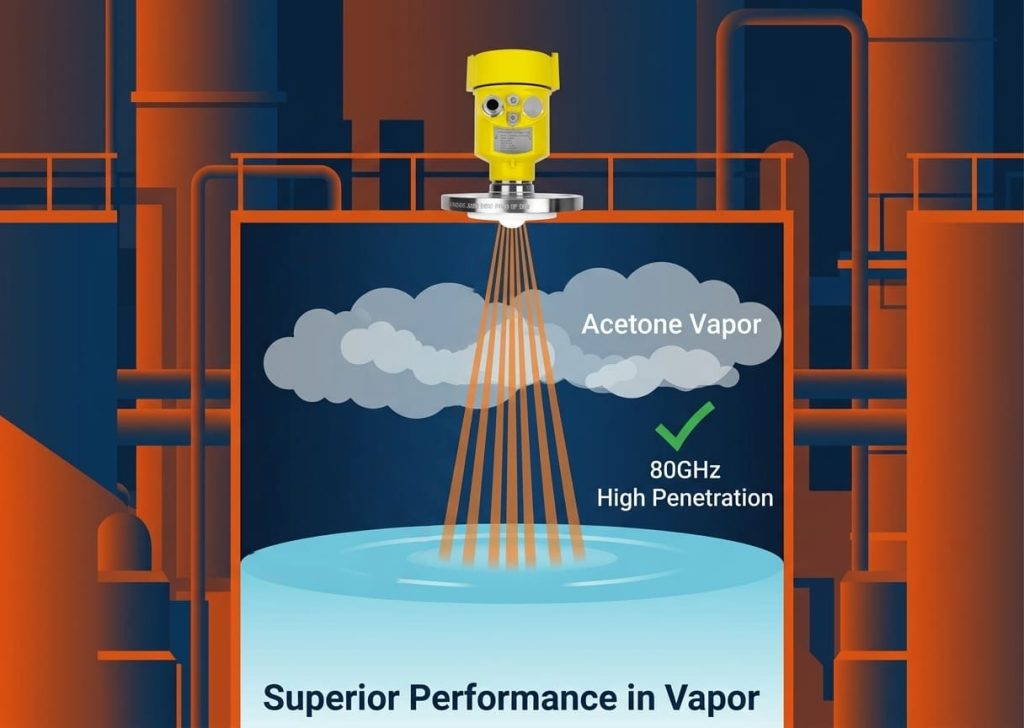
Because radar waves are largely unaffected by vapor, temperature changes, or tank pressure, the measurement remains stable even in harsh chemical conditions.
Key Advantages of High-Frequency Radar Level Sensors
Excellent Resistance to Vapor Interference
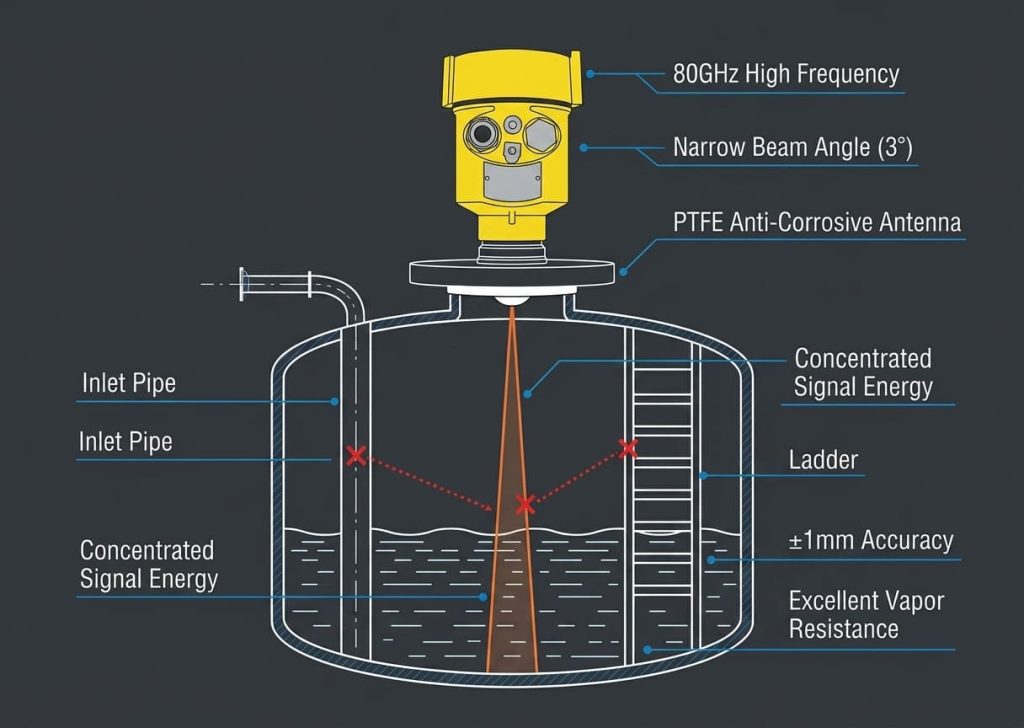
80GHz radar sensors feature extremely narrow beam angles and highly concentrated signal energy. This allows the sensor to effectively avoid internal tank obstacles such as ladders, agitators, or inlet pipes.
More importantly, radar measurement is not affected by acetone vapor, unlike ultrasonic technologies that depend on sound propagation.
High Measurement Accuracy
Modern 80GHz radar level transmitters can achieve accuracy up to ±1 mm, making them suitable for precision chemical processing and inventory management.
Stable Performance in Harsh Conditions
Whether installed on atmospheric tanks or pressurized vessels, radar sensors maintain reliable operation under varying temperatures and process conditions.
The non-contact design also minimizes maintenance requirements because the sensor does not directly touch the medium.
Explosion-Proof Safety Design
For hazardous chemical environments, explosion-proof certifications are critical. High-frequency radar level sensors can be equipped with:
- Intrinsically safe protection (Ex ia IIC T6)
- Flameproof explosion-proof designs
- Corrosion-resistant PTFE antennas
These features ensure safe operation in hazardous areas containing flammable solvents such as acetone.
Recommended Product for Corrosive and Volatile Chemicals
For demanding chemical storage applications, Pokcenser PWL-R804 Anti-Corrosive Radar Level Sensor is an excellent choice.
Key Features
- 80GHz high-frequency radar technology
- Non-contact continuous level measurement
- PTFE anti-corrosion antenna material
- Suitable for volatile and corrosive liquids
- High measurement stability in vapor-heavy environments
- Optional explosion-proof certifications
- Easy installation and low maintenance
The PWL-R804 is widely used in:
- Acetone storage tanks
- Acid and alkali tanks
- Chemical solvent containers
- Pharmaceutical process tanks
- Wastewater and chemical treatment systems
Digital Display Controller: Real-Time Local Monitoring
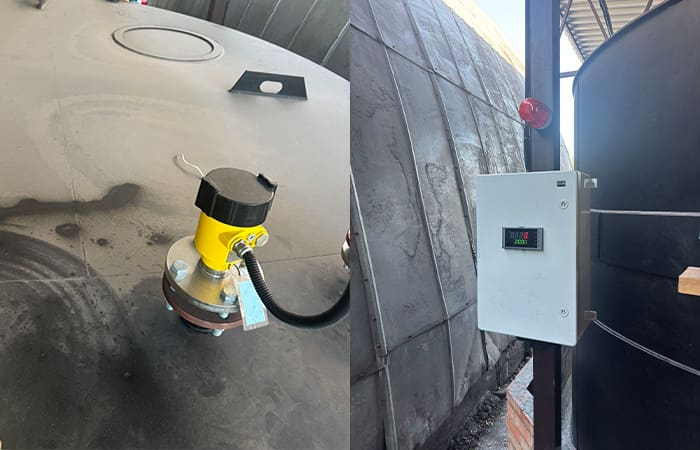
A digital display controller works together with the radar level sensor by receiving standard 4–20mA or RS485 signals and displaying real-time tank level data locally.
This creates a convenient on-site monitoring solution for operators and maintenance personnel.
Benefits of Digital Display Controllers
Improved Inspection Efficiency
Operators can instantly check tank levels on-site without repeatedly visiting the control room.
Enhanced Safety
Reducing unnecessary movement in hazardous areas helps improve operational safety in explosive environments.
Easier Maintenance and Diagnostics
Many intelligent display controllers support:
- Basic parameter configuration
- Alarm output
- Communication diagnostics
- Instrument troubleshooting
This helps maintenance teams quickly identify and resolve issues.
Complete Solution Advantages
| Component | Selection Features | Main Advantages |
| High-Frequency Radar Level Sensor | 80GHz frequency, PTFE antenna, explosion-proof options | Accurate measurement, unaffected by acetone vapor, high stability |
| Digital Display Controller | 4-20mA/RS485/RS232 communication, LED display | Real-time local display, easier inspection, improved safety |
Why More Chemical Plants Choose Radar Level Measurement
As industrial safety standards continue to rise, more chemical plants are replacing traditional level instruments with advanced radar technology.
Compared with ultrasonic level sensors, magnetic level gauges, or float systems, 80GHz radar level sensors provide:
- Better long-term reliability
- Higher accuracy
- Lower maintenance costs
- Stronger anti-interference capability
- Safer operation in hazardous environments
For volatile solvents like acetone, radar measurement has become one of the most trusted solutions in the chemical industry.
Although acetone tank level measurement presents several technical challenges, selecting the right instrumentation can ensure safe and stable operation.
The combination of an 80GHz high-frequency radar level sensor and a digital display controller offers a complete solution with:
- High accuracy
- Strong vapor resistance
- Reliable explosion-proof protection
- Convenient local monitoring
- Reduced maintenance requirements
If you are looking for a reliable level monitoring solution for acetone or other volatile chemical solvents, the Pokcenser PWL-R804 Anti-Corrosive Radar Level Sensor can help improve both safety and operational efficiency.
