 English
 Spanish
Electromagnetic Flow Meters for Municipal Water Supply Systems: Why They Are the Preferred Choice
Municipal water supply systems require accurate and reliable flow measurement to ensure efficient water production, distribution, and consumption management. Whether monitoring treatment plant output, tracking water usage in District Metered Areas (DMAs), or managing pump stations, selecting the right flow meter is critical.
Among the various flow measurement technologies available today, electromagnetic flow meters have become one of the most widely used solutions in municipal water projects due to their high accuracy, low maintenance requirements, and excellent long-term stability.
In this guide, we’ll explore why electromagnetic flow meters are the preferred choice for municipal water supply systems and how they help utilities improve operational efficiency.
Why Flow Measurement Matters in Municipal Water Supply Systems
Water utilities rely on accurate flow data for a variety of operational tasks.
Water Production Monitoring
Treatment plants need precise flow measurement to monitor daily water production and ensure regulatory compliance.
Leakage Detection
Flow meters installed throughout the distribution network help identify water losses and detect leaks before they become major issues.
Pump Station Optimization
Flow data allows operators to optimize pump performance, reduce energy consumption, and improve overall system efficiency.
Revenue and Consumption Analysis
Accurate flow measurement supports billing accuracy and helps utilities better understand consumption patterns.
Why Electromagnetic Flow Meters Are Ideal for Municipal Water Applications
Electromagnetic flow meters operate using Faraday’s Law of Electromagnetic Induction.
When conductive water passes through a magnetic field, a voltage signal is generated and converted into a flow measurement.
Because potable water and treated water have sufficient conductivity, electromagnetic flow meters provide highly reliable results.
High Measurement Accuracy
Electromagnetic flow meters typically offer accuracy levels up to ±0.5% or better.
This helps utilities maintain confidence in their operational data.
No Moving Parts
Unlike mechanical water meters, electromagnetic flow meters contain no moving components.
Benefits include:
- Reduced wear
- Longer service life
- Lower maintenance costs
No Pressure Loss
The measuring tube contains no obstructions.
As a result:
- No additional pressure drop occurs
- Pump energy consumption remains optimized
- System efficiency improves
Excellent Long-Term Stability
Electromagnetic flow meters maintain measurement performance over many years of operation.
This is particularly important for municipal infrastructure projects where equipment is expected to remain in service for extended periods.
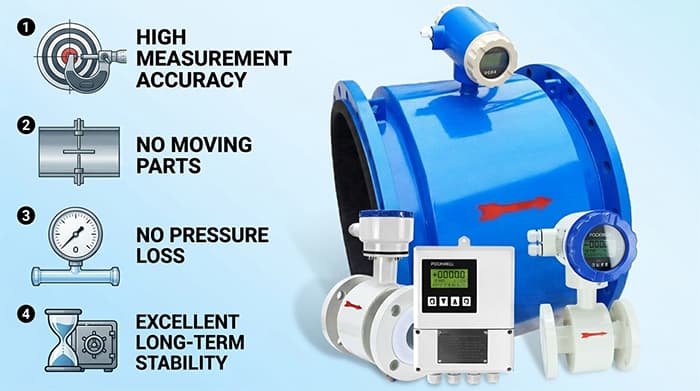
Recommended Product: Pokcenser Electromagnetic Flow Meter
For municipal water treatment and distribution projects, Pokcenser offers reliable electromagnetic flow measurement solutions designed for demanding industrial environments.
Key Features
- High accuracy measurement
- No moving parts
- Low maintenance requirements
- Suitable for clean water and treated water
- Multiple communication options
- Wide pipe size availability
- Industrial-grade design
Typical Applications
- Water treatment plants
- Municipal distribution networks
- Pump stations
- Reservoir monitoring
- DMA flow monitoring
- Bulk water transfer systems
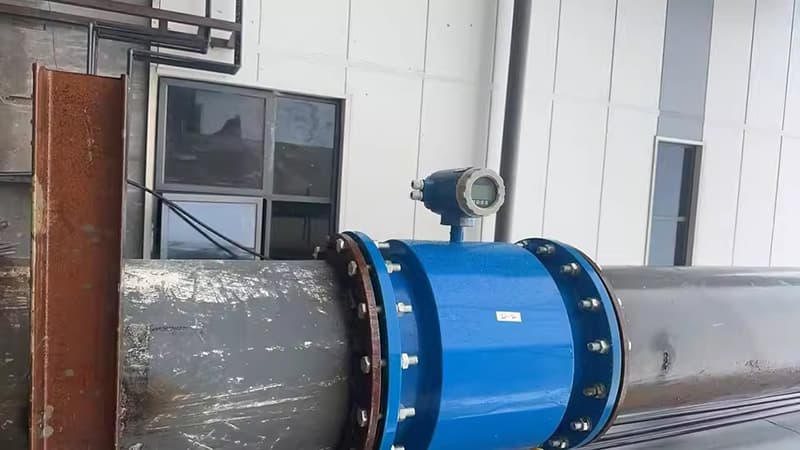
Common Municipal Water Applications
Water Treatment Plant Outlet Monitoring
Flow meters installed at treatment plant outlets provide production data used for:
- Regulatory reporting
- Water balance calculations
- System performance analysis
District Metered Areas (DMA)
DMA monitoring is essential for reducing non-revenue water.
Flow meters help utilities:
- Detect leaks
- Compare supply versus consumption
- Identify abnormal flow patterns
Pump Stations
Monitoring flow at pump stations enables:
- Pump efficiency analysis
- Energy optimization
- Operational troubleshooting
Reservoir Inlet and Outlet Monitoring
Flow data supports:
- Water storage management
- Distribution planning
- Emergency response preparation
Installation Considerations for Electromagnetic Flow Meters
Proper installation is essential for achieving optimal performance.
Ensure a Full Pipe
Electromagnetic flow meters require the measuring tube to remain completely filled with water.
Avoid installation at pipeline high points where air pockets may form.
Maintain Straight Pipe Runs
Providing sufficient straight pipe lengths helps improve measurement stability.
Proper Grounding
Correct grounding reduces electrical interference and ensures measurement accuracy.
Protect Underground Installations
For chamber installations, adequate drainage and environmental protection should be considered.
Electromagnetic Flow Meter vs Mechanical Water Meter
| Feature | Electromagnetic Flow Meter | Mechanical Water Meter |
| Accuracy | High | Moderate |
| Moving Parts | No | Yes |
| Pressure Loss | Minimal | Higher |
| Maintenance | Very Low | Moderate |
| Wear and Tear | Minimal | Higher |
| Large Diameter Pipes | Excellent | Limited |
| Long-Term Stability | Excellent | Can Decrease |
For most municipal bulk flow applications, electromagnetic flow meters provide superior lifecycle value.
Why More Municipalities Are Upgrading to Smart Flow Monitoring
Modern utilities increasingly integrate flow meters into digital monitoring systems.
Benefits include:
Real-Time Monitoring
Operators can access live flow data from centralized control systems.
Remote Management
Flow information can be transmitted through:
- SCADA systems
- PLC systems
- Remote telemetry units
Data-Driven Decision Making
Utilities can use historical flow data to:
- Optimize operations
- Reduce losses
- Improve maintenance planning
Why Choose Pokcenser?
Pokcenser has more than 10 years of experience in industrial process automation and instrumentation.
Our products are used in over 100 countries across industries including:
- Municipal water supply
- Water treatment
- Wastewater treatment
- Environmental monitoring
- Industrial automation
What We Offer
- CE certified products
- RoHS compliant solutions
- OEM & ODM support
- Professional technical consultation
- Fast response service
- Competitive factory-direct pricing
Frequently Asked Questions
Q1: Why are electromagnetic flow meters suitable for municipal water systems?
Because they provide high accuracy, low maintenance requirements, and long-term stability without moving parts.
Q2: Can electromagnetic flow meters measure potable water?
Yes. Potable water typically has sufficient conductivity for electromagnetic flow measurement.
Q3: Do electromagnetic flow meters cause pressure loss?
No. The measuring tube contains no obstructions, resulting in virtually no pressure loss.
Q4: Are electromagnetic flow meters suitable for large pipe diameters?
Yes. They are widely used in municipal pipelines ranging from small distribution lines to large transmission mains.
Q5: Can Pokcenser provide customized flow measurement solutions?
Yes. Pokcenser offers OEM, ODM, and application-specific flow monitoring solutions.
