 English
 Spanish
Ultrasonic Level Sensors for Wastewater Lift Stations: A Reliable and Cost-Effective Monitoring Solution
Wastewater lift stations play a critical role in municipal sewage collection systems. Their primary function is to transport wastewater from lower elevations to higher points where gravity flow can continue toward treatment facilities.
To ensure reliable operation, accurate level monitoring is essential.
A dependable level measurement system helps operators:
- Prevent overflow incidents
- Protect pumps from dry running
- Optimize pump operation
- Reduce maintenance costs
- Improve system reliability
Among the available level measurement technologies, ultrasonic level sensors have become one of the most popular solutions for wastewater lift stations due to their non-contact operation, easy installation, and low maintenance requirements.
Why Level Monitoring Is Critical in Wastewater Lift Stations
Wastewater lift stations often operate continuously and handle varying flow rates throughout the day.
Without reliable level monitoring, operators may encounter:
Overflow Events
Excessive wastewater levels can cause environmental contamination and regulatory violations.
Pump Damage
Incorrect level readings may lead to dry-running conditions that damage pumps.
Increased Energy Consumption
Poor pump control can result in unnecessary operating cycles and higher energy costs.
Maintenance Challenges
Unexpected failures often require emergency maintenance and costly downtime.
Accurate level measurement helps prevent these issues while improving operational efficiency.
Challenges of Wastewater Level Measurement
Wastewater applications are among the most difficult environments for level instrumentation.
High Humidity
Pump stations typically experience constant moisture and condensation.
Corrosive Gases
Hydrogen sulfide and other gases can affect equipment performance over time.
Floating Debris
Wastewater often contains solids, grease, and floating materials.
Foam Formation
Many lift stations experience surface foam that can interfere with certain measurement technologies.
Limited Maintenance Access
Some pump stations are located in remote or underground locations.
These conditions require a level sensor that is reliable, durable, and easy to maintain.
Why Ultrasonic Level Sensors Are a Popular Choice
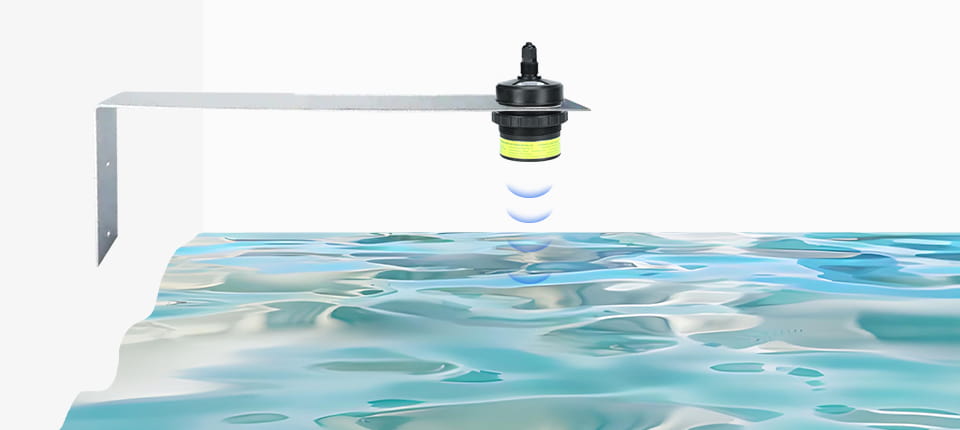
Ultrasonic sensors measure level by transmitting sound waves toward the liquid surface and calculating the return time of the reflected signal.
Because the sensor is installed above the wastewater surface, it never comes into direct contact with the liquid.
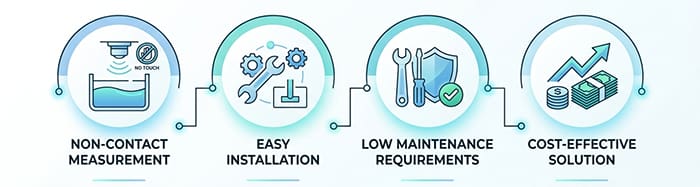
Non-Contact Measurement
Benefits include:
- No sensor contamination
- Reduced maintenance
- Longer service life
Easy Installation
Most ultrasonic sensors can be mounted directly above the wet well without modifying existing pipework.
Low Maintenance Requirements
No moving parts means fewer failures and lower maintenance costs.
Cost-Effective Solution
Compared with some alternative technologies, ultrasonic level sensors often provide excellent performance at a competitive cost.
Recommended Product: PWL-U500 Ultrasonic Level Sensor
Product:
PWL-U500 Ultrasonic Level Sensor
The PWL-U500 is one of Pokcenser’s most widely used ultrasonic level sensors for tanks, reservoirs, water systems, and wastewater applications.
Key Features
- Non-contact measurement
- 4-20mA and RS485 output options
- Intelligent anti-interference technology
- Automatic temperature compensation
- Optional IP68 protection
- Optional explosion-proof version available
Typical Applications
- Wastewater lift stations
- Sewage collection wells
- Water tanks
- Reservoirs
- Industrial process tanks
Recommended Product: PWL-U700 Ultrasonic Level Transmitter
Product:
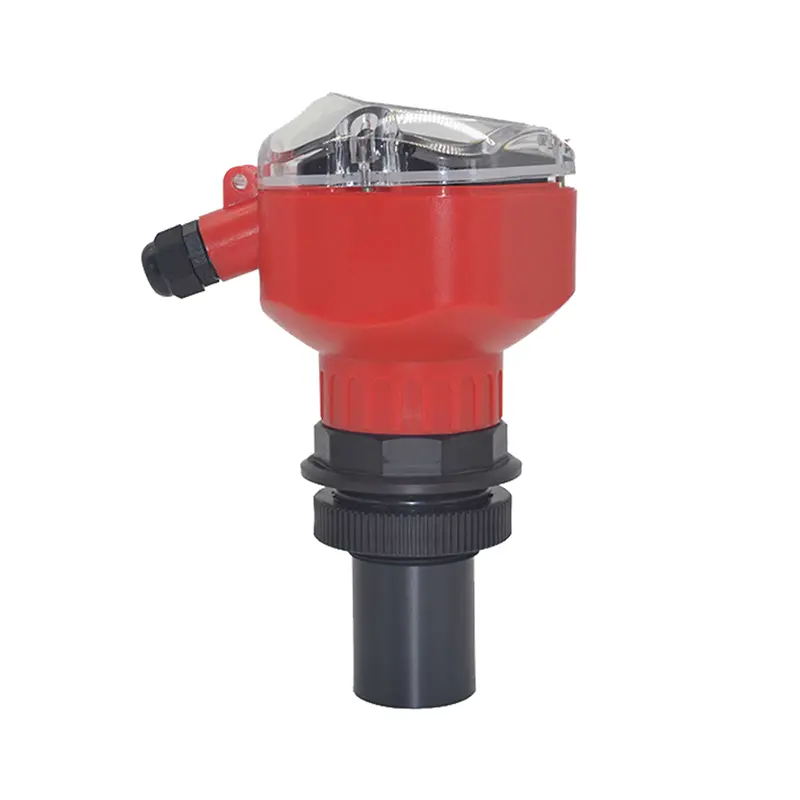
PWL-U700 Ultrasonic Level Transmitter
The PWL-U700 series is designed for industrial liquid level monitoring and supports measuring ranges up to 60 meters. It features non-contact measurement, intelligent filtering algorithms, and multiple output options.
Key Features
- Measuring range up to 60m
- Non-contact ultrasonic technology
- Intelligent filtering algorithm
- Optional relay output
- Corrosion-resistant construction
- IP66 protection level
Typical Applications
- Wastewater lift stations
- Pump stations
- Water treatment facilities
- Chemical storage tanks
- Open channel monitoring
Ultrasonic vs Other Wastewater Level Measurement Technologies
Ultrasonic Level Sensors
Advantages:
- Non-contact
- Easy installation
- Cost-effective
- Low maintenance
Limitations:
- Heavy foam may affect performance
Radar Level Sensors
Advantages:
- Less affected by foam and vapor
- Excellent reliability
Limitations:
- Higher investment cost
Hydrostatic Level Sensors
Advantages:
- Direct immersion measurement
- Suitable for deep wells
Limitations:
- Contact with wastewater
- Higher maintenance requirements
For many wastewater lift stations with moderate foam conditions, ultrasonic sensors provide an excellent balance between performance and cost.
Best Installation Practices
To achieve reliable performance, consider the following installation recommendations.
Avoid Obstructions
Install the sensor away from ladders, pipes, and structural components.
Maintain Vertical Alignment
The sensor should point directly toward the liquid surface.
Minimize Turbulence Effects
Avoid installation directly above inlet flows when possible.
Consider Foam Conditions
If persistent heavy foam is present, radar technology may be a better solution.
Benefits of Smart Wastewater Monitoring
Modern wastewater facilities increasingly integrate level sensors with:
- PLC systems
- SCADA platforms
- Remote telemetry units
- Cloud monitoring systems
This allows operators to:
Receive Real-Time Alarms
Immediate notification of high-level conditions.
Optimize Pump Control
Reduce energy consumption and equipment wear.
Improve Maintenance Planning
Identify operational issues before failures occur.
Reduce Site Visits
Remote monitoring minimizes labor requirements.
Why Choose Pokcenser?
Pokcenser has more than 10 years of experience in industrial automation and level measurement technology.
Our products are used in more than 100 countries across industries including:
- Water treatment
- Wastewater treatment
- Environmental monitoring
- Chemical processing
- Industrial manufacturing
What We Offer
- CE certified products
- OEM & ODM support
- Professional technical consultation
- Fast engineering support
- Competitive factory pricing
Frequently Asked Questions
Q1: Are ultrasonic sensors suitable for wastewater applications?
Yes. Ultrasonic sensors are widely used in wastewater lift stations because they provide non-contact measurement and require minimal maintenance.
Q2: What is the main advantage of ultrasonic level measurement?
The sensor does not contact the wastewater, reducing contamination and maintenance requirements.
Q3: Can ultrasonic sensors be used in underground pump stations?
Yes. They are commonly installed in sewage lift stations and underground wet wells.
Q4: What if foam is present on the wastewater surface?
Light to moderate foam can usually be managed. For heavy foam applications, radar level sensors may be recommended.
Q5: Which Pokcenser ultrasonic sensor is recommended for wastewater lift stations?
The PWL-U500 Ultrasonic Level Sensor and PWL-U700 Ultrasonic Level Transmitter are both suitable options depending on range and project requirements.
