 Inglés
 Español
Turbine vs Vortex Flow Meters: How to Choose the Right Technology
Among the many flow meter technologies on the market, turbine and vortex flow meters are two of the most widely specified for clean liquids, gases, and steam. Both are velocity-based instruments, both produce frequency output that is proportional to flow, and both are often — incorrectly — treated as interchangeable.
They are not. A turbine flow meter spins a rotor in the flowing medium; a vortex flow meter counts swirling eddies shed from a bluff body. That single difference drives everything else: what they can measure, how accurately, how much maintenance they need, and where they fail. Specifying the wrong one means paying for accuracy you do not use, or living with a meter that cannot handle your process.
This guide compares turbine and vortex flow meters across the criteria that matter — working principle, accuracy, viscosity and cleanliness limits, straight pipe requirements, maintenance, and cost — and gives you a practical decision path.
How a Turbine Flow Meter Works
A liquid turbine flow meter contains a rotor mounted on a bearing inside the flow path. As liquid passes through, the rotor spins at a speed proportional to the flow velocity. A pickup (magnetic or optical) senses each rotor blade passing and converts it into a frequency signal — the higher the flow, the higher the frequency.
Key characteristics:
- High accuracy: typically ±0.5% of reading, with some designs achieving ±0.2% of reading over a calibrated range.
- Clean media only: the rotor and bearing are exposed to the fluid, so abrasive particles, fibers, or sticky deposits damage the bearing and distort readings.
- Viscosity-sensitive: the rotor’s response changes with liquid viscosity. Turbine meters are at their best with clean, low-viscosity liquids such as water, diesel, gasoline, solvents, and light oils. High viscosity or non-Newtonian fluids produce significant error.
- Moving parts: the rotor and bearings wear over time and require periodic inspection and, eventually, replacement. For this reason, turbine meters suit applications where the medium is clean and the meter is accessible.
- Repetibilidad: excellent — turbine meters are a standard choice for custody-transfer-style batching and dosing where repeatability matters as much as absolute accuracy.
How a Vortex Flow Meter Works
A vortex flow meter places a bluff body (a shedder bar) across the flow. As fluid passes the bluff body, alternating vortices are shed downstream. The frequency of these vortices is directly proportional to flow velocity. A piezoelectric sensor in the shedder detects the pressure fluctuations and produces a frequency output.
Key characteristics:
- No moving parts: nothing in the meter wears, which makes vortex meters effectively maintenance-free and very robust in the field.
- Versatile media: the same meter body can measure liquids, gases, and steam, which makes vortex meters popular for utilities and process plants that want one technology across many lines.
- Precisión: typically ±1.0% of reading for liquids and ±1.0–1.5% for gases and steam — good, but a step below the best turbine meters on clean liquids.
- Reynolds number limitation: the vortex principle requires a minimum Reynolds number to form stable vortices. At very low flow, high viscosity, or low density, the signal degrades. This is the main practical constraint.
- Vibration sensitivity: mechanical vibration near the meter can mimic vortex pulses. Correct installation — including proper straight pipe and away from vibrating equipment — is essential.
- Wide rangeability: typically 10:1, and often wider for gases and steam, which suits variable-load processes.
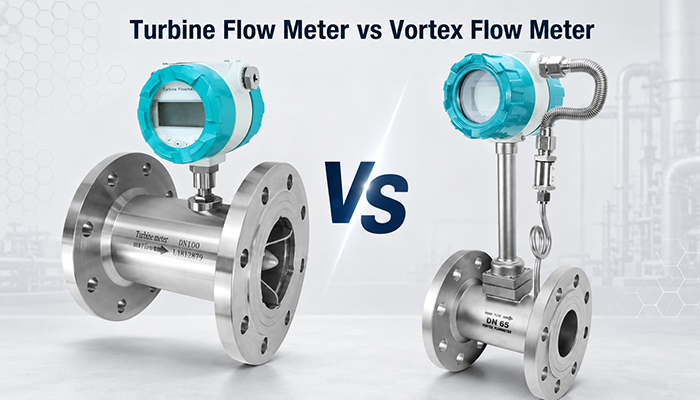
Head-to-Head Comparison: Turbine vs Vortex
| Criterion | Caudalímetro de turbina | Caudalímetro Vortex |
| Measuring principle | Rotor speed proportional to flow velocity | Vortex shedding frequency from a bluff body |
| Moving parts | Yes (rotor + bearing) | Ninguno |
| Typical accuracy | ±0.5% of reading (up to ±0.2% calibrated) | ±1.0% liquids; ±1.0–1.5% gases/steam |
| Best media | Clean, low-viscosity liquids | Liquids, gases, steam |
| High-viscosity liquid | Poor (large error) | Limited (Reynolds number dependent) |
| Solids / fibers / sticky media | Not suitable | Acceptable with care (clean liquids/gases preferred) |
| Rangeability | ~10:1 | 10:1, often wider for gases/steam |
| Pressure loss | Moderado | Moderado |
| Straight pipe requirement | Typically 10 × DN upstream / 5 × DN downstream | Typically 15–20 × DN upstream / 5 × DN downstream |
| Mantenimiento | Periodic bearing/rotor inspection | Effectively maintenance-free |
| Vibration sensitivity | Bajo | Moderate (can cause false pulses) |
| Typical cost | Moderado | Moderado |
When to Choose a Turbine Flow Meter
Choose a turbine flow meter when your process ticks these boxes:
- The medium is a clean, low-viscosity liquid: water, diesel, gasoline, kerosene, solvents, light fuel oils, or similar.
- You need high accuracy and excellent repeatability — for batching, dosing, blending, or transfer measurement where every percent counts.
- The line can be isolated and drained for maintenance, and the meter is accessible.
- Flow conditions are reasonably steady; strongly pulsating flow damages rotor bearings.
Typical turbine applications include petroleum processing, where liquid turbine meters measure fuels and light hydrocarbons; building automation and municipal systems metering water and heating circuits; and chemical plants dosing clean solvents and additives. The Pokcenser PWF-LTF liquid turbine flow meter is engineered for exactly these duties — petroleum processing, building automation and municipal applications, and the chemical industry — with a rugged rotor assembly and reliable pulse output for batching and control systems.
When to Choose a Vortex Flow Meter
Choose a vortex flow meter when:
- You measure gases, steam, or liquids — especially if one technology should cover multiple lines.
- Bajo mantenimiento is a priority: no moving parts means no bearing wear and fewer process shutdowns for service.
- The flow is relatively clean and the Reynolds number stays above the minimum for stable vortex formation.
- You can provide the required straight pipe run and a vibration-free mounting point.
Vortex meters are the workhorse of steam measurement in power plants, of gas flow in petrochemical facilities, and of utility metering in industrial plants. The Pokcenser PWF-GVF gas vortex flow meter is designed for petroleum, chemical, and electric power applications, delivering stable gas and steam measurement with no moving parts and minimal upkeep.
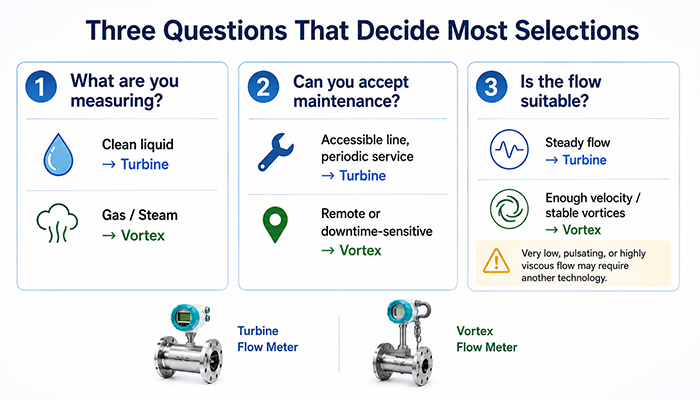
Three Questions That Decide Most Selections
1. What are you measuring — clean liquid, or gas/steam?
Clean low-viscosity liquid with a high accuracy requirement → turbine. Gas, steam, or a mix of media → vortex.
2. Can you live with moving parts and the maintenance they bring?
If the meter is accessible and the team accepts periodic service, turbine’s higher accuracy pays off. If the line is remote, hazardous, or downtime is expensive, vortex’s no-moving-parts design wins.
3. Is your flow stable and your Reynolds number adequate?
Turbine meters need reasonably steady flow to protect the bearing. Vortex meters need enough velocity to form stable vortices. Pulsating, very low, or highly viscous flow is a problem for both — and may point you toward a different technology entirely (see our flow meter selection guide for the full picture).
A Note on Accuracy Expectations
“Which one is more accurate?” is the most common question — and the honest answer is “it depends on the medium.” On clean, low-viscosity liquids, a turbine flow meter typically holds ±0.5% of reading, outperforming vortex. On gases and steam, turbine meters are not the natural choice (they are liquid-oriented designs), and a vortex meter’s ±1.0–1.5% of reading is typically the right expectation. In other words: choose the technology that suits the medium, and the accuracy will follow.
Choosing the Right Flow Meter, Summary
- Clean liquids, high accuracy, batching and dosing → turbine flow meter (e.g. PWF-LTF).
- Gas, steam, mixed media, low maintenance → vortex flow meter (e.g. PWF-GVF).
- Viscous or dirty liquids, or high-pressure/high-temperature lines → consider other technologies; electromagnetic and Coriolis meters are covered in our related guides.
If you are unsure which technology fits your process, send us your medium, flow range, pipe size, and operating conditions — Pokcenser engineers will recommend a meter rather than sell you one.
PREGUNTAS FRECUENTES
1. Which is more accurate: a turbine or a vortex flow meter?
On clean, low-viscosity liquids, a turbine flow meter is typically more accurate (±0.5% of reading, sometimes ±0.2% calibrated) than a vortex meter (±1.0%). On gases and steam, the vortex meter is the practical choice with typical accuracy of ±1.0–1.5% of reading.
2. Can a vortex flow meter measure liquids?
Yes. Vortex meters measure liquids, gases, and steam with the same meter body. The main limitation is Reynolds number: at very low flow rates or with high-viscosity liquids, stable vortices may not form, and accuracy degrades.
3. Is a turbine flow meter suitable for gases?
Liquid turbine flow meters (such as the PWF-LTF) are designed for clean liquids and should not be used for gas service. Gas measurement is better handled by gas-specific meters such as vortex, thermal mass, or gas ultrasonic designs.
4. Do vortex flow meters need longer straight pipe runs than turbine meters?
Typically yes. Vortex meters generally require about 15–20 × DN upstream and 5 × DN downstream, while turbine meters commonly need about 10 × DN upstream and 5 × DN downstream. Always follow the figure stated in the datasheet for your specific model.
