 English
 Spanish
Optimizing Industrial Sensor Data Collection and Display Systems
After enough plant start‑ups and midnight callouts, you develop a habit: trust your sensors, then double check that their data actually reaches the people and systems that need it. In industrial automation, accurate, timely measurements underpin efficiency and safety, and the way we collect, transmit, and visualize that data shapes everything from process control to compliance. Below, I share practical, modern ways to tighten those data paths across varied industrial settings, the same playbook I lean on when commissioning or troubleshooting in the field.
Understanding the Critical Need for Industrial Sensor Data Management
Industrial processes live or die by precise measurements. From tracking tank levels to keeping an eye on water quality, sensor data drives operational decisions. Strong data management makes sure these insights show up where they matter, right when they are needed.
1. The Challenges of Traditional Data Collection Methods
I have seen plenty of clipboards and isolated spreadsheets slow teams down. Manual logging invites human error, which introduces inaccuracies and delays. Isolated systems create data silos that hide the bigger picture. That fragmentation blocks thorough analysis and keeps teams from acting proactively. Older platforms also struggle to scale or adapt, especially when you mix sensor types or introduce advanced analytics. Integration becomes a project in itself, and momentum stalls.
2. The Benefits of Integrated Data Display and Monitoring
When data display and monitoring are integrated, raw readings turn into actionable insight. Real-time visibility into critical parameters lets operators catch anomalies early and respond quickly. That cuts downtime and helps allocate resources where they have the most impact. Centralized platforms pull data from many sources into one view, which supports stronger decisions, tighter quality control, and regulatory compliance. The net result is measurable gains in efficiency and safety.
Key Components of Modern Sensor Data Collection Systems
A modern collection system is a chain, and every link matters. Sensors, acquisition hardware, and communication protocols all play their part in data integrity and accessibility. Knowing how each piece works helps you design solutions that perform on the plant floor, not just on paper.
1. Exploring Diverse Sensor Types and Their Data Outputs
Industrial sensors cover a wide range of physical and chemical measurements. Flow meters quantify liquid or gas movement, and level sensors track heights in tanks. Temperature sensors watch thermal conditions, and pressure sensors read force per unit area. Water quality instruments, including TDS, residual chlorine, pH, ORP, conductivity, DO, and turbidity sensors, reveal what is happening inside a fluid. Each sensor generates data in a specific format that calls for the right handling and interpretation. For example, a [thermal mass flow meter](https://pokcensertech.com/product-category/products/flow-meters/thermal-gas-mass-flow-meter/) measures gas flow accurately.
| Sensor Type | Measured Parameter | Output Type (Typical) | Key Features |
|---|---|---|---|
| TDS Sensor (e.g., PT6500) | Total Dissolved Solids | 4-20mA, RS485 Modbus RTU | Full-color display, data logging, temperature compensation |
| Residual Chlorine Sensor (e.g., CS5530C) | Residual Chlorine | 4-20mA, RS485 Modbus | Color LCD, constant pressure method, automatic calibration |
| Flow Meter (e.g., PWF-U2000MCC) | Liquid Flow Rate | 4-20mA, RS485 Modbus | High accuracy (±0.5% FS), multi-channel, clamp-on |
| Level Sensor (e.g., PWP412-T3) | Water Level, Temperature | SDI-12 | IP68, all-stainless-steel, submersible |
| pH/ORP Sensor (e.g., PCS1753CD, PT4000) | pH, ORP, Temperature | RS485 Modbus RTU, 4-20mA | IP68, chemical resistance, automatic calibration |
| Conductivity Sensor (e.g., PCS3740PCD) | Conductivity, TDS, Salinity | RS485 Modbus RTU | IP68, 2/4 electrode design, temperature compensation |
| Dissolved Oxygen Sensor (e.g., PCS4760PD) | Dissolved Oxygen | RS485 Modbus RTU | Optical/fluorescence method, IP68, temperature compensation |
| Turbidity Sensor (e.g., PCS7820D) | Turbidity | RS485 Modbus RTU | 90° infrared method, IP68, multiple ranges |
2. Understanding Data Acquisition Devices and Technologies
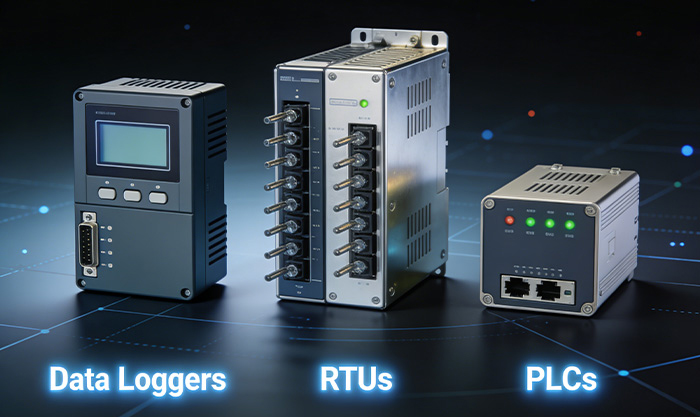
Data acquisition devices bridge sensors and control systems. They convert analog signals into digital data that can be processed, stored, and acted on. Common options include data loggers, RTUs, and PLCs. Data loggers capture measurements over time for later review. RTUs sit in remote locations, collecting data and sending it back to a central system. PLCs run control logic and take in sensor data directly, folding it into automation tasks. Your choice depends on data volume, sampling rate, and environmental conditions, along with how the system needs to grow.
3. The Role of Communication Protocols in Data Transmission
Communication protocols define how devices talk to each other. In industrial environments, 4-20mA, RS485 Modbus RTU, and SDI-12 are common.
* 4-20mA: This analog current loop is robust and widely used for long-distance transmission, offering immunity to electrical noise. Many of our sensors, like the PT6500 TDS meter, utilize 4-20mA output.
* RS485 Modbus RTU: A digital serial communication protocol, RS485 Modbus RTU supports multi-drop networks, allowing multiple devices to share a single communication line. This protocol is prevalent in our digital sensors, such as the PCS1753CD pH sensor and PCS3740PCD conductivity sensor.
* SDI-12: This protocol is specifically designed for environmental data acquisition, enabling low-power communication with multiple sensors over a single cable. Our PWP412-T3 hydrostatic water level and temperature transmitter features direct SDI-12 output.
These protocols keep data flowing reliably from sensor to control system or local display.
Advanced Data Display and Monitoring Solutions for Industrial Applications
How you present data affects how fast teams can act. Modern plants use tools that surface the right information at the right moment, without burying operators in noise.
1. Leveraging Human-Machine Interfaces for Real-time Visibility
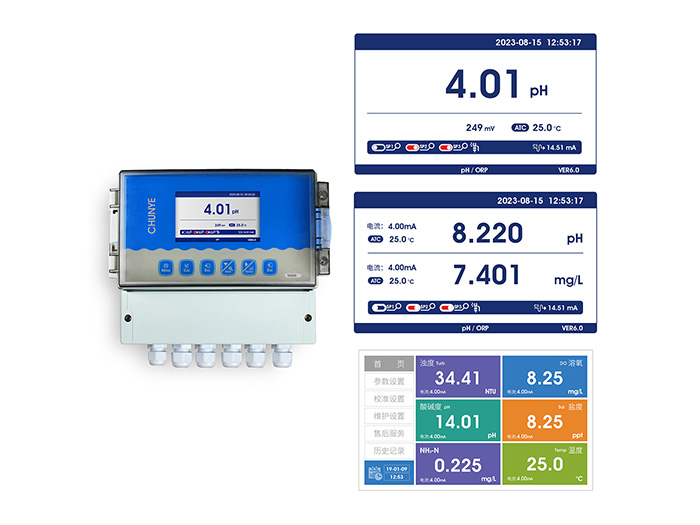
Human-Machine Interfaces give operators a clear graphical view of processes. They show real-time values, alarms, and control parameters in a format people can scan quickly. That boosts situational awareness and speeds up troubleshooting. Many of Pokcenser’s instruments, such as the PT6500 Online TDS Meter Controller and PCS5530C Residual Chlorine Electrode and Meter, feature full-color multi-line or LCD displays for clear readings and immediate feedback. On-site, those local displays often save a service call.
2. Implementing SCADA and IIoT Platforms for Centralized Control
SCADA systems collect data from sensors and PLCs, then present an integrated view of the plant or process. Teams can monitor, control, and optimize from a central location. IIoT platforms build on that by using cloud computing, advanced analytics, and machine learning. That opens the door to predictive maintenance, remote diagnostics, and analysis across sites. Both approaches help manage complex operations and turn data into strategic insight.
3. Utilizing Data Logging and Cloud Solutions for Analysis
Solid logging is the backbone of trend analysis. Devices like the PT6500 TDS Meter Controller include built-in logging and trend charts for post-event review and process tuning. Cloud solutions add scale and remote access. Industrial data can be stored securely and reviewed from anywhere, which makes collaboration far easier. Cloud analytics can sift through large datasets, surfacing patterns that local tools might miss. That supports continuous improvement and long-horizon planning.
Implementing Effective Sensor Data Systems for Enhanced Operations
Designing an effective system starts with a plan and ends with clean, reliable data in the hands of decision-makers. Choose technologies that fit the environment and the scale of the process, then wire the pieces together so information moves without friction.
1. Ensuring Accuracy and Reliability in Sensor Data
Accuracy and reliability take regular work. Calibration and preventive maintenance keep readings tight. Environmental factors, like temperature swings, can shift measurements, which is why many modern sensors, such as the PCS1753CD pH sensor, include automatic temperature compensation. Selecting the right sensor for the application and environment is a major part of dependable data. In hazardous areas, using [explosion-proof sensors](https://pokcensertech.com/product/pwp350-universal-industrial-pressure-sensor/) protects people and preserves data integrity.
2. Integrating Pokcenser’s Diverse Sensor Solutions into Data Systems
Pokcenser Automation offers a comprehensive range of sensors and instruments designed for seamless integration into various data systems. Our [main products](https://pokcensertech.com/product-category/products/) include flow meters, level sensors, pressure transmitters, temperature sensors, and water analysis instruments. These devices support industry-standard communication protocols like 4-20mA and RS485 Modbus RTU, ensuring compatibility with existing SCADA and PLC systems. For example, our [submersible level transmitters](https://pokcensertech.com/product-category/products/level-sensors/submersible-level-transmitter/) are ideal for monitoring liquid levels in challenging environments, providing accurate data for control systems. We also provide [ultrasonic level sensors](https://pokcensertech.com/product-category/products/level-sensors/ultrasonic-level-sensor/) for non-contact measurement.
Consider our PWF-U2000MCC Ultrasonic Flowmeter for high-accuracy flow measurement in municipal and industrial water applications. It offers multi-channel support and RS485 Modbus communication. For water quality monitoring, the PT6500 Online TDS Meter Controller provides continuous monitoring with data logging and trend charts. These integrated solutions simplify data collection and enhance monitoring capabilities across diverse industries, from [Water and Wastewater Treatment](https://pokcensertech.com/product-category/solutions/water-wastewater/) to [Chemical Tanks](https://pokcensertech.com/product-category/solutions/chemicals/).
3. Achieving Operational Efficiency and Predictive Maintenance
When sensor data flows in real time, operators can fine tune processes on the spot, which cuts waste and lifts quality. Continuous monitoring and analysis support predictive maintenance, catching issues before they turn into failures. That shift from reactive to proactive reduces downtime and extends asset life. With advanced analytics on top of good data, plants can trim energy use, streamline production, and raise overall productivity. The payoff shows up on both the operations dashboard and the balance sheet.
Partner with Pokcenser Automation for Your Sensor Data Solutions
Optimizing your industrial sensor data collection and display systems is a strategic investment. We offer robust, reliable, and integrated sensor solutions tailored to your specific needs. Our team provides comprehensive support from initial application evaluation to after-sales service. Contact us today to discuss how we can enhance your operational efficiency and control.
Phone: +86 181 7515 5326
Email: in**@*******er.com
FAQs
1. What are the primary benefits of upgrading to a modern sensor data collection and display system?
Upgrading to a modern system brings real-time monitoring, better data accuracy, and stronger decision-making. It cuts manual errors, breaks down data silos, and supports advanced analytics for predictive maintenance. Together, those improvements raise operational efficiency, reduce downtime, and improve resource management.
2. How do different communication protocols like Modbus and 4-20mA impact system design?
Protocols define how sensors send data. 4-20mA is an analog standard known for long-distance reliability and noise immunity. RS485 Modbus RTU is a digital protocol that supports many devices on one line and carries richer data. The choice influences wiring, hardware selection, and software integration.
3. Can Pokcenser’s sensors be integrated with existing SCADA or IIoT platforms?
Yes. Pokcenser’s sensors are designed for broad compatibility. Many products offer 4-20mA and RS485 Modbus RTU outputs. Those protocols integrate with most SCADA systems and modern IIoT platforms, which allows flexible deployment.
4. What factors should be considered when choosing a data display solution for industrial environments?
Look at process complexity, number of data points, and the level of real-time interaction required. Check display size, resolution, environmental ruggedness such as IP rating, and software features for trends and alarms. User experience and fit with existing control systems also matter.
5. How does temperature compensation in sensors contribute to data accuracy?
Temperature compensation corrects errors caused by temperature changes. Many physical and chemical properties shift with temperature. By compensating for those effects, sensors keep readings consistent and accurate across different operating conditions.

