 English
 Spanish
Understanding Repeatability, Linearity, and Hysteresis in Industrial Sensors
When comparing industrial sensors, many engineers focus on accuracy. While accuracy is important, it is only one aspect of measurement performance.
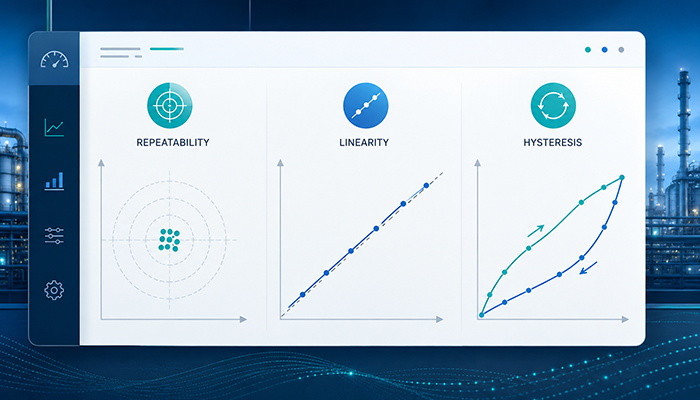
Professional datasheets often include specifications such as repeatability, linearity, and hysteresis. These terms are closely related but describe different characteristics of a sensor’s performance.
Understanding these specifications can help engineers choose the right instrument for their application, avoid unnecessary costs, and improve process reliability.
In this guide, we’ll explain what repeatability, linearity, and hysteresis mean, how they differ, and why they matter in industrial measurement.
Why These Specifications Matter
Industrial sensors are expected to provide stable and reliable measurements over long periods of operation.
A sensor may have excellent accuracy but poor repeatability, or excellent repeatability but noticeable hysteresis.
Understanding the complete performance profile helps ensure:
- Stable process control
- Consistent product quality
- Reliable long-term operation
- Reduced calibration frequency
- Better equipment selection
What Is Repeatability?
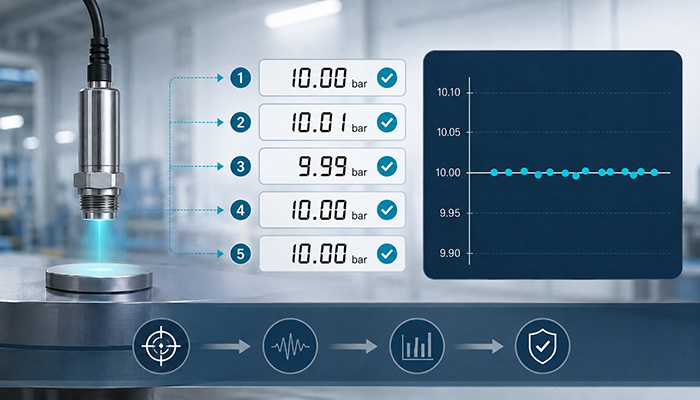
Repeatability describes a sensor’s ability to produce the same measurement when the same input is applied multiple times under identical conditions.
In other words, if nothing changes in the process, the sensor should continue to report nearly the same value.
Example
A pressure transmitter measures a process pressure of 10 bar five times.
Results:
- 10.00 bar
- 10.01 bar
- 9.99 bar
- 10.00 bar
- 10.00 bar
These readings demonstrate excellent repeatability.
Why Repeatability Is Important
Poor repeatability can lead to:
- Unstable control loops
- Frequent alarm activation
- Inconsistent production
- Reduced confidence in process data
Applications requiring precise dosing or batch control particularly benefit from high repeatability.
What Is Linearity?
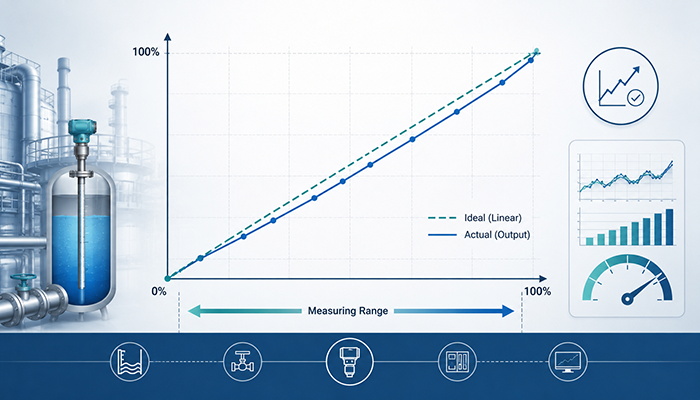
Linearity describes how closely a sensor’s output follows a straight-line relationship across its entire measuring range.
Ideally, as the measured value increases, the output should increase proportionally.
In practice, slight deviations from the ideal line are normal.
Example
For a pressure transmitter with a range of 0–100 bar:
| Actual Pressure | Ideal Output | Actual Output |
| 20 bar | 20% | 20.1% |
| 50 bar | 50% | 49.9% |
| 80 bar | 80% | 80.2% |
The closer these values are to the ideal line, the better the linearity.
Why Linearity Matters
Poor linearity can cause:
- Larger errors at certain measurement points
- Reduced control precision
- Inconsistent process calculations
Applications with a wide operating range benefit from sensors with excellent linearity.
What Is Hysteresis?
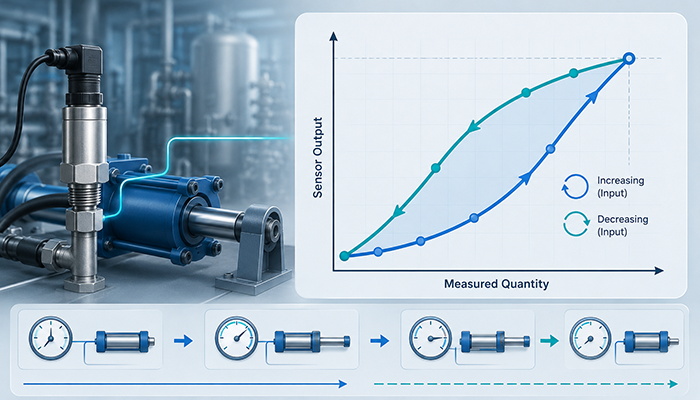
Hysteresis refers to the difference in sensor output when approaching the same measurement point from different directions.
In simple terms:
The reading may not be exactly the same when pressure is increasing versus when pressure is decreasing.
Example
Increasing pressure:
50.00 bar
Decreasing pressure:
49.92 bar
Although the actual pressure is identical, the output differs slightly.
This difference is called hysteresis.
What Causes Hysteresis?
Common causes include:
- Mechanical deformation
- Material elasticity
- Internal friction
- Diaphragm stress
- Wear of mechanical components
High-quality industrial sensors are designed to minimize hysteresis through improved materials and manufacturing techniques.
Repeatability vs Linearity vs Hysteresis
| Specification | What It Describes | Why It Matters |
| Repeatability | Consistency of repeated measurements | Stable control and reliable monitoring |
| Linearity | Accuracy across the entire measuring range | Uniform measurement performance |
| Hysteresis | Difference between increasing and decreasing measurements | Precision during changing process conditions |
Although related, these specifications evaluate different aspects of sensor performance.
Which Applications Require Better Repeatability?
High repeatability is particularly important in:
Chemical Dosing Systems
Small measurement variations can affect chemical concentration.
Batch Processing
Consistent measurements improve product quality and repeatability between production batches.
Laboratory and Pilot Plants
Research applications often require highly repeatable measurements for reliable test results.
Which Applications Require Better Linearity?
Excellent linearity is beneficial for:
- Water treatment systems
- Flow measurement
- Tank level monitoring
- Continuous process control
These applications often operate across a wide measurement range.
Which Applications Are Sensitive to Hysteresis?
Low hysteresis is especially valuable for:
- Pressure cycling systems
- Hydraulic equipment
- Compressor monitoring
- Pump testing
- Dynamic process control
These systems frequently experience increasing and decreasing process values.
How Manufacturers Improve Sensor Performance
Modern industrial sensors reduce repeatability errors, linearity deviations, and hysteresis through:
- Precision sensing elements
- Advanced digital compensation
- Temperature compensation
- High-quality diaphragm materials
- Automated factory calibration
- Long-term stability testing
These technologies improve measurement consistency throughout the instrument’s service life.
Recommended Applications
High-performance industrial sensors are particularly valuable for:
Pressure Measurement
Pressure transmitters used in process control require excellent repeatability and low hysteresis to ensure stable operation.
Flow Measurement
Accurate flow meters benefit from strong linearity across the full measuring range.
Level Measurement
Reliable level sensors provide consistent measurements despite changing tank conditions.
Water Quality Monitoring
Stable sensor performance improves long-term monitoring and reduces maintenance requirements.
Common Misunderstandings
“High Accuracy Means High Repeatability”
Not always.
A sensor may consistently produce the same reading (good repeatability) while still having an offset from the true value.
“Linearity Only Matters at Full Scale”
Incorrect.
Linearity affects measurement performance throughout the entire measuring range.
“Hysteresis Is the Same as Drift”
No.
Hysteresis occurs when approaching the same point from different directions.
Drift develops gradually over time due to aging or environmental influences.
Why Choose Pokcenser?
Pokcenser develops industrial instrumentation designed for stable, long-term measurement performance.
Our product portfolio includes:
- Pressure Transmitters
- Differential Pressure Transmitters
- Radar Level Sensors
- Ultrasonic Level Sensors
- Electromagnetic Flow Meters
- Ultrasonic Flow Meters
- Water Quality Instruments
Our engineering team helps customers select instruments that provide the right balance of accuracy, repeatability, stability, and long-term reliability for each application.
Frequently Asked Questions
Q1: Which is more important, accuracy or repeatability?
Both are important. Accuracy indicates how close a measurement is to the true value, while repeatability reflects how consistently the sensor produces the same result.
Q2: Can a sensor have excellent repeatability but poor accuracy?
Yes. A sensor may consistently report the same incorrect value if it requires calibration.
Q3: Does hysteresis affect every sensor?
Yes. Every sensing technology exhibits some degree of hysteresis, although high-quality industrial sensors minimize this effect.
Q4: Why is linearity important?
Good linearity ensures consistent measurement performance across the entire operating range rather than only at specific points.
Q5: Can calibration improve repeatability?
Calibration primarily improves accuracy. Repeatability depends more on the sensor’s design and manufacturing quality.
Conclusion
Accuracy is only one measure of a sensor’s performance. Repeatability, linearity, and hysteresis are equally important for achieving stable, reliable, and consistent measurements in industrial automation.
By understanding these specifications and selecting instruments that match the requirements of your application, you can improve process control, reduce maintenance, and achieve better long-term measurement performance.
When evaluating industrial sensors, look beyond a single accuracy specification and consider the complete performance profile to make a more informed purchasing decision.
