 English
 Spanish
How to Reduce Measurement Errors in Industrial Flow Measurement
Accurate flow measurement is essential for process control, product quality, energy management, and cost reduction. Whether measuring water, chemicals, oil, or compressed air, even small measurement errors can lead to production inefficiencies, inaccurate billing, and unnecessary maintenance.
However, many flow measurement problems are not caused by defective instruments. Instead, they result from incorrect installation, unsuitable operating conditions, or poor maintenance practices.
This article explores the most common causes of flow measurement errors and provides practical solutions to help engineers improve measurement accuracy and maximize the performance of their flow meters.
Why Flow Measurement Accuracy Matters
Industrial flow meters are widely used in:
- Water and wastewater treatment
- Chemical processing
- Food and beverage production
- HVAC systems
- Oil and gas
- Power generation
Accurate flow data helps operators:
- Improve process efficiency
- Optimize chemical dosing
- Reduce water and energy consumption
- Ensure product consistency
- Lower operating costs
- Support regulatory compliance
Even a small measurement error can become significant over thousands of hours of operation.
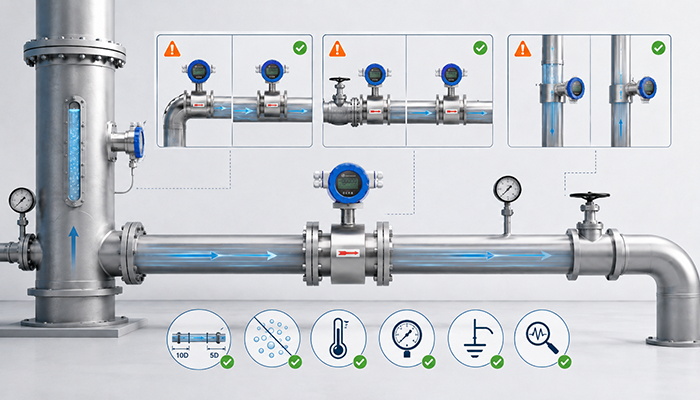
Common Cause 1: Insufficient Straight Pipe Length
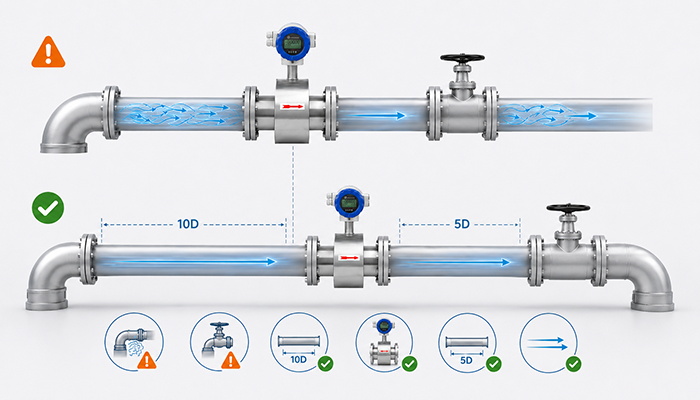
One of the most frequent installation mistakes is placing a flow meter too close to pipe disturbances.
Components such as elbows, valves, pumps, reducers, or tees create turbulence that affects the flow profile inside the pipe.
Possible Effects
- Unstable readings
- Reduced accuracy
- Measurement fluctuations
Best Practice
Follow the manufacturer’s recommended straight pipe requirements.
A common guideline is:
- Upstream: 10D (ten times the pipe diameter)
- Downstream: 5D (five times the pipe diameter)
Actual requirements may vary depending on the flow meter type and installation conditions.
Common Cause 2: Air Bubbles in the Pipeline
Entrapped air is a common issue, especially in water supply and wastewater systems.
Air bubbles can significantly affect flow measurement, particularly for electromagnetic and ultrasonic flow meters.
Typical Causes
- Pump suction problems
- Partially filled pipelines
- Poor venting
- High points in piping systems
Best Practice
- Ensure the pipeline remains completely full during operation.
- Install air release valves where appropriate.
- Avoid installing flow meters at the highest point of the pipeline.
Common Cause 3: Installing the Flow Meter in a Partially Filled Pipe
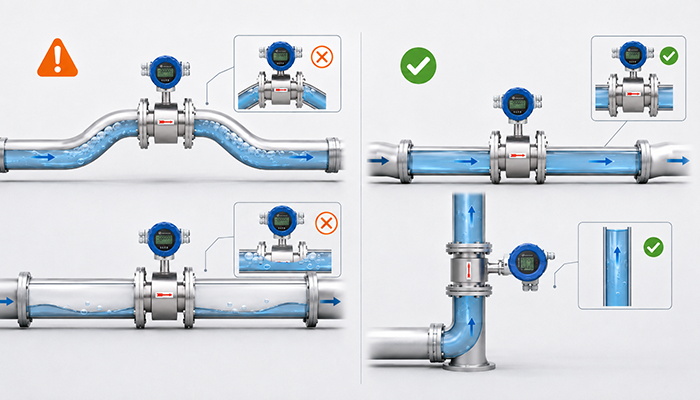
Most full-bore flow meters require the pipe to remain completely filled with liquid.
If the pipe is only partially full, the measured flow may be significantly lower than the actual flow.
Best Installation Locations
- Vertical pipes with upward flow
- Low points in horizontal pipelines
- Sections where the pipe remains continuously full
Avoid installation near free-flowing outlets where the pipe may drain.
Common Cause 4: Selecting the Wrong Flow Meter Technology
Different flow meter technologies are designed for different applications.
Using the wrong technology can result in poor performance, even if the installation is correct.
Electromagnetic Flow Meters
Best suited for:
- Conductive liquids
- Clean water
- Wastewater
- Chemicals
Not suitable for:
- Oil
- Gas
- Steam
- Non-conductive liquids
Ultrasonic Flow Meters
Best suited for:
- Clean liquids
- Large-diameter pipelines
- Temporary flow testing
- Retrofit installations
Clamp-on ultrasonic flow meters are particularly useful because they require no pipe cutting and no interruption to the process.
Turbine Flow Meters
Best suited for:
- Clean, low-viscosity liquids
- Stable flow conditions
Not recommended for liquids containing large amounts of suspended solids.
Vortex Flow Meters
Best suited for:
- Steam
- Compressed air
- Industrial gases
- High-temperature liquids
Common Cause 5: Incorrect Flow Direction
Many flow meters have a designated flow direction marked by an arrow on the sensor body.
Installing the instrument in the opposite direction may cause:
- Incorrect readings
- Zero flow indication
- Measurement instability
Always verify the flow direction before installation.
Common Cause 6: Incorrect Grounding
Poor electrical grounding can introduce electrical noise, especially for electromagnetic flow meters.
Possible Symptoms
- Signal fluctuations
- Measurement drift
- Communication errors
Best Practice
Use proper grounding rings or grounding electrodes where recommended and follow the manufacturer’s wiring instructions.
Common Cause 7: Operating Outside the Recommended Flow Velocity
Every flow meter has an optimal operating velocity range.
Flow rates that are too low or too high can reduce measurement accuracy.
Typical Recommendations
- Electromagnetic flow meters: approximately 0.5–10 m/s
- Turbine flow meters: maintain stable flow within the recommended operating range
- Ultrasonic flow meters: avoid extremely low velocities whenever possible
Selecting the correct meter size is just as important as choosing the correct technology.
Common Cause 8: Lack of Regular Maintenance
Although many modern flow meters require minimal maintenance, periodic inspection remains important.
Recommended Maintenance Tasks
- Inspect sensor surfaces for fouling.
- Verify electrical connections.
- Check communication signals.
- Confirm zero-point stability.
- Perform calibration when required.
Regular maintenance helps maintain long-term measurement accuracy.
Recommended Pokcenser Flow Meter Solutions
Pokcenser offers a complete range of industrial flow measurement solutions for different applications.
Electromagnetic Flow Meters
Suitable for:
- Water treatment
- Wastewater
- Chemical dosing
- Conductive process liquids
Ultrasonic Flow Meters
Suitable for:
- Retrofit installations
- Large pipelines
- Cooling water systems
- Temporary flow measurement
Clamp-on models allow installation without cutting the pipe or stopping production.
Turbine Flow Meters
Suitable for:
- Clean liquids
- Fuel measurement
- Process control
- Industrial water systems
Radar Flow Meters
Suitable for:
- Open channels
- Rivers
- Irrigation canals
- Flood monitoring
- Environmental monitoring
Selecting the appropriate flow meter technology is the foundation of accurate and reliable flow measurement.
Additional Tips for Improving Flow Measurement Accuracy
To achieve the best performance:
- Select the correct flow meter technology.
- Ensure the pipe remains completely full.
- Maintain sufficient straight pipe lengths.
- Install the meter in the correct flow direction.
- Eliminate air pockets where possible.
- Follow proper grounding practices.
- Perform routine inspections and calibration.
- Operate within the recommended flow velocity range.
These practices can significantly improve measurement stability and reduce maintenance costs.
Why Choose Pokcenser?
Pokcenser has more than 10 years of experience in industrial process measurement and automation.
Our flow meters are used in over 100 countries across industries including:
- Water and wastewater
- Chemical processing
- Food and beverage
- Oil and gas
- HVAC
- Environmental monitoring
We provide:
- CE-certified products
- OEM & ODM services
- Professional technical support
- Factory-direct pricing
- Customized measurement solutions
Frequently Asked Questions
Q1: What is the most common cause of inaccurate flow measurement?
Insufficient straight pipe length and partially filled pipelines are among the most common causes.
Q2: Why do air bubbles affect flow meter accuracy?
Air bubbles interrupt the measurement principle of many liquid flow meters, resulting in unstable or inaccurate readings.
Q3: Can I install a flow meter directly after a pump?
It is generally not recommended. Pumps create turbulence, so adequate upstream straight pipe length should be maintained.
Q4: Do all flow meters require regular calibration?
Calibration requirements depend on the application and industry standards. Critical processes may require periodic verification to maintain accuracy.
Q5: Which flow meter is best for wastewater applications?
Electromagnetic flow meters are commonly used for conductive wastewater, while radar flow meters are ideal for open channels and rivers. Clamp-on ultrasonic flow meters are also an excellent option for retrofit projects where pipe modification is not practical.
Conclusion
Accurate flow measurement depends on much more than selecting a high-quality flow meter. Proper installation, correct technology selection, regular maintenance, and suitable operating conditions all play essential roles in achieving reliable performance.
By understanding and eliminating common sources of measurement error, industrial facilities can improve process efficiency, reduce maintenance costs, and maximize the value of their flow measurement systems.
Whether you need an electromagnetic, ultrasonic, turbine, or radar flow meter, choosing the right solution and following best installation practices will ensure accurate and dependable flow measurement for years to come.
