 English
 Spanish
10 Common Mistakes When Installing Industrial Sensors (and How to Avoid Them)
Selecting a high-quality industrial sensor is only the first step toward reliable measurement. Even the most advanced pressure transmitter, radar level sensor, flow meter, or water quality analyzer can produce inaccurate readings if it is installed incorrectly.
According to field service experience, many measurement problems are caused not by the sensor itself, but by improper installation. These issues often result in unstable readings, frequent maintenance, reduced equipment life, and unnecessary downtime.
In this guide, we’ll explore ten of the most common installation mistakes and explain how to avoid them.
Mistake 1: Choosing the Wrong Installation Location
The installation location directly affects measurement accuracy and long-term reliability.
Common Problems
- Installing sensors near pumps or compressors
- Mounting close to heavy vibration sources
- Positioning sensors where maintenance access is difficult
- Installing in areas exposed to excessive heat
Best Practice
Always install sensors in locations with stable operating conditions and easy access for inspection and maintenance.
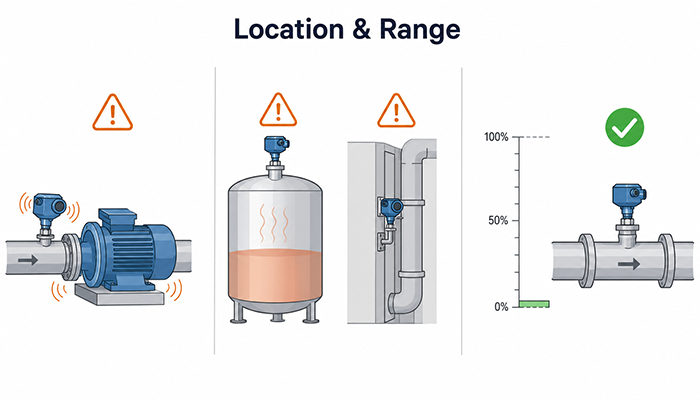
Mistake 2: Selecting the Wrong Measurement Range
Many users assume that choosing the largest measurement range provides greater flexibility.
In reality, an oversized range often reduces measurement resolution and may increase relative measurement error at normal operating conditions.
Best Practice
Select a measurement range that closely matches the actual operating conditions while allowing an appropriate safety margin.
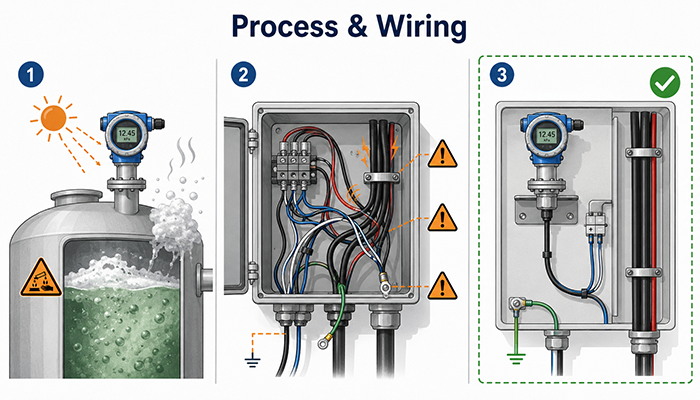
Mistake 3: Ignoring Process Conditions
Before installation, evaluate:
- Process pressure
- Temperature
- Medium characteristics
- Corrosiveness
- Viscosity
- Foam or vapor
Failure to consider these factors may lead to poor measurement performance or premature sensor failure.
Mistake 4: Incorrect Cable Installation
Improper wiring can introduce electrical interference and communication problems.
Common Mistakes
- Running signal cables alongside power cables
- Poor grounding
- Loose terminal connections
- Using unsuitable cable types
Best Practice
Use shielded cables where recommended and follow the manufacturer’s wiring instructions.
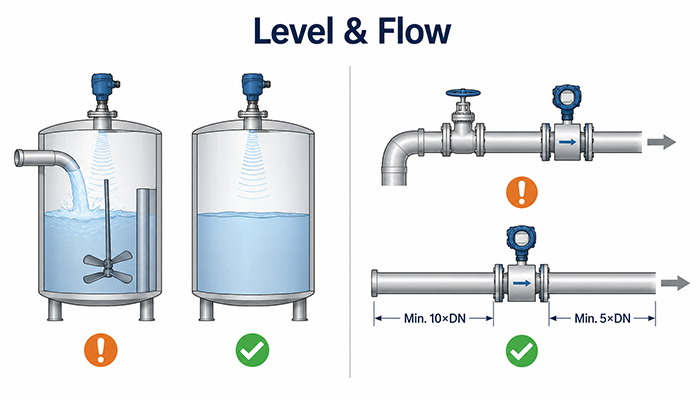
Mistake 5: Poor Mounting Position for Level Sensors
For radar and ultrasonic level sensors, installation position is critical.
Avoid mounting:
- Directly above tank inlets
- Near internal ladders
- Beside mixers
- Under support beams
These obstacles may generate false echoes or interfere with the measurement signal.
Best Practice
Install the sensor above a clear, unobstructed measurement surface whenever possible.
Mistake 6: Installing Flow Meters Too Close to Pipe Disturbances
Flow measurement accuracy depends on a stable flow profile.
Installing a flow meter immediately after:
- Elbows
- Pumps
- Valves
- Reducers
may create turbulence that affects measurement performance.
Best Practice
Maintain the manufacturer’s recommended straight pipe lengths upstream and downstream.
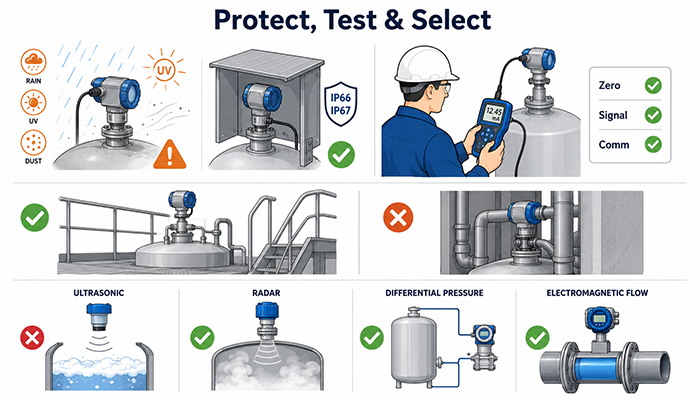
Mistake 7: Neglecting Environmental Protection
Outdoor installations expose sensors to:
- Rain
- Dust
- UV radiation
- High humidity
- Flooding
Best Practice
Select products with appropriate IP ratings and ensure cable entries are properly sealed.
Mistake 8: Skipping Calibration and Commissioning
Some users assume a factory-calibrated sensor is ready for immediate operation.
However, installation should always include:
- Zero verification
- Signal testing
- Communication checks
- System integration testing
This ensures accurate measurements before production begins.
Mistake 9: Failing to Plan for Maintenance
Installing sensors where they cannot be safely accessed often leads to delayed maintenance and increased downtime.
Best Practice
Leave sufficient space for:
- Calibration
- Cleaning
- Inspection
- Replacement
Proper planning can significantly reduce maintenance costs over the equipment’s lifetime.
Mistake 10: Choosing the Wrong Sensor Technology
Not every sensor is suitable for every application.
Examples include:
- Ultrasonic sensors may struggle with heavy foam or dense vapor.
- Radar level sensors are often better suited to harsh environments with steam, condensation, or corrosive media.
- Differential pressure transmitters are preferred for level measurement in sealed or pressurized vessels.
- Electromagnetic flow meters require conductive liquids and are not suitable for hydrocarbons or gases.
Best Practice
Select the sensing technology based on the application—not just the price.
Why Proper Installation Matters
Correct installation provides several long-term benefits:
- Improved measurement accuracy
- Longer equipment life
- Reduced maintenance frequency
- Better process control
- Lower operating costs
- Increased production reliability
Even small installation improvements can significantly enhance system performance.
How Pokcenser Supports Successful Installation
Pokcenser not only supplies industrial instruments but also provides technical support to help customers select and install the right products for their applications.
Our product portfolio includes:
Pressure Measurement
- Smart Pressure Transmitters
- Differential Pressure Transmitters
Level Measurement
- Radar Level Sensors
- Ultrasonic Level Sensors
Flow Measurement
- Electromagnetic Flow Meters
- Radar Flow Meters
- Ultrasonic Flow Meters
Water Quality Monitoring
- pH Sensors
- Conductivity Sensors
- Dissolved Oxygen Sensors
- ORP Sensors
- Turbidity Sensors
With more than 10 years of experience in industrial automation, Pokcenser supports customers in over 100 countries with reliable products and professional application guidance.
Frequently Asked Questions
Q1: What is the most common installation mistake?
Incorrect installation location is one of the leading causes of unstable measurements and premature sensor failure.
Q2: Why do radar level sensors require careful positioning?
Objects such as ladders, nozzles, and mixers can reflect radar signals and cause false level readings.
Q3: Can improper wiring affect sensor accuracy?
Yes. Electrical interference and poor grounding can cause unstable output signals and communication problems.
Q4: Is calibration necessary after installation?
Yes. Commissioning should include verification of measurement accuracy, signal output, and communication with the control system.
Q5: How can I maximize the lifespan of industrial sensors?
Choose the correct sensor technology, install it according to manufacturer recommendations, protect it from environmental hazards, and perform regular inspection and maintenance.
Conclusion
Successful industrial measurement depends on more than selecting a high-quality sensor. Proper installation is equally important for achieving accurate measurements, reliable operation, and long service life.
By avoiding these ten common installation mistakes, engineers can improve process stability, reduce maintenance costs, and maximize the return on their instrumentation investment.
Whether you’re installing pressure transmitters, level sensors, flow meters, or water quality analyzers, following best installation practices will help ensure dependable performance throughout the entire lifecycle of your industrial automation system.
