 English
 Spanish
What Is HART Communication? Benefits, Applications, and How It Works
As industrial automation continues to evolve, digital communication has become an essential part of process control. While protocols such as Modbus, PROFINET, and Ethernet/IP are increasingly common, HART (Highway Addressable Remote Transducer) communication remains one of the most widely used standards in the process industry.
Today, millions of HART-enabled instruments are installed worldwide, providing reliable communication for pressure transmitters, level sensors, flow meters, and temperature instruments.
This article explains what HART communication is, how it works, and why it is still widely used in modern industrial automation.
What Is HART Communication?
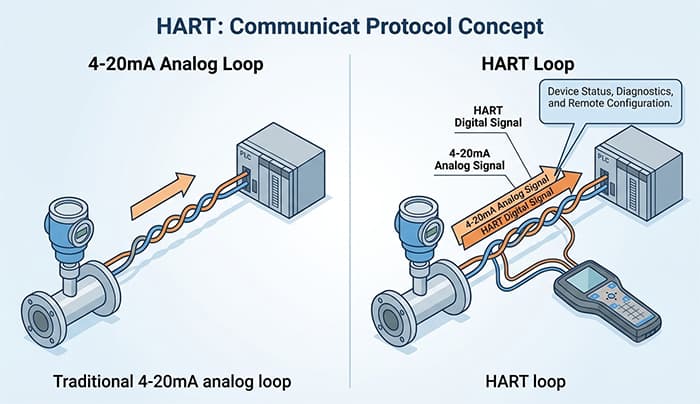
HART (Highway Addressable Remote Transducer) is a communication protocol that combines analog 4–20mA transmission with digital communication.
Unlike a standard 4–20mA output that only transmits one process variable, HART allows additional digital information to be sent over the same pair of wires.
This means users can receive both the analog measurement signal and detailed device information without installing additional communication cables.
How Does HART Communication Work?
HART uses Frequency Shift Keying (FSK) technology to superimpose digital signals onto the existing 4–20mA current loop.
The analog signal continues to represent the measured process value, while the digital signal carries additional information such as:
- Device configuration
- Sensor diagnostics
- Process variables
- Alarm status
- Calibration data
- Device identification
Because the analog current is unaffected, HART systems remain compatible with existing PLCs and control systems
Key Advantages of HART Communication
Compatible with Existing 4–20mA Systems
One of HART’s biggest advantages is backward compatibility.
Facilities can upgrade to smart transmitters without replacing existing analog control systems.
Remote Configuration
Engineers can configure instruments remotely without opening the transmitter enclosure.
Typical parameters include:
- Measuring range
- Damping time
- Engineering units
- Zero adjustment
- Span adjustment
This reduces commissioning time and improves maintenance efficiency.
Advanced Diagnostics
Unlike conventional analog transmitters, HART-enabled devices provide valuable diagnostic information.
Examples include:
- Sensor health
- Internal electronics status
- Loop current diagnostics
- Fault alarms
- Configuration history
These diagnostics support predictive maintenance and reduce unexpected downtime.
Multiple Process Variables
Many smart transmitters can transmit more than one process variable through HART communication.
For example, a differential pressure transmitter may provide:
- Differential pressure
- Static pressure
- Process temperature
- Device status
without requiring additional analog outputs.

HART vs Traditional 4–20mA
| Feature | 4–20mA | HART |
| Analog Process Signal | ✔ | ✔ |
| Digital Communication | ✖ | ✔ |
| Remote Configuration | ✖ | ✔ |
| Device Diagnostics | ✖ | ✔ |
| Multiple Process Variables | ✖ | ✔ |
| Compatible with Existing PLCs | ✔ | ✔ |
HART provides significantly more information while maintaining compatibility with traditional control systems.
HART vs RS485 Modbus
Although both are widely used in industrial automation, HART and RS485 Modbus serve different purposes.
| Feature | HART | RS485 Modbus |
| Communication Type | Analog + Digital | Digital Only |
| Wiring | 4–20mA Loop | RS485 Bus |
| Device Configuration | Excellent | Excellent |
| Multi-drop Capability | Limited | Excellent |
| PLC Compatibility | Very High | Requires Modbus Support |
| Remote Monitoring | Good | Excellent |
Many modern industrial facilities use both HART and Modbus depending on the application.
Typical Applications of HART Communication
HART communication is commonly used in industries that require reliable process control and advanced diagnostics.
Water and Wastewater Treatment
Used for monitoring:
- Pressure
- Tank level
- Flow
- Chemical dosing
Chemical Processing
Supports accurate measurement and remote configuration in hazardous environments.
Oil and Gas
Widely used for pressure, level, and flow measurement in upstream, midstream, and downstream facilities.
Food and Beverage
Provides stable process monitoring while simplifying maintenance and calibration.
Power Generation
Used for steam pressure, condensate systems, and boiler instrumentation.

Recommended Pokcenser Products Supporting HART Communication
PWP3051 Smart Pressure Transmitter
The PWP3051 Smart Pressure Transmitter supports HART communication, providing accurate pressure measurement along with remote configuration and advanced diagnostics.
Typical applications include:
- Water treatment
- Chemical processing
- Oil and gas
- Food and beverage
- Industrial automation
PWP3051DP Smart Monocrystalline Silicon Differential Pressure Transmitter
The PWP3051DP combines high measurement accuracy with HART communication, making it ideal for:
- Filter differential pressure monitoring
- Closed tank level measurement
- Steam applications
- Process control systems
PWL-R801 80GHz Radar Level Sensor
For continuous level measurement, the PWL-R801 supports HART communication, enabling reliable remote configuration and integration into modern automation systems.
Suitable applications include:
- Storage tanks
- Process vessels
- Water treatment
- Chemical tanks
When Should You Choose a HART Transmitter?
A HART-enabled transmitter is recommended when:
- You already use a 4–20mA control system.
- Remote configuration is required.
- Predictive maintenance is important.
- Device diagnostics are needed.
- Future digital integration is planned.
For basic applications requiring only a process signal, a standard 4–20mA transmitter may be sufficient.
Why Choose Pokcenser?
Pokcenser provides intelligent industrial instrumentation designed for modern automation systems.
Many of our pressure transmitters and radar level sensors support HART communication, allowing customers to benefit from both traditional analog control and advanced digital diagnostics.
We offer:
- CE-certified products
- OEM & ODM services
- Professional technical support
- Fast delivery
- Factory-direct pricing
Frequently Asked Questions
Q1: What does HART stand for?
HART stands for Highway Addressable Remote Transducer.
Q2: Does HART replace the 4–20mA signal?
No. HART adds digital communication while retaining the standard 4–20mA analog signal.
Q3: Can HART and PLC systems work together?
Yes. HART transmitters remain fully compatible with conventional 4–20mA PLC input modules.
Q4: Is HART better than RS485 Modbus?
Neither is universally better. HART is ideal for upgrading existing analog systems, while RS485 Modbus is well suited for digital multi-device networks.
Q5: Which Pokcenser products support HART communication?
Selected smart pressure transmitters, differential pressure transmitters, and radar level sensors support HART communication. Please refer to the individual product specifications to confirm available communication options for each model.
