 English
 Spanish
How to Select the Right Flow Meter for Wastewater Treatment Plants
Accurate flow measurement is one of the most critical requirements in wastewater treatment facilities. Whether monitoring influent, effluent, sludge transfer, or chemical dosing, a reliable flow meter helps operators optimize treatment efficiency, reduce operational costs, and comply with environmental regulations.
However, wastewater applications are often challenging. Suspended solids, corrosive media, variable flow rates, and harsh operating conditions can quickly affect measurement accuracy if the wrong technology is selected.
In this guide, we’ll explain how to choose the right flow meter for wastewater treatment plants and why many operators worldwide trust Pokcenser flow measurement solutions.
Why Accurate Wastewater Flow Measurement Matters
Wastewater treatment plants rely on flow data for several important functions:
- Influent flow monitoring
- Effluent discharge measurement
- Sludge transportation control
- Chemical dosing optimization
- Pump performance monitoring
- Regulatory reporting
Even small measurement errors can result in:
- Increased operating costs
- Inefficient chemical usage
- Process instability
- Environmental compliance risks
Selecting the appropriate flow meter is therefore a long-term investment in plant efficiency and reliability.
Common Challenges in Wastewater Applications
Unlike clean water systems, wastewater contains contaminants that create measurement difficulties.
Typical challenges include:
High Solid Content
Wastewater often contains:
- Sand
- Silt
- Organic matter
- Sludge particles
Flow meters must maintain accuracy despite suspended solids.
Corrosive Media
Industrial wastewater may contain:
- Acids
- Alkalis
- Chemicals
- Cleaning agents
Materials must resist corrosion over long operating periods.
Variable Flow Conditions
Flow rates can fluctuate significantly during:
- Peak usage periods
- Stormwater events
- Industrial discharge cycles
The flow meter must provide stable readings across a wide measuring range.
Difficult Installation Environments
Wastewater facilities often require:
- Underground installation
- Outdoor operation
- High humidity resistance
- Flood protection
Reliable industrial-grade protection is essential.
Which Flow Meter Technology Is Best for Wastewater?
Several flow measurement technologies are available, but not all perform equally well in wastewater applications.
Electromagnetic Flow Meters
Electromagnetic flow meters are widely considered the best solution for wastewater measurement.
They operate according to Faraday’s Law of Electromagnetic Induction and measure conductive liquids without moving parts.
Advantages
✔ High accuracy
✔ No pressure loss
✔ No moving components
✔ Excellent for dirty liquids
✔ Suitable for sludge and sewage
✔ Low maintenance requirements
Because wastewater is typically conductive, electromagnetic flow meters provide highly reliable performance.
Ultrasonic Flow Meters
Ultrasonic flow meters measure flow using sound wave technology.
Advantages
✔ Non-invasive installation
✔ No pipe cutting required
✔ Suitable for retrofit projects
✔ Minimal maintenance
They are often used when shutting down pipelines is difficult or impossible.
However, performance may be affected in applications with excessive air bubbles or heavy solid content.
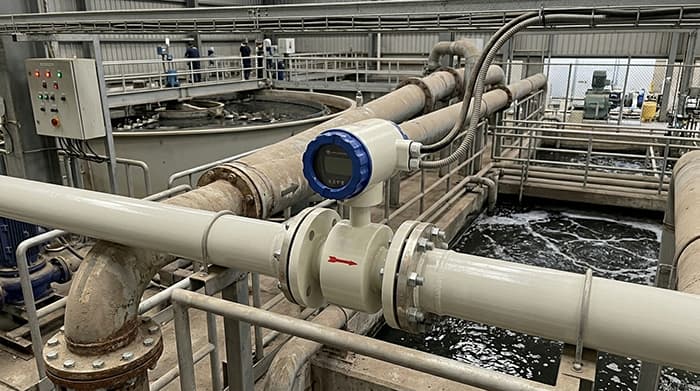
Recommended Solution: Pokcenser Electromagnetic Flow Meter
For most wastewater treatment facilities, Pokcenser electromagnetic flow meters offer an ideal combination of reliability, accuracy, and long-term durability.
Key Features
- High measurement accuracy
- Suitable for conductive liquids
- Wide pipe size options
- Corrosion-resistant liner materials
- Multiple communication protocols
- 4-20mA, Pulse, RS485 outputs
- IP65/IP68 protection available
Typical Applications
- Municipal wastewater treatment
- Industrial wastewater plants
- Sludge transportation systems
- Effluent monitoring
- Water reuse systems
Factors to Consider When Selecting a Wastewater Flow Meter
1. Liquid Conductivity
Electromagnetic flow meters require conductive liquids.
Fortunately, most wastewater streams easily meet conductivity requirements.
2. Pipe Diameter
Flow meter size must match pipeline dimensions.
Common wastewater pipeline sizes include:
- DN50
- DN100
- DN150
- DN200
- DN300 and above
Proper sizing ensures optimal accuracy.
3. Flow Range
Evaluate:
- Minimum flow rate
- Normal operating flow
- Maximum flow capacity
The selected meter should cover the full operating range.
4. Installation Location
Choose between:
- Full-bore pipeline installation
- Insertion installation
- Clamp-on ultrasonic installation
Site conditions often determine the most suitable solution.
5. Environmental Conditions
Consider:
- Ambient temperature
- Flood risk
- Humidity
- Chemical exposure
Industrial-grade enclosures improve reliability.
Typical Wastewater Plant Flow Measurement Points
Influent Monitoring
Measures incoming wastewater volume.
Objectives:
- Capacity planning
- Process optimization
- Regulatory reporting
Effluent Monitoring
Tracks treated water discharge.
Objectives:
- Compliance verification
- Performance monitoring
Sludge Transfer Monitoring
Measures sludge movement between process stages.
Objectives:
- Process efficiency
- Pump control
Chemical Dosing Systems
Ensures accurate chemical injection.
Objectives:
- Cost reduction
- Treatment consistency
Why Choose Pokcenser?
Pokcenser has provided industrial automation solutions for more than 10 years and serves customers in over 100 countries.
What Makes Pokcenser Different?
✔ CE, ISO, ATEX, RoHS certified products
✔ OEM & ODM support
✔ Professional engineering consultation
✔ Fast technical assistance
✔ Competitive factory pricing
✔ One-stop instrumentation solutions
With more than 150,000 successful projects worldwide, Pokcenser helps customers improve process efficiency while reducing operating costs.
FAQs
Q1: Which flow meter is best for sewage applications?
Electromagnetic flow meters are generally the preferred choice because they perform exceptionally well in conductive liquids containing solids.
Q2: Can ultrasonic flow meters measure wastewater?
Yes. Ultrasonic flow meters can measure wastewater, especially in retrofit projects, although heavy solids and air bubbles may affect performance.
Q3: Does an electromagnetic flow meter cause pressure loss?
No. Electromagnetic flow meters have no internal obstructions and create virtually no pressure loss.
Q4: What accuracy can be achieved?
Most industrial electromagnetic flow meters achieve accuracy levels of ±0.5% or better under proper installation conditions.
Q5: How often should a wastewater flow meter be maintained?
Electromagnetic flow meters have no moving parts and typically require very little maintenance.
Conclusion
Wastewater treatment plants require reliable, accurate, and durable flow measurement solutions. While several technologies are available, electromagnetic flow meters remain the preferred option for most sewage and wastewater applications due to their excellent performance in conductive liquids containing suspended solids.
If you’re looking for a dependable wastewater flow measurement solution, Pokcenser’s electromagnetic flow meter series offers the accuracy, durability, and technical support needed for long-term success.
Contact Pokcenser today to discuss your wastewater treatment project and receive a customized flow measurement solution tailored to your application.
