 English
 Spanish
Reliable Tank Level Monitoring Solutions for Chemical Storage Tanks
Chemical storage tanks are essential assets in industries such as chemical manufacturing, petrochemical processing, water treatment, pharmaceuticals, and mining. Maintaining accurate tank level measurements is critical not only for inventory management but also for operational safety and environmental compliance.
Traditional measurement methods often struggle with corrosive liquids, vapor, foam, and changing process conditions. As a result, many industrial facilities are upgrading to advanced radar level measurement technology.
In this article, we’ll explore the challenges of chemical tank monitoring, the best measurement technologies available, and how Pokcenser radar level sensors provide reliable performance in demanding industrial environments.
Why Accurate Chemical Tank Level Monitoring Is Important
A chemical storage tank contains valuable and often hazardous materials. Inaccurate level measurements can lead to serious consequences, including:
- Tank overflow incidents
- Production interruptions
- Inventory inaccuracies
- Environmental contamination
- Increased operational costs
- Safety hazards for personnel
Real-time level monitoring helps operators:
✔ Prevent overfilling
✔ Improve inventory management
✔ Optimize purchasing schedules
✔ Reduce manual inspections
✔ Enhance plant safety
For these reasons, accurate level measurement has become a standard requirement in modern chemical facilities.
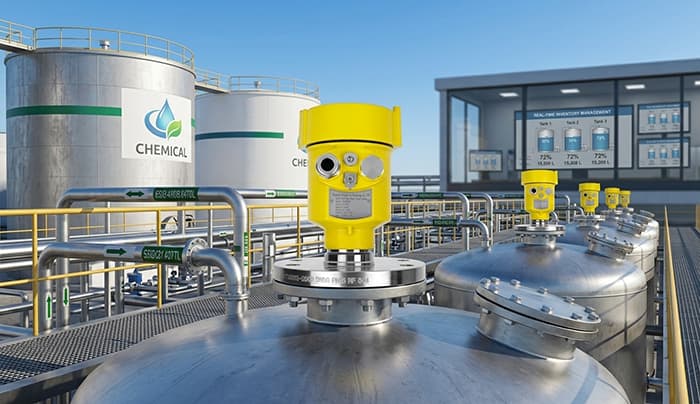
Common Challenges in Chemical Tank Applications
Chemical storage environments present unique measurement challenges.
Corrosive Liquids
Many tanks contain:
- Sulfuric acid
- Hydrochloric acid
- Sodium hydroxide
- Solvents
- Industrial chemicals
Contact-type sensors may deteriorate quickly when exposed to aggressive media.
Vapor and Fumes
Chemical reactions often generate:
- Vapors
- Gas emissions
- Condensation
These conditions can interfere with some measurement technologies.
Foam Formation
Many chemicals generate foam during:
- Filling operations
- Mixing processes
- Agitation
Foam can create inaccurate level readings with traditional sensors.
High Temperature Conditions
Some chemical storage systems operate at elevated temperatures, requiring robust instrumentation capable of maintaining accuracy.
Why Radar Level Sensors Are Ideal for Chemical Tanks
Among available technologies, radar level sensors have become the preferred solution for chemical storage applications.
Radar technology uses microwave signals to measure the distance between the sensor and the liquid surface.
Unlike contact sensors, radar devices do not touch the medium, significantly improving reliability and service life.
Advantages of Radar Level Measurement
✔ Non-contact measurement
✔ High accuracy
✔ Resistant to vapor and condensation
✔ Minimal maintenance
✔ Suitable for corrosive liquids
✔ Excellent long-term stability
✔ Reliable performance in outdoor environments
These advantages make radar technology particularly effective in chemical processing facilities.
Recommended Product: Pokcenser Radar Level Sensor
For chemical tank monitoring, Pokcenser recommends:
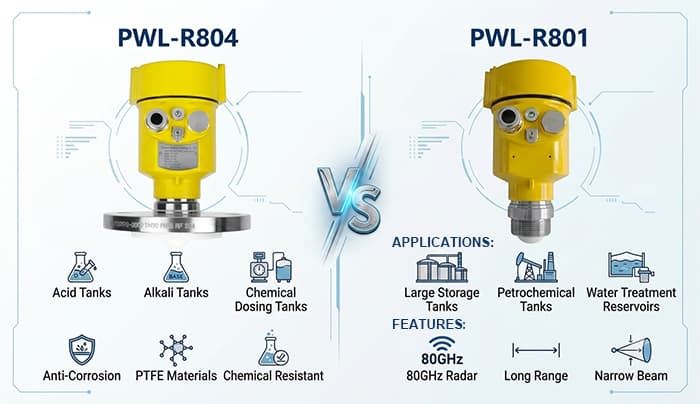
PWL-R804 Anti-Corrosive Radar Level Sensor
The PWL-R804 is specifically designed for aggressive chemical applications.
Key Features
- Non-contact radar measurement
- Anti-corrosion materials
- High measurement accuracy
- Stable performance in harsh environments
- Suitable for acids and alkalis
- Multiple output options including 4-20mA and RS485
This sensor is particularly suitable for:
- Acid storage tanks
- Alkali storage tanks
- Chemical dosing tanks
- Waste chemical collection systems
For Large Storage Tanks: 80GHz Radar Technology
When measuring large tanks or requiring superior accuracy, Pokcenser also offers:
PWL-R801 80GHz Radar Level Sensor
The 80GHz radar platform provides:
- Narrow beam angle
- Higher measurement accuracy
- Strong anti-interference capability
- Long measuring range
- Reliable operation in narrow tanks
The PWL-R801 is widely used in:
- Petrochemical storage tanks
- Bulk chemical storage facilities
- Large water treatment plants
- Industrial process tanks
Typical Applications
Acid Storage Tanks
Radar sensors avoid direct contact with corrosive media, extending service life while improving reliability.
Alkali Storage Tanks
Accurate level measurement helps prevent overflow and optimize chemical consumption.
Solvent Storage Systems
Radar technology performs reliably despite vapor accumulation often found in solvent applications.
Chemical Dosing Tanks
Continuous monitoring ensures precise inventory control and uninterrupted production processes.
Benefits of Automated Tank Level Monitoring
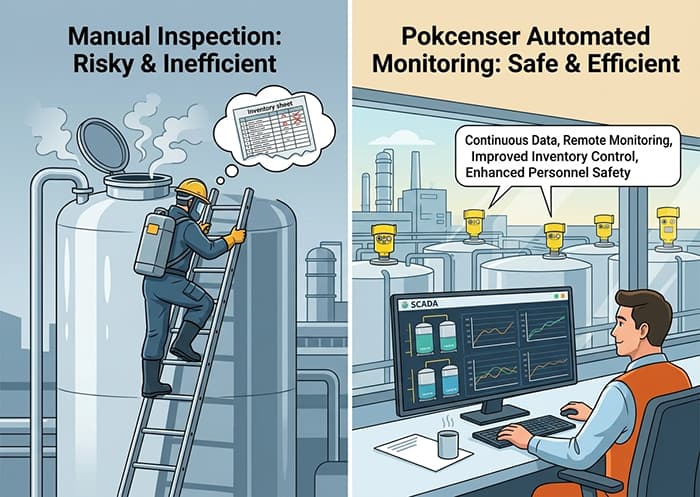
Many facilities still rely on manual tank inspections.
Automated monitoring provides significant advantages:
Improved Safety
Operators no longer need to climb tanks for level verification.
Better Inventory Management
Real-time level data improves procurement planning and stock control.
Reduced Maintenance Costs
Non-contact radar technology minimizes wear and maintenance requirements.
Higher Process Efficiency
Continuous monitoring improves production scheduling and operational planning.
Why Choose Pokcenser?
Pokcenser has specialized in industrial process automation for more than 10 years.
Today, our products support customers across more than 100 countries and numerous industries.
Benefits of Working with Pokcenser
✔ CE, ISO, ATEX, and RoHS certified products
✔ OEM & ODM customization support
✔ Professional application engineering assistance
✔ Fast pre-sales and after-sales support
✔ Competitive factory-direct pricing
✔ Complete level measurement solutions
More than 150,000 industrial automation solutions have been successfully delivered worldwide.
Frequently Asked Questions
Q1: Can radar level sensors measure corrosive chemicals?
Yes. Radar level sensors are non-contact devices and are ideal for corrosive liquid applications.
Q2: Will vapor affect radar measurement?
Radar technology is far less affected by vapor and condensation compared with ultrasonic measurement technologies.
Q3: Are radar sensors suitable for outdoor tanks?
Yes. Radar sensors perform reliably under changing weather conditions and outdoor environments.
Q4: Which radar sensor is best for acid tanks?
The Pokcenser PWL-R804 Anti-Corrosive Radar Level Sensor is specifically designed for corrosive chemical applications.
Q5: What output signals are available?
Most Pokcenser radar level sensors support 4-20mA, RS485, Modbus, and other industrial communication protocols.
Reliable tank level monitoring is essential for safe and efficient chemical storage operations. Traditional measurement methods often struggle with corrosion, vapor, foam, and demanding process conditions.
Modern radar level sensors eliminate these challenges by providing accurate, non-contact measurements with minimal maintenance requirements.
For corrosive chemical tanks, the Pokcenser PWL-R804 Anti-Corrosive Radar Level Sensor offers dependable long-term performance. For large storage tanks requiring superior accuracy, the Pokcenser PWL-R801 80GHz Radar Level Sensor provides industry-leading measurement capabilities.
Contact Pokcenser today to discuss your chemical storage application and receive a customized tank level monitoring solution.
