 English
 Spanish
IP65 vs IP67 vs IP68: How to Choose the Right Protection Level for Industrial Sensors
When selecting industrial instrumentation, many engineers focus on accuracy, communication protocols, and measurement range. However, one critical specification is often overlooked:
Ingress Protection (IP) Rating.
An incorrectly selected protection level can result in premature equipment failure, water ingress, corrosion, downtime, and increased maintenance costs.
Whether you are installing sensors in a wastewater treatment plant, chemical facility, river monitoring station, or outdoor storage tank, understanding IP ratings is essential.
This guide explains the differences between IP65, IP67, and IP68 protection levels and how to choose the right sensor for your application.
What Does an IP Rating Mean?
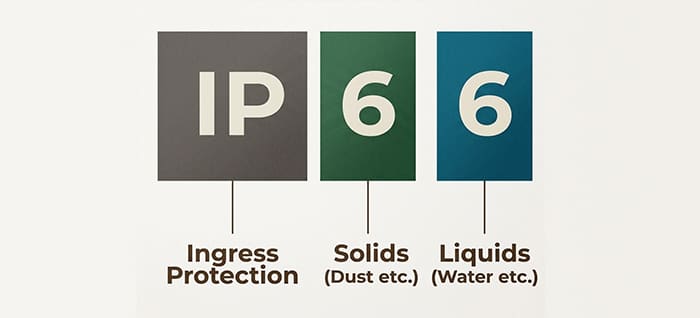
IP stands for Ingress Protection.
The rating is defined by IEC standards and consists of two digits.
Example:
IP68
- First digit = Protection against solid particles
- Second digit = Protection against liquids
First Digit (Dust Protection)
| Rating | Protection |
| 5 | Dust Protected |
| 6 | Dust Tight |
Second Digit (Water Protection)
| Rating | Protection |
| 5 | Water Jets |
| 6 | Powerful Water Jets |
| 7 | Temporary Immersion |
| 8 | Continuous Immersion |
The higher the number, the better the protection.
What Is IP65?
IP65 means:
Dust Protection
- Completely protected against dust ingress.
Water Protection
- Protected against low-pressure water jets from any direction.
Suitable Applications
- Indoor factories
- Control rooms
- Machine automation
- Equipment panels
IP65 is often sufficient when equipment is installed in clean industrial environments and is not exposed to flooding or immersion.
What Is IP67?
IP67 provides:
Dust Protection
- Fully dust-tight.
Water Protection
- Protection against temporary immersion in water.
Typical testing involves immersion to approximately 1 meter depth for a limited period.
Suitable Applications
- Outdoor equipment
- Rain-exposed installations
- Tank farms
- Industrial processing areas
Many industrial sensors use IP67 protection because it provides a good balance between durability and cost.
What Is IP68?
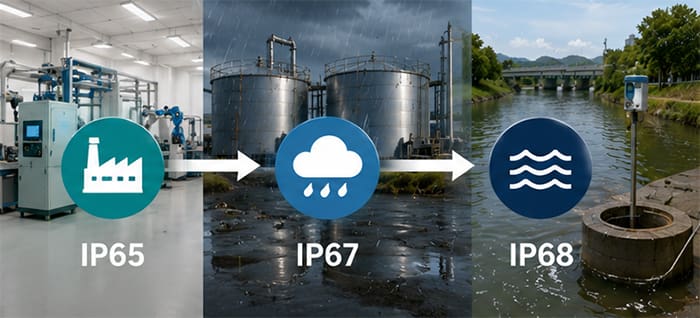
IP68 is the highest protection level commonly found in industrial instrumentation.
Dust Protection
- Fully dust-tight.
Water Protection
- Suitable for continuous immersion.
Actual immersion depth depends on the product design.
Suitable Applications
- Flood-prone environments
- River monitoring stations
- Wastewater treatment plants
- Underground installations
- Submersible monitoring systems
For harsh outdoor applications, IP68 is often the preferred choice.
When Is IP68 Necessary?
Many users automatically select IP68 without considering actual installation conditions.
IP68 becomes important when equipment is exposed to:
Flooding
Examples:
- Pump stations
- Underground chambers
- Stormwater systems
Continuous Moisture
Examples:
- Reservoir monitoring
- River monitoring
- Coastal installations
Direct Water Contact
Examples:
- Submersible sensors
- Water depth monitoring
- Wastewater pits
Recommended Product: PWL-R807 Radar Water Level Meter
The PWL-R807 is designed specifically for hydrological monitoring applications and features an IP68 protection level. It is suitable for rivers, dams, lakes, open channels, and underground drainage networks.
Key Benefits
- 76-81GHz FMCW radar technology
- IP68 waterproof protection
- Non-contact measurement
- Suitable for harsh outdoor environments
- Long-term maintenance-free operation
Typical Applications
- River level monitoring
- Flood warning systems
- Reservoir management
- Smart water projects
Recommended Product: PWF-U2000B Ultrasonic Flow Meter
The PWF-U2000B clamp-on ultrasonic flow meter offers:
- Converter IP67
- Sensor IP65 or IP68 options
This flexibility allows users to select the protection level according to the installation environment.
How to Select the Right IP Rating
Choose IP65 If:
✔ Indoor installation
✔ Dry industrial environment
✔ Limited water exposure
Choose IP67 If:
✔ Outdoor installation
✔ Rain exposure
✔ Occasional washdown cleaning
✔ Temporary immersion risk
Choose IP68 If:
✔ Flooding is possible
✔ Continuous humidity exposure
✔ Underground installation
✔ Water monitoring applications
✔ Wastewater treatment projects
Why Choosing the Correct Protection Level Saves Money
Selecting the proper IP rating can:
- Reduce maintenance costs
- Prevent unexpected failures
- Extend equipment lifespan
- Improve operational reliability
- Lower total ownership costs
The most expensive sensor is often the one that must be replaced prematurely because its protection level was inadequate.
Why Choose Pokcenser?
Pokcenser provides industrial automation solutions to customers in more than 100 countries worldwide.
Our products are designed for demanding industrial environments and are widely used in:
- Water & wastewater
- Environmental monitoring
- Chemical processing
- Food & beverage
- Oil & gas
What We Offer
- CE, ISO, ATEX, and RoHS certified products
- OEM & ODM support
- Professional engineering assistance
- Fast technical support
- Factory-direct pricing
Frequently Asked Questions
Q1: Is IP68 always better than IP67?
Not necessarily. If the sensor is installed indoors, IP67 or even IP65 may be completely sufficient.
Q2: Can IP68 sensors be permanently submerged?
Yes, provided the product is specifically designed for continuous immersion.
Q3: Which protection level is best for wastewater treatment plants?
IP68 is typically recommended for harsh wastewater environments.
Q4: Which Pokcenser sensors have IP68 protection?
Examples include the PWL-R807 Radar Water Level Meter and PWL-R808 Radar Water Level Sensor series.
Q5: Does a higher IP rating affect measurement accuracy?
No. IP ratings relate to environmental protection, not measurement accuracy.
